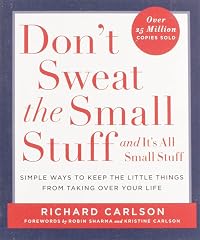
Don't Sweat the Small Stuff--And It's All Small Stuff
by Richard Carlson
Don't Sweat the Small Stuff (1)
On This Page
Description
Don't Sweat the Small S It's All Small Stuff is an audiobook that tells you how to keep from letting the little things in life drive you crazy. In thoughtful and insightful language, author Richard Carlson reveals ways to calm down in the midst of your incredibly hurried, stress-filled life. You can learn to put things into perspective by making the small daily changes Dr. Carlson suggests, including advice such as "Choose your battles wisely"; "Remind yourself that when you die, your 'in' show more box won't be empty"; and "Make peace with imperfection." With Don't Sweat the Small S you'll also learn how to: - Live in the present moment - Let others have the glory at times - Lower your tolerance to stress - Trust your intuitions - Live each day as it might be your last. With gentle, supportive suggestions, Dr. Carlson reveals ways to make your actions more peaceful and caring, with the added benefit of making your life more calm and stress-free. show lessTags
Recommendations




Member Reviews
Don't Sweat the Small Stuff...And it's All Small Stuff by Richard Carlson
This book is a simple book that is comprised of 100 small ways to improve happiness and tranquility in your life. Each tip is only a page or two long and are actually simple things that make a lot of sense. For instance, instead of interrupting someone to agree or disagree on whatever they are talking about., let them finish what they are saying. In other words, let them have their glory, you don't have to be the center of attention all the time. There were several times throughout the book where I found myself saying 'I am so guilty of that!' One of them talks about not letting things get to you, meaning don't sit there and continue to think of the situation and show more let it fester. I am guilty of this. However, as I try to live as much of a drama free life as possible, I have found that I also already employ several tactics described in this book. For instance, I always try to see the viewpoint of others. This is a pretty quick read, or can just be read a little bit over time. I would think that by even doing a few of these things, people would find their lives to be a bit simpler and more peaceful. show less
This book is a simple book that is comprised of 100 small ways to improve happiness and tranquility in your life. Each tip is only a page or two long and are actually simple things that make a lot of sense. For instance, instead of interrupting someone to agree or disagree on whatever they are talking about., let them finish what they are saying. In other words, let them have their glory, you don't have to be the center of attention all the time. There were several times throughout the book where I found myself saying 'I am so guilty of that!' One of them talks about not letting things get to you, meaning don't sit there and continue to think of the situation and show more let it fester. I am guilty of this. However, as I try to live as much of a drama free life as possible, I have found that I also already employ several tactics described in this book. For instance, I always try to see the viewpoint of others. This is a pretty quick read, or can just be read a little bit over time. I would think that by even doing a few of these things, people would find their lives to be a bit simpler and more peaceful. show less
Book 28 - Richard Carlson - Don’t Sweat the Small Stuff
An interesting and fascinating if frustrating read. 100 very short chapters all about looking beyond the minutiae of life. I don’t know Mr Carlson’s faith and indeed there are several chapters that overtly talk about God and faith but then there are others that very clearly are not Christian-based.
So I leave it for you to decide. An easy read with some brilliant pointers for ensuring we look at what is important in life, looking through the trees to focus on the wood if you will.
Some thoughts to leave you with
‘The nature of your “in basket” is that it’s meant to have items to be completed in it—it’s not meant to be empty.’
‘Mark Twain said, “I have been show more through some terrible things in my life, some of which actually happened.” ‘
And perhaps the one that impacted me the most...
‘The beauty of doing nothing is that it teaches you to clear your mind and relax. It allows your mind the freedom to “not know,” for a brief period of time. Just like your body, your mind needs an occasional break from its hectic routine. When you allow your mind to take a break, it comes back stronger, sharper, more focused and creative.’
Why not do some nothing today ? show less
An interesting and fascinating if frustrating read. 100 very short chapters all about looking beyond the minutiae of life. I don’t know Mr Carlson’s faith and indeed there are several chapters that overtly talk about God and faith but then there are others that very clearly are not Christian-based.
So I leave it for you to decide. An easy read with some brilliant pointers for ensuring we look at what is important in life, looking through the trees to focus on the wood if you will.
Some thoughts to leave you with
‘The nature of your “in basket” is that it’s meant to have items to be completed in it—it’s not meant to be empty.’
‘Mark Twain said, “I have been show more through some terrible things in my life, some of which actually happened.” ‘
And perhaps the one that impacted me the most...
‘The beauty of doing nothing is that it teaches you to clear your mind and relax. It allows your mind the freedom to “not know,” for a brief period of time. Just like your body, your mind needs an occasional break from its hectic routine. When you allow your mind to take a break, it comes back stronger, sharper, more focused and creative.’
Why not do some nothing today ? show less
Don’t Sweat the Small Stuff…and it’s all small stuff: simple ways to keep the little things from taking over your life, by Richard Carlson, suggests 100 ways for people to change the way they think about or address the stress in their lives. Each of the suggestions is presented on one or two small pages, which can be quickly read and understood. Most of them address specific issues such as, “Make Peace with Imperfection” or “Become More Patient” or “Become a Less Aggressive Driver” or “Do One Thing at a Time.” The book does not espouse a spiritual approach. However, several of the techniques seem to come from a Buddhist tradition, e.g., “Quiet the Mind” or “Practice Ignoring Your Negative Thoughts” or show more “Learn to Live in the Present Moment” or “Resist the Urge to Criticize.” Overall this book is a short and simple list of suggestions to help us understand that stress is a ubiquitous part of life, which must be addressed internally by the way we react to it. Carlson does not provide a panacea for stress, but he does provide some helpful concepts. He also presents a short list of selected reading. show less
This is kinda nice.
And, although I think (!) I've reached the point where I don't need to compulsively reject it all, or contradict it in practice, but there's always more that can be improved. Even for such as I, who lives such a careless, carefree, unplanned, undocumented life, really, not to mention that I never trouble others by always laying my thoughts and opinions before them. (Now, *that* would make a nice title for a book, wouldn't it? 'Thoughts and Opinions'.)
So, he does a good job of showing you how to let go of things, without overplaying it. (Titles come easier than books.)
But, as to the book itself, or rather, the style itself, perhaps it should be mentioned that it can sometimes be a little vague (given the nature of show more his thought, I can't help but think of the great contrast *in style* with Epictetus, who is terse and pointed almost to the point of sharpness--Carlson, by contrast, is gentle almost to the point of diffuseness, so I suppose we may take our pick), not in a way that makes the book mediocre or bad, but rather just enough to stop it from being a really very good or excellent book.
A good example of his sometimes loose writing style is, I think, the section where he suggests adopting the attitude of an anthropologist. The basic idea is clear enough--instead of rejecting things out of hand, seek to understand without judging. Okay, good. But, oddly enough, I had already started to think of part of my reading (that of a certain YA sci-fi novel) to be, well, semi-anthropological, and yet, while Carlson mentions the obvious, that this sort of thing can lead to a certain sort of arrogant kind of stance, he didn't really sharpen my understanding, or refine it, to help me avoid that. He just threw out a cute anecdote that gives a general sense of the overall principle--don't judge punk rockers: acknowledge their different-ness. Which leads to another, minor, weakness: occasionally he's a little PC in how he says things, a little cautious--but, it could be worse; it's really not *so* bad.
Anyway, I've had reason to criticize a certain weakness in his writing, but I don't want to drag it out of proportion. It is "small stuff"--lol. It has strengths too--most obviously and most importantly, by explaining important ideas about how to improve your outlook, allow yourself to be more positive, and lessen unnecessary stress and tension in your life, all while being very readable--it's actually very light reading. And, true, sometimes you'll be left wondering whether a certain criticism, a limitation, really applies to you, or whether you're just sweating when you should be relaxing...if you know what I mean. But, you know, that's the stuff of life.
So, overall, it's a very decent little book to read.
After all, I just compared him to Epictetus, even tho this isn't philosophy, but more like social science. See? Small stuff. Even from me.
What? You're saying even *my* cataloguer's categories are ultimately just...small stuff?
...Anyway, with anything like this (anything somewhat philosophical--in the broadest sense--in outlook) the big caveat, I think, is that emotion (occasionally even anger!) is sometimes required of us, but the big point is that, with a little perspective, we can avoid doing when no doing is required, whereas without some perspective, it's easy to become derailed over things that are ultimately petty.
It's also worth remembering that it's only our own intentions that we direct, since neither other people nor outside circumstance are in our power.
...but, like I said, I can't promise that Carlson will always cut straight to the point, or always balance things correctly--"stop blaming others"! And then stop blaming yourself!
...It's been awhile since I read this sort of thing for the first time, and my opinion of it does fluctuate--naturally enough, I suppose. But I think a big thing to remember, as I see it, is that--if you don't mind my stealing from Livy--that you should, whenever possible, write *for* morality *by the means of* good writing, good style--which means that the style really is important, since correctness and confusion are really only a few steps away from each other, much of the time...that's really why Sharon Lebell's translation, or whatever, of the Handbook was so disappointing--sometimes you can't *successfully* cut this stuff up into these little sections with cute little newspaper headlines, and you can see Carlson's work has the same sort of...limitation. If you read some of those phrases too quickly, you might walk away with almost the opposite of the reasonable, balanced view that we might strive to come to.
I mean, it sounds wierd to say, but I think you have to understand that, yes, those little things don't matter, without, of course, thinking that those little things *don't matter*. Call it whatever you want--paradox, koan, rune--it may be a bit of a mystery, but I think it's still true.
But, for all that, again--it would be quite possible to over-estimate the weaknesses of the book; you really can learn quite alot from it.
{P.S. Or, if you'd rather I just *cut right through it*--cover your ears of you need to--this IS better than the ephemeral nonsense of Plato, so don't let it bother you *too* much if it reminds you of Paul, or someone--don't worry...just get married, like Epictetus himself.}
...And the book, yeah, the book is pretty good.
And there was (at least) one big bit of wisdom here, that wasn't necessarily spelled out by the Greek--that you don't have to *wait* for everything to be *finished* before you can be happy; you can be happy where you are. And that, itself, is special.
And, let's face it: he can be just as quirky and funny as he is enlightened. Remember, when:
"We also forget that when we're blowing things out of proportion, *we* are the ones doing the blowing."
;)
And, yeah, sometimes he says things which are really just for him...I don't care what *anyone* says: waking up at three in the morning is something you do if you're in the fucking German army; it's not something that any real person would do. ("The Invasion of Russia starts at four-fifteen this morning; I'd better get up early so I have time to clean the old Mauser!")
Although, as he himself says, "Even those of us who are committed to nonseriousness are probably too serious", and I know that, at times, this is even true of myself.
But, whatever.
(8/10) show less
And, although I think (!) I've reached the point where I don't need to compulsively reject it all, or contradict it in practice, but there's always more that can be improved. Even for such as I, who lives such a careless, carefree, unplanned, undocumented life, really, not to mention that I never trouble others by always laying my thoughts and opinions before them. (Now, *that* would make a nice title for a book, wouldn't it? 'Thoughts and Opinions'.)
So, he does a good job of showing you how to let go of things, without overplaying it. (Titles come easier than books.)
But, as to the book itself, or rather, the style itself, perhaps it should be mentioned that it can sometimes be a little vague (given the nature of show more his thought, I can't help but think of the great contrast *in style* with Epictetus, who is terse and pointed almost to the point of sharpness--Carlson, by contrast, is gentle almost to the point of diffuseness, so I suppose we may take our pick), not in a way that makes the book mediocre or bad, but rather just enough to stop it from being a really very good or excellent book.
A good example of his sometimes loose writing style is, I think, the section where he suggests adopting the attitude of an anthropologist. The basic idea is clear enough--instead of rejecting things out of hand, seek to understand without judging. Okay, good. But, oddly enough, I had already started to think of part of my reading (that of a certain YA sci-fi novel) to be, well, semi-anthropological, and yet, while Carlson mentions the obvious, that this sort of thing can lead to a certain sort of arrogant kind of stance, he didn't really sharpen my understanding, or refine it, to help me avoid that. He just threw out a cute anecdote that gives a general sense of the overall principle--don't judge punk rockers: acknowledge their different-ness. Which leads to another, minor, weakness: occasionally he's a little PC in how he says things, a little cautious--but, it could be worse; it's really not *so* bad.
Anyway, I've had reason to criticize a certain weakness in his writing, but I don't want to drag it out of proportion. It is "small stuff"--lol. It has strengths too--most obviously and most importantly, by explaining important ideas about how to improve your outlook, allow yourself to be more positive, and lessen unnecessary stress and tension in your life, all while being very readable--it's actually very light reading. And, true, sometimes you'll be left wondering whether a certain criticism, a limitation, really applies to you, or whether you're just sweating when you should be relaxing...if you know what I mean. But, you know, that's the stuff of life.
So, overall, it's a very decent little book to read.
After all, I just compared him to Epictetus, even tho this isn't philosophy, but more like social science. See? Small stuff. Even from me.
What? You're saying even *my* cataloguer's categories are ultimately just...small stuff?
...Anyway, with anything like this (anything somewhat philosophical--in the broadest sense--in outlook) the big caveat, I think, is that emotion (occasionally even anger!) is sometimes required of us, but the big point is that, with a little perspective, we can avoid doing when no doing is required, whereas without some perspective, it's easy to become derailed over things that are ultimately petty.
It's also worth remembering that it's only our own intentions that we direct, since neither other people nor outside circumstance are in our power.
...but, like I said, I can't promise that Carlson will always cut straight to the point, or always balance things correctly--"stop blaming others"! And then stop blaming yourself!
...It's been awhile since I read this sort of thing for the first time, and my opinion of it does fluctuate--naturally enough, I suppose. But I think a big thing to remember, as I see it, is that--if you don't mind my stealing from Livy--that you should, whenever possible, write *for* morality *by the means of* good writing, good style--which means that the style really is important, since correctness and confusion are really only a few steps away from each other, much of the time...that's really why Sharon Lebell's translation, or whatever, of the Handbook was so disappointing--sometimes you can't *successfully* cut this stuff up into these little sections with cute little newspaper headlines, and you can see Carlson's work has the same sort of...limitation. If you read some of those phrases too quickly, you might walk away with almost the opposite of the reasonable, balanced view that we might strive to come to.
I mean, it sounds wierd to say, but I think you have to understand that, yes, those little things don't matter, without, of course, thinking that those little things *don't matter*. Call it whatever you want--paradox, koan, rune--it may be a bit of a mystery, but I think it's still true.
But, for all that, again--it would be quite possible to over-estimate the weaknesses of the book; you really can learn quite alot from it.
{P.S. Or, if you'd rather I just *cut right through it*--cover your ears of you need to--this IS better than the ephemeral nonsense of Plato, so don't let it bother you *too* much if it reminds you of Paul, or someone--don't worry...just get married, like Epictetus himself.}
...And the book, yeah, the book is pretty good.
And there was (at least) one big bit of wisdom here, that wasn't necessarily spelled out by the Greek--that you don't have to *wait* for everything to be *finished* before you can be happy; you can be happy where you are. And that, itself, is special.
And, let's face it: he can be just as quirky and funny as he is enlightened. Remember, when:
"We also forget that when we're blowing things out of proportion, *we* are the ones doing the blowing."
;)
And, yeah, sometimes he says things which are really just for him...I don't care what *anyone* says: waking up at three in the morning is something you do if you're in the fucking German army; it's not something that any real person would do. ("The Invasion of Russia starts at four-fifteen this morning; I'd better get up early so I have time to clean the old Mauser!")
Although, as he himself says, "Even those of us who are committed to nonseriousness are probably too serious", and I know that, at times, this is even true of myself.
But, whatever.
(8/10) show less
Bought this years ago when it was first all the rage. I don't usually jump on bandwagons like this, but I was at a crossroads in my life and spending a lot of time in Books-A-Million, where the books were on display. It helped me rectify some things in my own mind.
Recently, I've been at another crossroads and have turned to several other books for some clarification, so I decided to give this another read-through. I'm glad I did.
I forgot how much insight there is within the pages of this text. Using advice and philosophies from multiple sources, Carlson delivers a series of a hundred truisms that everyone should consider at least once in their lives. He doesn't lay anything on heavy-handed, and there is no religious connotation to the show more advice (in fact, there is a strong Eastern philosophical leaning to many of the statements). Excellent recommendations about living your life, some that I picked up and still follow since my first read, some that I've forgotten and plan to try incorporating now.
Hard not to recommend this one to anyone looking to find changes to help them live a better life. show less
Recently, I've been at another crossroads and have turned to several other books for some clarification, so I decided to give this another read-through. I'm glad I did.
I forgot how much insight there is within the pages of this text. Using advice and philosophies from multiple sources, Carlson delivers a series of a hundred truisms that everyone should consider at least once in their lives. He doesn't lay anything on heavy-handed, and there is no religious connotation to the show more advice (in fact, there is a strong Eastern philosophical leaning to many of the statements). Excellent recommendations about living your life, some that I picked up and still follow since my first read, some that I've forgotten and plan to try incorporating now.
Hard not to recommend this one to anyone looking to find changes to help them live a better life. show less
In this collection of one hundred "Open Your Eyes" hints to true happiness, I often found myself drifting and wondering. Sure, the things Carlson suggests in his book are wonderful, but I couldn't help but asking: "How do you focus on inner peace when it's a struggle to keep the lights on?" I got a little too hung up on thinking these tips would only work for the affluent--and when they did seem in reach, there were simply too many of them. That's precisely the reason why I've been reading this book off and on (and over and over) for seven months. There simply isn't any other way to tackle it effectively. The short blurbs are complete wisdom, and it is a book truly worth owning and ingesting piece by piece.
Like so many books for self-help, there's a huge disconnect between the ease of stating the philosophy, and the ease of implementing it. Besides the huge disconnect between the imagined problem being solved and the real problems most people face.
Members
- Recently Added By
Lists

Best Self Help Books
87 works; 18 members

Life and How to Live It
21 works; 4 members

Men's healing resources
747 works; 1 member
Author Information

142 Works 12,524 Members
Author and psychotherapist Richard Carlson was born on May 16, 1961 and grew up in Piedmont, California. He received his undergraduate degree from Pepperdine University, his Ph.D. in psychology from Sierra University, and an honorary law degree from Pepperdine University. Before becoming a full-time author, he was a psychotherapist in private show more practice. His wrote 30 books that deal with psychological and spiritual health, including the Don't Sweat the Small Stuff series. He was a supporter of the National Center for Family Literacy. He died of cardiac arrest on December 13, 2006. (Bowker Author Biography) show less
Awards and Honors
Series

Common Knowledge
- Canonical title
- Don't Sweat the Small Stuff--And It's All Small Stuff
- Original title
- Don't Sweat the Small Stuff
- Original publication date
- 1997
- Dedication
- I dedicate this book to my daughters, Jazzy and Kenna, who remind me every day how important it is to remember not to "sweat the small stuff." I love you both so much, Thank you for being just the way you are.
- First words
- Whenever we're dealing with bad news, a difficult person, or a disappointment of some kind, most of us get into certain habits, ways of reacting to life--particularly adversity--that don't server us very well.
- Last words
- (Click to show. Warning: May contain spoilers.)I will end this book by sincerely saying that I wish you well.
Classifications
Statistics
- Members
- 5,307
- Popularity
- 2,559
- Reviews
- 63
- Rating
- (3.60)
- Languages
- 13 — Chinese, Dutch, English, Estonian, Finnish, French, German, Hungarian, Indonesian, Japanese, Norwegian (Bokmål), Portuguese, Swedish
- Media
- Paper, Audiobook, Ebook
- ISBNs
- 54
- ASINs
- 21