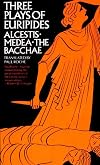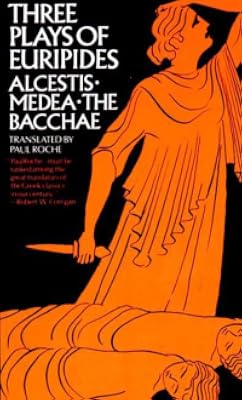
3 Plays: Alcestis / Bacchae / Medea
by Euripides
On This Page
Description
Euripides is rightly lauded as one of the great dramatists of all time. In his lifetime, he wrote over 90 plays and although only 18 have survived they reveal the scope and reach of his genius. Euripides is identified with many theatrical innovations that have influenced drama all the way down to modern times, especially in the representation of traditional, mythical heroes as ordinary people in extraordinary circumstances. As would be expected from a life lived 2,500 years ago, details of show more it are few and far between. Accounts of his life, written down the ages, do exist but whether much is reliable or surmised is open to debate. Most accounts agree that he was born on Salamis Island around 480 BC, to mother Cleito and father Mnesarchus, a retailer who lived in a village near Athens. Upon the receipt of an oracle saying that his son was fated to win "crowns of victory", Mnesarchus insisted that the boy should train for a career in athletics. However, what is clear is that athletics was not to be the way to win crowns of victory. Euripides had been lucky enough to have been born in the era as the other two masters of Greek Tragedy; Sophocles and schylus. It was in their footsteps that he was destined to follow. His first play was performed some thirteen years after the first of Socrates plays and a mere three years after schylus had written his classic The Oristria. Theatre was becoming a very important part of the Greek culture. The Dionysia, held annually, was the most important festival of theatre and second only to the fore-runner of the Olympic games, the Panathenia, held every four years, in appeal. Euripides first competed in the City Dionysia, in 455 BC, one year after the death of schylus, and, incredibly, it was not until 441 BC that he won first prize. His final competition in Athens was in 408 BC. The Bacchae and Iphigenia in Aulis were performed after his death in 405 BC and first prize was awarded posthumously. Altogether his plays won first prize only five times. Euripides was also a great lyric poet. In Medea, for example, he composed for his city, Athens, "the noblest of her songs of praise". His lyric skills however are not just confined to individual poems: "A play of Euripides is a musical whole....one song echoes motifs from the preceding song, while introducing new ones." Much of his life and his whole career coincided with the struggle between Athens and Sparta for hegemony in Greece but he didn't live to see the final defeat of his city. Euripides fell out of favour with his fellow Athenian citizens and retired to the court of Archelaus, king of Macedon, who treated him with consideration and affection. At his death, in around 406BC, he was mourned by the king, who, refusing the request of the Athenians that his remains be carried back to the Greek city, buried him with much splendor within his own dominions. His tomb was placed at the confluence of two streams, near Arethusa in Macedonia, and a cenotaph was built to his memory on the road from Athens towards the Piraeus. show lessTags
Recommendations


























Member Reviews
Besides, you are a born woman:
feeble when it comes to the sublime,
marvelously inventive over crime.
Oh Medea, you emerge as the force in this tumultuous collection and such a distinction is not lost on the gore-spattered pages where it take an epic hero to return a lost love from the dead to a shitbag husband (Alcestis) and then later a hallucination to inspire an incestual dismemberment (Bacchae). My reading of Medea is anchored by her being foreign-born, a stranger whose displacement is opened wide by her jackass husband and his efforts at social elevation through snagging a new bride of royal (and white) stock. There is something to be said for the original Lady Vengeance. Her vision and pluck are to be respected even if we cower and show more squirm before her monstrous deeds. She maintains a grace evn in the darkest light. show less
feeble when it comes to the sublime,
marvelously inventive over crime.
Oh Medea, you emerge as the force in this tumultuous collection and such a distinction is not lost on the gore-spattered pages where it take an epic hero to return a lost love from the dead to a shitbag husband (Alcestis) and then later a hallucination to inspire an incestual dismemberment (Bacchae). My reading of Medea is anchored by her being foreign-born, a stranger whose displacement is opened wide by her jackass husband and his efforts at social elevation through snagging a new bride of royal (and white) stock. There is something to be said for the original Lady Vengeance. Her vision and pluck are to be respected even if we cower and show more squirm before her monstrous deeds. She maintains a grace evn in the darkest light. show less
THE BACCHAE
I bought this trio of plays mainly for The Bacchae , as Donna Tartt hinted this was an influence for her book [b:The Secret History|29044|The Secret History|Donna Tartt|https://d.gr-assets.com/books/1327733397s/29044.jpg|221359] (a story of classical Greek students who attempt to recreate some ancient rites in the Vermont woods). I began the story expecting scenes of wild revelry in the mountains. I had assumed that Dionysus represented laid back festivity and if he had a flaw it was debauchery to excess. But it turns out he also has a jealous side as vengeful as any Old Testament deity that comes out in this play.The scene in which the Maenads decimate a man as a wild animal would, ripping him limb from limb, in a trance of show more Dionysian super-strength was really something to read. And very helpful in illuminating one crucial scene in The Secret History. A major theme of this play seems to be the importance of balancing the rational knowledge-seeking mind with its mysterious unconscious counterpart. It is the gift of the free-flowing grape which allows humans to escape temporarily the sufferings of the literal world.
MEDEA
At first Medea seems a bit crazy, but after a little reading you can see she is plainly dealing with the outrage and hurt of being unceremoniously cast aside for a new wife, especially painful after all she’s done for her husband (it turns out there is a whole backstory told in [b:Jason and the Golden Fleece|764332|Jason and the Golden Fleece (The Argonautica)|Apollonius of Rhodes|https://d.gr-assets.com/books/1178147869s/764332.jpg|750408] where she played a key role in helping him steal the fleece/avenge his enemy, then emigrated from her homeland to be with him). Because she is so intense her revenge takes an epic form. At one point Medea tries to retreat from her tragic plan, but by then the wheels have been set in motion. The play is full of suspense as it builds to its dramatic conclusion. What is interesting is trying to interpret what the moral of the story might be.In the story King Aegeus appears to Medea after having just left the Oracle of Delphi, diviner of the gods. They strike a deal in which he offers her sanctuary, and this becomes the linchpin in her plan of escape. To me the timing is just too perfect: it's as if the gods sent him and are on her side. Maybe they do hold Jason to blame? Could this have been a cautionary tale to cheating men of Euripides’s Greece, a sort of Fatal Attraction for the ancients? I wonder!
ALCESTIS
This is the tale of a man allowed to cheat death provided he can find a substitute to take his place (a favor from Apollo who intervenes with The Fates). This person turns out to be his near saintly wife Alcestis but when Death comes a knockin’ the husband, Admetus, has a serious case of remorse. My favorite scene in the play is when Admetus tries to put the blame on his elderly father for Alcestis’s fate, as both parents had refused earlier to be the martyr their son so desired, but the old man has none of it. He gives as good as he gets and tells his son “So, be quiet, you degenerate, and remember that if you love your life so does everybody”. Then he calls his son a murderer and forces him to take the responsibility! I liked how Euripides lets each character be true to himself even at the expense of contradicting the hero. This play demonstrates the importance of hospitality to the ancient Greeks (which was also a theme in the Odyssey) and how the gods can produce a happy ending if they desire. show less
I bought this trio of plays mainly for The Bacchae , as Donna Tartt hinted this was an influence for her book [b:The Secret History|29044|The Secret History|Donna Tartt|https://d.gr-assets.com/books/1327733397s/29044.jpg|221359] (a story of classical Greek students who attempt to recreate some ancient rites in the Vermont woods). I began the story expecting scenes of wild revelry in the mountains. I had assumed that Dionysus represented laid back festivity and if he had a flaw it was debauchery to excess. But it turns out he also has a jealous side as vengeful as any Old Testament deity that comes out in this play
MEDEA
At first Medea seems a bit crazy, but after a little reading you can see she is plainly dealing with the outrage and hurt of being unceremoniously cast aside for a new wife, especially painful after all she’s done for her husband (it turns out there is a whole backstory told in [b:Jason and the Golden Fleece|764332|Jason and the Golden Fleece (The Argonautica)|Apollonius of Rhodes|https://d.gr-assets.com/books/1178147869s/764332.jpg|750408] where she played a key role in helping him steal the fleece/avenge his enemy, then emigrated from her homeland to be with him). Because she is so intense her revenge takes an epic form. At one point Medea tries to retreat from her tragic plan, but by then the wheels have been set in motion. The play is full of suspense as it builds to its dramatic conclusion. What is interesting is trying to interpret what the moral of the story might be.
ALCESTIS
This is the tale of a man allowed to cheat death provided he can find a substitute to take his place (a favor from Apollo who intervenes with The Fates). This person turns out to be his near saintly wife Alcestis but when Death comes a knockin’ the husband, Admetus, has a serious case of remorse. My favorite scene in the play is when Admetus tries to put the blame on his elderly father for Alcestis’s fate,
Very nice translation with informative explanations of the Choral statements
Ratings
Members
- Recently Added By
Author Information

1,345+ Works 34,154 Members
Euripides was born in Attica, Greece probably in 480 B.C. He was the youngest of the three principal fifth-century tragic poets. In his youth he cultivated gymnastic pursuits and studied philosophy and rhetoric. Soon after he received recognition for a play that he had written, Euripides left Athens for the court of Archelaus, king of Macedonia. show more Fragments of about fifty-five plays survive. Among his best-known plays are Alcestis, Medea and Philoctetes, Electra, Iphigenia in Tauris, The Trojan Women, and Iphigenia in Aulis Iphigenia. He died in Athens in 406 B.C. (Bowker Author Biography) show less
Work Relationships
Common Knowledge
- Canonical title
- 3 Plays: Alcestis / Bacchae / Medea
Classifications
- Genre
- Fiction and Literature
- DDC/MDS
- 882.01 — Literature & rhetoric Classical & modern Greek literatures Classical Greek dramatic poetry and drama standard subdivisions; collections; history, description, critical appraisal; Specific periods Ancient period to ca. 499
- LCC
- PA3975 .A2 — Language and Literature Greek language and literature. Latin language and literature Greek literature Individual authors Euripedes
- BISAC
Statistics
- Members
- 300
- Popularity
- 106,850
- Reviews
- 3
- Rating
- (3.94)
- Languages
- English
- Media
- Paper, Ebook
- ISBNs
- 13
- ASINs
- 2