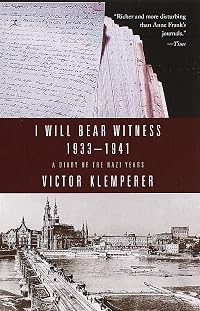
I Will Bear Witness: A Diary of the Nazi Years 1933-1941
by Victor Klemperer
The Diaries of Victor Klemperer (1), Ich will Zeugnis ablegen bis zum letzten. 2 Bd. (1)
On This Page
Description
The author's diary entries detail daily life in the Third Reich. The diaries contain accounts of events witnessed, conversations overheard, and character studies of victims, victimizers, fanatics, and opportunists in Nazi Germany.Tags
Recommendations













































Member Recommendations




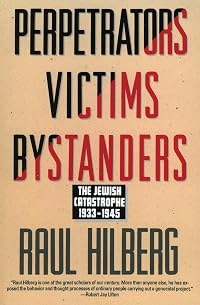
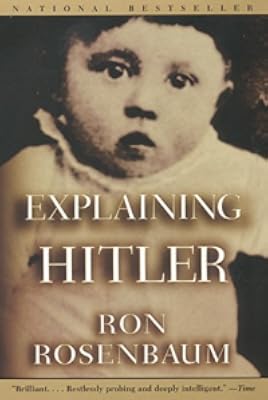
BookshelfMonstrosity The published version of Klemperer’s secret wartime diary are a vivid and personal account of day-to-day life in Nazi Germany. Writing with sophistication and insight, he records the stories of ordinary Germans and their hopes and fears during the dark days of the war. This provides interesting points of comparison with Dodd's experiences.
Member Reviews
No matter how you dress it up, this is a hard book to read. Mainly because hindsight is 20/20 and we know what a travesty the Nazi years truly were to the German Jewish people. Today, reading Klemperer's journals are valuable lessons in fortitude, courage, and grace. Despite everything he remained committed to documenting his world around him...even as it slowly fell apart. At first the indignity was small, a blip: the loss of admittance to his library's reading room. No Jews allowed. Then, the indignities became too big to ignore - the loss of his teaching position at the university, then use of the beloved automobile, then they had to move from their new dream house. Every creature comfort was slowly stripped away. His typewriter, show more tobacco, even new socks. Can you imagine smoking blackberry tea or filling an application for used socks? What is so admirable is, in the face of all this humility, Klemperer still recognized and drew attention to the civility his enemy occasionally displayed.
From the very beginning, although he was only 52 years of age at the start of I Will Bear Witness, Klemperer was convinced he had not long to live. He made comments like, "I no longer think about tomorrow" (p 15), and "My heart cannot bear all this misery much longer" (p 17). He was sure his heart would give out any day. It was if each passing birthday came as a shock to him because he could see the future of Germany's political landscape. How would he survive it? Yet, every day he strove to improve his life and that of his wife of 45 years. Buying land, building a house, learning to drive a car, taking Eva to her beloved flower shows, keeping a diary and continuing to write throughout it all. These are the little triumphs of Klemperer's life. show less
From the very beginning, although he was only 52 years of age at the start of I Will Bear Witness, Klemperer was convinced he had not long to live. He made comments like, "I no longer think about tomorrow" (p 15), and "My heart cannot bear all this misery much longer" (p 17). He was sure his heart would give out any day. It was if each passing birthday came as a shock to him because he could see the future of Germany's political landscape. How would he survive it? Yet, every day he strove to improve his life and that of his wife of 45 years. Buying land, building a house, learning to drive a car, taking Eva to her beloved flower shows, keeping a diary and continuing to write throughout it all. These are the little triumphs of Klemperer's life. show less
I found this diary fascinating and believe it's an indispensable work of history -- almost one-of-a-kind. You see a lot of diaries and memoirs from the Holocaust/WW2 years, but not much from the mid- to late-1930s and the rise of Hitler. Reading Klemperer's diary, which covers January 1933 through December 1941, you can see how the fascist state gradually chipped away at the rights of Jews, and the Holocaust was accomplished in little baby steps. I can summarize it like this:
Jewish civil servants were thrown out of their jobs. Klemperer, a college professor, was forced into early retirement and didn't get a veteran's pension. Non-Jewish maids were prohibited from working in Jewish households. First Aryan civil servants, then all Aryans show more were forbidden to associate with Jews. Jews had to fill out an inventory of all their assets. Everyone was either leaving the country or trying to; many of Klemperer's Jewish friends left for places as far away as South America. Kristallnacht happened; the synagogues burned. Jews were no longer permitted to drive. War started, and with it, rations: Jews got smaller rations than Aryans. People who were half Jewish or less could serve in the military, but had limited opportunities for promotion. Jews were no longer allowed to use the library reading room, then they were forbidden to check out library books. There was an earlier curfew for Jews, and they were only allowed to go grocery shopping at certain times of the day. Many stores had "No Jews Allowed" signs. Jews were no longer allowed to live in their own homes; Klemperer and his wife had to move into a special "Jew house" and rent out their home to a tenant selected by the Nazis. Klemperer committed a minor breach of blackout regulations and served an eight-day jail sentence in solitary confinement; the same offense, committed by an Aryan, would probably have resulted in a 20-mark fine. As the book ended, Klemperer had just gotten out of jail and his typewriter was confiscated; Jews were no longer permitted to have them. And the war has three and a half years left to go!
Yet Klemperer was extremely fortunate in a lot of ways. He was very assimilated -- in fact, he had converted to Christianity, after a fashion -- and had a lot of Aryan friends, and most of them remained his friends. His siblings provided much-needed financial support. And his marriage to an Aryan woman would eventually save his life; he was one of the few hundred German Jews who never had to go into hiding and was never deported to a concentration camp.
All this he faithfully records, along with the minutae of daily life: his pet cat, building and maintaining his house, learning to drive and buying a lemon that breaks every week, constant dental appointments and general hypochondria, dinner parties, reading, scholarship, sibling rivalry, the weather, etc etc etc.
One thing I took note of was, at least from what Klemperer saw, perhaps half the German population sympathized with the Jews, if only in a quiet way. He writes about meeting ardent Nazis and people who try to make his life miserable because of his Jewishness, but more often he notes expressions of sympathy from strangers, shopkeepers slipping forbidden food into his basket, that sort of thing. He even wrote about a "Star Club," a group of Aryans who went around giving friendly greetings to Jews on the street who wore the yellow star, just to show them not everyone hated them. This sort of thing flatly contradicts the theses of a lot of scholars who write books with titles like "Hitler's Willing Executioners." The problem was, at least in Klemperer's case, most of the people who sympathized with him did so in a very quiet, unproductive way: they were either too apathetic or too scared to take real action. As some wise person once said, all that is needed for evil to triumph is for good men to do nothing.
Victor Klemperer wrote two other diaries, one up to 1945 and the other about the postwar years in Communist East Germany. I hope they are as good as this one; I plan to read them both as soon as I can get my hands on them. show less
Jewish civil servants were thrown out of their jobs. Klemperer, a college professor, was forced into early retirement and didn't get a veteran's pension. Non-Jewish maids were prohibited from working in Jewish households. First Aryan civil servants, then all Aryans show more were forbidden to associate with Jews. Jews had to fill out an inventory of all their assets. Everyone was either leaving the country or trying to; many of Klemperer's Jewish friends left for places as far away as South America. Kristallnacht happened; the synagogues burned. Jews were no longer permitted to drive. War started, and with it, rations: Jews got smaller rations than Aryans. People who were half Jewish or less could serve in the military, but had limited opportunities for promotion. Jews were no longer allowed to use the library reading room, then they were forbidden to check out library books. There was an earlier curfew for Jews, and they were only allowed to go grocery shopping at certain times of the day. Many stores had "No Jews Allowed" signs. Jews were no longer allowed to live in their own homes; Klemperer and his wife had to move into a special "Jew house" and rent out their home to a tenant selected by the Nazis. Klemperer committed a minor breach of blackout regulations and served an eight-day jail sentence in solitary confinement; the same offense, committed by an Aryan, would probably have resulted in a 20-mark fine. As the book ended, Klemperer had just gotten out of jail and his typewriter was confiscated; Jews were no longer permitted to have them. And the war has three and a half years left to go!
Yet Klemperer was extremely fortunate in a lot of ways. He was very assimilated -- in fact, he had converted to Christianity, after a fashion -- and had a lot of Aryan friends, and most of them remained his friends. His siblings provided much-needed financial support. And his marriage to an Aryan woman would eventually save his life; he was one of the few hundred German Jews who never had to go into hiding and was never deported to a concentration camp.
All this he faithfully records, along with the minutae of daily life: his pet cat, building and maintaining his house, learning to drive and buying a lemon that breaks every week, constant dental appointments and general hypochondria, dinner parties, reading, scholarship, sibling rivalry, the weather, etc etc etc.
One thing I took note of was, at least from what Klemperer saw, perhaps half the German population sympathized with the Jews, if only in a quiet way. He writes about meeting ardent Nazis and people who try to make his life miserable because of his Jewishness, but more often he notes expressions of sympathy from strangers, shopkeepers slipping forbidden food into his basket, that sort of thing. He even wrote about a "Star Club," a group of Aryans who went around giving friendly greetings to Jews on the street who wore the yellow star, just to show them not everyone hated them. This sort of thing flatly contradicts the theses of a lot of scholars who write books with titles like "Hitler's Willing Executioners." The problem was, at least in Klemperer's case, most of the people who sympathized with him did so in a very quiet, unproductive way: they were either too apathetic or too scared to take real action. As some wise person once said, all that is needed for evil to triumph is for good men to do nothing.
Victor Klemperer wrote two other diaries, one up to 1945 and the other about the postwar years in Communist East Germany. I hope they are as good as this one; I plan to read them both as soon as I can get my hands on them. show less
I Will Bear Witness, 1933-1941 & 1942-1945
A Diary of the Nazi Years
By Victor Klemperer
Victor Klemperer was a professor of French literature, specializing in the Enlightenment, employed at the Technical University of Dresden at the time the Nazis came to power in 1933. At that point in his career he already had a few scholarly works in print and was planning another, a project on the 18th century he continued researching and writing until circumstances forced him to postpone that work. But he did continue the personal diary he had begun many years earlier, now with the purpose of documenting not the big picture of Nazism in Germany (he would leave that to historians) but the experience of it by a single individual, along with other show more ordinary personal matters he had been recording for decades.
The fact that the Nazis considered him a Jew despite his conversion to Protestantism in his youth put him in the bulls-eye of their abuse. But he was married to an "Aryan," and on that account some of the harshest measures heaped on non-Aryans were sometimes blunted or postponed, including shipment to Theresienstadt, the concentration camp in Czechoslovakia where most of Dresden's Jews were to meet their deaths. He had to wear the yellow star, avoid contact with Aryans, not use public transportation, subsist on starvation rations, and would in fact have been sent off to his death within a few days had not British Lancaster bombers rained fire on the population of Dresden, Aryan and non-Aryan alike, in the spring of 1945, allowing Victor and his wife Eva to escape the city and leave behind his Jewish identity by claiming his identification papers were destroyed in the fire.
There are plenty of books about the Nazi era. What's so special about the Klemperer diaries? Why would I recommend these two volumes to anyone interested in learning what the Hitler regime was like over any work by a professional historian, however worthy that study may be?
My answer has to do with the special character of the diaries, their combination of documentation of a horror growing worse with each passing day (everyone Klemperer talks to believes such an absurd regime will surely fall within months) and the details of a middle-aged upper-middle-class couple's life, including the stresses and strains on their marriage, not all of them the result of Nazi oppression. One quickly comes to feel one is living with the Klemperers, if only as a fly on the wall, as they struggle to complete the construction of their "dream house" in a suburb just outside Dresden — Eva's obsession despite their having to subsist on a modest pension after her husband losses his university post.
The daily visits to the house site as they scrape together the money to lay a foundation, then construct modest living quarters and, of course, a garden, seem like an exercise in futility, given what the reader knows is going to happen a few years later. You want to shout at them, "Get out! Get out!" But Eva is determined to have her house, partly, one suspects, because she had given up her own career as a musicologist and performer in favor of her husband's career. Besides, Hitler really did seem too extreme, too downright surreal, to last much longer (odd, that in America he was seen as a "moderate" who would keep the Bolshevik menace in check). And, besides, as the author of these diaries keeps asserting, he, Victor Klemperer, is a German, a real German, not like the aberrations who had taken over his country, though his faith in that identity is sorely tried over the next twelve years.
The course of the Klemperer marriage, however inadvertent, is continuous and detailed. In the '30s, Victor is careful to not complain about Eva's morning fits or constant dental emergencies or her obsession with the house, but the reader wonders what is going on in the woman's mind, when (with the hindsight of history) the dreadful future seems so clearly written on the wall. But as the years pass and the noose tightens economically and in every other way around the necks of Jews, Eva meets each new deprivation with remarkable personal resources, not just sharing all of her husband's social and economic disabilities but assisting neighbors in need in the "Jews houses" where the Klemperers are finally forced to live, right down to scrubbing their floors. She also risks her freedom (as an Aryan she could have secured her own status simply by divorcing him), if not her life, by smuggling the manuscript pages of his diary to an Aryan safe house. Using her Aryan ration card she spends hours each day scrounging for food (mostly potatoes, sometimes rotten). And, yet, the Klemperers maintain a remarkably active social life, mostly with others marked as Jews but also with a handful of Aryans.
In the end, the diaries reveal the slow maturing of two human beings who are already well into middle age at the point the diaries open. Victor evolves from a slightly ivory-towerish academic into a more fully rounded person capable of both empathy and a sense of complexity for the people, all the people, he lives among; Eva, from a house-hungry spouse with possibly a grievance about the loss of her own chance at a career into a courageous and devoted spouse and neighbor. Their marriage and love for one another grows stronger with each new stress placed upon them. What seems in the early pages of the diaries a marriage held together perhaps largely by routine and convenience, by its mid-point has become a thing of unshakable devotion and deep affection.
The diaries provide documentation of many different aspects of German society under the Third Reich, despite the restriction of their being written from one man's point of view. Among these is the obvious fact that many Germans had no use for Hitler, were sympathetic to those the Nazis designated as Jews or otherwise non-Aryan and, as might be expected in a situation where getting the wherewithal just to survive became more and more difficult, were largely ignorant of the strictures Jews were living under. Why else would they risk their own freedom and lives by befriending and assisting individual Jews? There is a naïveté about some of their expressions of support — a stranger crossing the street to shake the hand of someone wearing a yellow star (much to the chagrin of the person wearing it, knowing how dangerous such an act was, primarily for the star-wearer); a shopkeeper slipping extra food into the bag of someone wearing the star and offering a whispered word of encouragement to hang on, it won't be long now till the war is over.
There are far too many of these acts, some of them a good deal more substantial than what I've indicated, to put them down to anything other than sincerity. And on the question of what ordinary Germans knew about the "Final Solution," even Jews themselves didn't realize what shipment to Theresienstadt meant until the last year or two of the war. For a time they even entertained a belief that in Theresienstadt they would at least have a better diet and get decent medical care. It's hard to believe non-Jews could have known something more, at least not ordinary working stiffs, despite the manic, irrational broadcasts by Goebbels blaming "World Jewry" for all the evils in the world (in one he insists the Jews using their American dupes were bombing Rome in order to destroy Christianity, just a first step in their plan to kill all the gentiles in the world). Even when the truth becomes clear about Auschwitz and the other death camps, some supporters of Hitler insist the Fuehrer could not have known about the camps because he was a "man of peace.”
Klemperer writes:
"...National Socialism was already [in 1923] ...powerful and popular. Except that at the time I did not yet see it like that. How comforting and depressing that is! Depressing: Hitler really was in line with the will of the German people. Comforting: One never really knows what is going on. Then the Republic seemed secure, today the Third Reich appears secure."
But he also writes, later:
"There is no German or West European Jewish question. Whoever recognizes one, only adopts or confirms the false thesis of the NSDAP and serves its cause. Until 1933 and for at least a good century before that, the German Jews were entirely German and nothing else.... The anti-Semitism, which was always present, is not at all evidence to the contrary. Because the friction between Jews and Aryans was not half as great as that between Protestants and Catholics, or between employers and employees or between East Prussians for example and southern Bavarians or Rhinelanders and Bavarians. The German Jews were part of the German nation, as the French Jews were a part of the French nation, etc. "
There seem, in fact, to be two distinct kinds of (Aryan) Germans in these diaries: Nazi thugs who descend on Jews' apartments, beat up the old women and men and steal the butter off the table before trashing the place; and "ordinary" Germans, even officials like local police who, when they had to visit the Jews Houses, doffed their hats, shook hands, apologized for the intrusion and even offered words of reassurance. One wonders how this could be the same country, never mind the same city. These "good" Germans give Victor hope, though by the end he believes the entire nation will have to be reeducated in the values he believes to have been essential to German culture dating back to the Enlightenment (he blames Romanticism for Nazism). He, happily, lives to see that day and even to reclaim his former professorship at the Technical University of Dresden, which lay then in the Soviet zone and becomes part of East Germany.
One wonders why these diaries are not more widely read as firsthand witness for that horrific period of German history. Is it because life as Klemperer records it is too complex for our sound-bite culture (some of the older men in the Jews House cheer for the Wehrmacht — they had fought against the Brits and French in the first world war and can't bring themselves to change sides). Is it because he insists early on that Zionism and Nazism are ideologically the same thing: blood = land? I keep expecting him to change his mind about Zionism after the slaughter of Jews goes into high gear in 1942-43, but he sticks to his guns. He fully expects to be one of the slaughtered, watches as his neighbors are taken away in twos and threes. He loses his faith in the Germany he believed in before 1933, but he never loses faith in the principles he believes that culture exemplified at its best.
It's impossible to summarize a work as varied and rich as these diaries, never mind give a sense for the experience of living through those years vicariously with the Klemperers. The diaries end in 1945 with a return to their suburban home after living for several weeks as refugees in Bavaria. But that return is, of course, just another beginning. The volume of the diary that takes up where these two leave off extends as far as 1959 and was published in Britain, but not in the US. Klemperer died the following year, 1960, of a heart attack. show less
A Diary of the Nazi Years
By Victor Klemperer
Victor Klemperer was a professor of French literature, specializing in the Enlightenment, employed at the Technical University of Dresden at the time the Nazis came to power in 1933. At that point in his career he already had a few scholarly works in print and was planning another, a project on the 18th century he continued researching and writing until circumstances forced him to postpone that work. But he did continue the personal diary he had begun many years earlier, now with the purpose of documenting not the big picture of Nazism in Germany (he would leave that to historians) but the experience of it by a single individual, along with other show more ordinary personal matters he had been recording for decades.
The fact that the Nazis considered him a Jew despite his conversion to Protestantism in his youth put him in the bulls-eye of their abuse. But he was married to an "Aryan," and on that account some of the harshest measures heaped on non-Aryans were sometimes blunted or postponed, including shipment to Theresienstadt, the concentration camp in Czechoslovakia where most of Dresden's Jews were to meet their deaths. He had to wear the yellow star, avoid contact with Aryans, not use public transportation, subsist on starvation rations, and would in fact have been sent off to his death within a few days had not British Lancaster bombers rained fire on the population of Dresden, Aryan and non-Aryan alike, in the spring of 1945, allowing Victor and his wife Eva to escape the city and leave behind his Jewish identity by claiming his identification papers were destroyed in the fire.
There are plenty of books about the Nazi era. What's so special about the Klemperer diaries? Why would I recommend these two volumes to anyone interested in learning what the Hitler regime was like over any work by a professional historian, however worthy that study may be?
My answer has to do with the special character of the diaries, their combination of documentation of a horror growing worse with each passing day (everyone Klemperer talks to believes such an absurd regime will surely fall within months) and the details of a middle-aged upper-middle-class couple's life, including the stresses and strains on their marriage, not all of them the result of Nazi oppression. One quickly comes to feel one is living with the Klemperers, if only as a fly on the wall, as they struggle to complete the construction of their "dream house" in a suburb just outside Dresden — Eva's obsession despite their having to subsist on a modest pension after her husband losses his university post.
The daily visits to the house site as they scrape together the money to lay a foundation, then construct modest living quarters and, of course, a garden, seem like an exercise in futility, given what the reader knows is going to happen a few years later. You want to shout at them, "Get out! Get out!" But Eva is determined to have her house, partly, one suspects, because she had given up her own career as a musicologist and performer in favor of her husband's career. Besides, Hitler really did seem too extreme, too downright surreal, to last much longer (odd, that in America he was seen as a "moderate" who would keep the Bolshevik menace in check). And, besides, as the author of these diaries keeps asserting, he, Victor Klemperer, is a German, a real German, not like the aberrations who had taken over his country, though his faith in that identity is sorely tried over the next twelve years.
The course of the Klemperer marriage, however inadvertent, is continuous and detailed. In the '30s, Victor is careful to not complain about Eva's morning fits or constant dental emergencies or her obsession with the house, but the reader wonders what is going on in the woman's mind, when (with the hindsight of history) the dreadful future seems so clearly written on the wall. But as the years pass and the noose tightens economically and in every other way around the necks of Jews, Eva meets each new deprivation with remarkable personal resources, not just sharing all of her husband's social and economic disabilities but assisting neighbors in need in the "Jews houses" where the Klemperers are finally forced to live, right down to scrubbing their floors. She also risks her freedom (as an Aryan she could have secured her own status simply by divorcing him), if not her life, by smuggling the manuscript pages of his diary to an Aryan safe house. Using her Aryan ration card she spends hours each day scrounging for food (mostly potatoes, sometimes rotten). And, yet, the Klemperers maintain a remarkably active social life, mostly with others marked as Jews but also with a handful of Aryans.
In the end, the diaries reveal the slow maturing of two human beings who are already well into middle age at the point the diaries open. Victor evolves from a slightly ivory-towerish academic into a more fully rounded person capable of both empathy and a sense of complexity for the people, all the people, he lives among; Eva, from a house-hungry spouse with possibly a grievance about the loss of her own chance at a career into a courageous and devoted spouse and neighbor. Their marriage and love for one another grows stronger with each new stress placed upon them. What seems in the early pages of the diaries a marriage held together perhaps largely by routine and convenience, by its mid-point has become a thing of unshakable devotion and deep affection.
The diaries provide documentation of many different aspects of German society under the Third Reich, despite the restriction of their being written from one man's point of view. Among these is the obvious fact that many Germans had no use for Hitler, were sympathetic to those the Nazis designated as Jews or otherwise non-Aryan and, as might be expected in a situation where getting the wherewithal just to survive became more and more difficult, were largely ignorant of the strictures Jews were living under. Why else would they risk their own freedom and lives by befriending and assisting individual Jews? There is a naïveté about some of their expressions of support — a stranger crossing the street to shake the hand of someone wearing a yellow star (much to the chagrin of the person wearing it, knowing how dangerous such an act was, primarily for the star-wearer); a shopkeeper slipping extra food into the bag of someone wearing the star and offering a whispered word of encouragement to hang on, it won't be long now till the war is over.
There are far too many of these acts, some of them a good deal more substantial than what I've indicated, to put them down to anything other than sincerity. And on the question of what ordinary Germans knew about the "Final Solution," even Jews themselves didn't realize what shipment to Theresienstadt meant until the last year or two of the war. For a time they even entertained a belief that in Theresienstadt they would at least have a better diet and get decent medical care. It's hard to believe non-Jews could have known something more, at least not ordinary working stiffs, despite the manic, irrational broadcasts by Goebbels blaming "World Jewry" for all the evils in the world (in one he insists the Jews using their American dupes were bombing Rome in order to destroy Christianity, just a first step in their plan to kill all the gentiles in the world). Even when the truth becomes clear about Auschwitz and the other death camps, some supporters of Hitler insist the Fuehrer could not have known about the camps because he was a "man of peace.”
Klemperer writes:
"...National Socialism was already [in 1923] ...powerful and popular. Except that at the time I did not yet see it like that. How comforting and depressing that is! Depressing: Hitler really was in line with the will of the German people. Comforting: One never really knows what is going on. Then the Republic seemed secure, today the Third Reich appears secure."
But he also writes, later:
"There is no German or West European Jewish question. Whoever recognizes one, only adopts or confirms the false thesis of the NSDAP and serves its cause. Until 1933 and for at least a good century before that, the German Jews were entirely German and nothing else.... The anti-Semitism, which was always present, is not at all evidence to the contrary. Because the friction between Jews and Aryans was not half as great as that between Protestants and Catholics, or between employers and employees or between East Prussians for example and southern Bavarians or Rhinelanders and Bavarians. The German Jews were part of the German nation, as the French Jews were a part of the French nation, etc. "
There seem, in fact, to be two distinct kinds of (Aryan) Germans in these diaries: Nazi thugs who descend on Jews' apartments, beat up the old women and men and steal the butter off the table before trashing the place; and "ordinary" Germans, even officials like local police who, when they had to visit the Jews Houses, doffed their hats, shook hands, apologized for the intrusion and even offered words of reassurance. One wonders how this could be the same country, never mind the same city. These "good" Germans give Victor hope, though by the end he believes the entire nation will have to be reeducated in the values he believes to have been essential to German culture dating back to the Enlightenment (he blames Romanticism for Nazism). He, happily, lives to see that day and even to reclaim his former professorship at the Technical University of Dresden, which lay then in the Soviet zone and becomes part of East Germany.
One wonders why these diaries are not more widely read as firsthand witness for that horrific period of German history. Is it because life as Klemperer records it is too complex for our sound-bite culture (some of the older men in the Jews House cheer for the Wehrmacht — they had fought against the Brits and French in the first world war and can't bring themselves to change sides). Is it because he insists early on that Zionism and Nazism are ideologically the same thing: blood = land? I keep expecting him to change his mind about Zionism after the slaughter of Jews goes into high gear in 1942-43, but he sticks to his guns. He fully expects to be one of the slaughtered, watches as his neighbors are taken away in twos and threes. He loses his faith in the Germany he believed in before 1933, but he never loses faith in the principles he believes that culture exemplified at its best.
It's impossible to summarize a work as varied and rich as these diaries, never mind give a sense for the experience of living through those years vicariously with the Klemperers. The diaries end in 1945 with a return to their suburban home after living for several weeks as refugees in Bavaria. But that return is, of course, just another beginning. The volume of the diary that takes up where these two leave off extends as far as 1959 and was published in Britain, but not in the US. Klemperer died the following year, 1960, of a heart attack. show less
This is an exceptional book. Victor Klemperer was a German professor of Romance literature in the 18th century, particularly French literature, at Dresden Technical University, from 1920. He was a lapsed Jew, having converted to Protestantism, but even this would not have saved him, as it did not so many others. What delayed the executioner's final act was two facts: Klemperer was a front-line veteran of the WWI and he was married to an Aryan woman. Both were mitigating, though not sufficient factors, and in fact it was only the great fire-bombing of Dresden that saved him from the final deportation to what certainly would have been his death. That story, however, will have to await the next volume of his diaries (scheduled for show more publication this year); this book is subtitled: A Diary of the Nazi Years, 1933-1941.
It is a remarkable chronicle of the times. Klemperer notes early on that his intention was not to provide the details of political developments and events; those can be studied through official histories. Rather, he wanted to focus on the impact of those events on every-day life, and of course from his special perspective as subject to the laws for Jews. It is striking how early they began (in 1933) and what petty indignities they forced upon Jews, progressing through ever more severe measures and penalties as the rule of law was completely overtaken by the rule of force in which every little petty tyrant, in the name of the Party, had leeway to vent his own prejudices.
As early as 1933, i.e., shortly after the election of the National Socialists, there was discrimination and violence instigated by the political authorities against Jews, Communists, and social democrats. There was no evident bloodshed at that point, but a growing atmosphere of oppression within which no one breathed freely and in which no free word existed whether oral or written. There was a depressingly long, and ever increasing list of restrictions imposed on Jews over the years. Bank accounts become restricted, discriminatory taxes applied, all sorts of business restrictions as to what Jews could own or operate, civil servants were prohibited from "consorting with Jews, including the so-called decent Jews, and disreputable elements", Jews were banned from public libraries (a particular blow to Klemperer), they were not allowed in public parks, stores, resorts; an Aryan cleaning woman who worked for Victor and Eva was forced to quit her job or it would have gone badly for the employment of her grown children. There is a constant narrowing of space and freedom: Victor is forced out of his position at the University with a reduced pension (the fact that he received one at all was due to his WWI service); Victor and Eva are forced to rent their home which they have built at great sacrifice, to an Aryan, and forced to move into two rooms in a Jewish apartment building; Jews cannot be outside after 8 PM, they have to surrender all ready cash, they are subject to arbitrary intrusions by the police to inventory their effects, and to confiscate certain ones, they cannot own radios, then they cannot own typewriters, the milkmaid cannot deliver any more to Jews. And then the final indignity, for many: Jews are forced to wear the yellow star.
Victor is constantly beset by financial worries and the ill-health of himself and of Eva, as well as the constantly deteriorating political environment, and the growing conviction that the regime will last much longer than had been hoped. His consolations: building their home, which despite the financial burden was a life-giving focus for Eva; learning to drive a car which gave them freedom of movement (until that too was banned; the descriptions of Victor learning to drive and his continual mishaps are hilarious); Victor's focus on writing a definitive history of French literature in the 18th century on which he vacillates between believing that it is the best thing he has ever done or it will never be published anyway so why bother; Victor's interest in the language of the Third Reich and how the bombast of political announcements find their way into every-day speech (he wrote a book on this after the war). An example of his notes in this regard:
Everything is aimed at deafening the individual in collectivism. In general pay attention to the role of radio! Not like other technical achievements: new contents, new philosophy. But: new style. Printed matter suppressed. Oratorical, oral. Primitive--at a higher level. (Author's emphasis: what would Klemperer have thought of television?!)
The diaries are also a fascinating description of the swinging moods of the people and of Jews in particular: the regime will never last--it is strong; the western powers will never tolerate Hitler's actions--they have not stomach for it and Hitler gains in strength with each victory; the National Socialists are the only alternative to communism.
Victor is very clear. He has no time for sympathizers, or people whom he thinks are too dense to see the reality that is suffocating them. He breaks with a number of people whom he thinks are sympathetic to, or soft on, the Nazis. And he harbours an particular hatred for those whom he would see as guilty of not following the higher calling of intellectual honesty:
If one day the situation were reversed and the fate of the vanquished lay in my hands, then I would let all the ordinary folk go and even some of the leaders, who might perhaps after all have had honourable intentions and not know what they were doing. But I would have all the intellectuals strung up, and the professors three feet higher than the rest; they would be left hanging from the lamp-posts for as long as was compatible with hygiene.
In a forward to the book the translator, Martin Chalmers, argues that the help and even kindnesses offered by many ordinary Germans to the Klemperers, argues against the thesis from Daniel Goldhagen (Hitler's Willing Executioners) which proposes the existence of an all-pervasive "eliminationist anti-Semitism" as the common sense of Nazi and pre-Nazi Germany. I'm not sure that a clear reading of the text supports Chalmers's views. Yes, there were individual, and even brave, acts of kindness, but these were isolated, and often carefully veiled to minimize the risk to the person offering them. Would these people have stood up for Jews in public and in defiance of the enormous pressure that the system exerted? Unlikely. Klemperer himself sees other characteristics of his time and of Germans:
The fact is, that the Nazi doctrine is in part not really alien to the people, in part is gradually polluting the healthy section of the population. Neither Christian nor Jew is safe from infection.
I am slowly giving up hope of politics; Hitler is after all the Chosen One of his people. I do not believe that he is in the least bit shaky, I am slowly beginning to think that his regime can really still last for decades. There is so much lethargy in the German people and so much immorality and above all so much stupidity. (written in April, 1937)
...Hitlerism is after all more deeply and firmly rooted in the nation and corresponds more to the German nature than I would like to admit.
How deeply Hitler's attitudes are rooted in the German people, how good the preparations were for his Aryan doctrine, how unbelievably I have deceived myself my whole life long, when I imagined myself to belong to Germany, and how completely homeless I am.
The gradual, and then accelerated, accumulation of discriminatory measures, and the complete evisceration of the concept and application of the rule of law (how we take that so for granted!), reaffirms the wisdom of a quote from Christobel Bielenberg, an English woman married to a German, both of whom were involved with the anti-Hitler movement (in The Past is Myself):
...it became increasingly difficult for us to escape the occasional compromise. By compromising we could learn how each small demand for our outward acquiescence could lead to the next and with the gentle persistence of an incoming tide could lap at the wall of just that integrity we were so anxious to preserve.
This is the key. Almost anyone can recognize a cataclysmic change, but we deserve to be measured by our responses to the small changes and small tests that we face. Above all, "character is a matter of vigilance" (Peter Malkin: Eichmann in My Hands).
This is an excellent book. A tribute at once to the strength of the human spirit, and of the supporting influence of love and affection, while at the same time a chronicle of the meanness of that same human spirit in others. Throughout Klemperer worries about whether he and Eva should try to leave Germany even though their ties are German and they have no appreciable means of livelihood in another country. In the end they do not, and then the option is closed-off. The descriptions of the political scene show the turmoil in people's minds as to the future and what will happen with the regime. Knowing the outcome, instead of being a contemporary faced with the multifarious and unforeseeable channels of historical development, gives a bitter poignancy to the reading. show less
It is a remarkable chronicle of the times. Klemperer notes early on that his intention was not to provide the details of political developments and events; those can be studied through official histories. Rather, he wanted to focus on the impact of those events on every-day life, and of course from his special perspective as subject to the laws for Jews. It is striking how early they began (in 1933) and what petty indignities they forced upon Jews, progressing through ever more severe measures and penalties as the rule of law was completely overtaken by the rule of force in which every little petty tyrant, in the name of the Party, had leeway to vent his own prejudices.
As early as 1933, i.e., shortly after the election of the National Socialists, there was discrimination and violence instigated by the political authorities against Jews, Communists, and social democrats. There was no evident bloodshed at that point, but a growing atmosphere of oppression within which no one breathed freely and in which no free word existed whether oral or written. There was a depressingly long, and ever increasing list of restrictions imposed on Jews over the years. Bank accounts become restricted, discriminatory taxes applied, all sorts of business restrictions as to what Jews could own or operate, civil servants were prohibited from "consorting with Jews, including the so-called decent Jews, and disreputable elements", Jews were banned from public libraries (a particular blow to Klemperer), they were not allowed in public parks, stores, resorts; an Aryan cleaning woman who worked for Victor and Eva was forced to quit her job or it would have gone badly for the employment of her grown children. There is a constant narrowing of space and freedom: Victor is forced out of his position at the University with a reduced pension (the fact that he received one at all was due to his WWI service); Victor and Eva are forced to rent their home which they have built at great sacrifice, to an Aryan, and forced to move into two rooms in a Jewish apartment building; Jews cannot be outside after 8 PM, they have to surrender all ready cash, they are subject to arbitrary intrusions by the police to inventory their effects, and to confiscate certain ones, they cannot own radios, then they cannot own typewriters, the milkmaid cannot deliver any more to Jews. And then the final indignity, for many: Jews are forced to wear the yellow star.
Victor is constantly beset by financial worries and the ill-health of himself and of Eva, as well as the constantly deteriorating political environment, and the growing conviction that the regime will last much longer than had been hoped. His consolations: building their home, which despite the financial burden was a life-giving focus for Eva; learning to drive a car which gave them freedom of movement (until that too was banned; the descriptions of Victor learning to drive and his continual mishaps are hilarious); Victor's focus on writing a definitive history of French literature in the 18th century on which he vacillates between believing that it is the best thing he has ever done or it will never be published anyway so why bother; Victor's interest in the language of the Third Reich and how the bombast of political announcements find their way into every-day speech (he wrote a book on this after the war). An example of his notes in this regard:
Everything is aimed at deafening the individual in collectivism. In general pay attention to the role of radio! Not like other technical achievements: new contents, new philosophy. But: new style. Printed matter suppressed. Oratorical, oral. Primitive--at a higher level. (Author's emphasis: what would Klemperer have thought of television?!)
The diaries are also a fascinating description of the swinging moods of the people and of Jews in particular: the regime will never last--it is strong; the western powers will never tolerate Hitler's actions--they have not stomach for it and Hitler gains in strength with each victory; the National Socialists are the only alternative to communism.
Victor is very clear. He has no time for sympathizers, or people whom he thinks are too dense to see the reality that is suffocating them. He breaks with a number of people whom he thinks are sympathetic to, or soft on, the Nazis. And he harbours an particular hatred for those whom he would see as guilty of not following the higher calling of intellectual honesty:
If one day the situation were reversed and the fate of the vanquished lay in my hands, then I would let all the ordinary folk go and even some of the leaders, who might perhaps after all have had honourable intentions and not know what they were doing. But I would have all the intellectuals strung up, and the professors three feet higher than the rest; they would be left hanging from the lamp-posts for as long as was compatible with hygiene.
In a forward to the book the translator, Martin Chalmers, argues that the help and even kindnesses offered by many ordinary Germans to the Klemperers, argues against the thesis from Daniel Goldhagen (Hitler's Willing Executioners) which proposes the existence of an all-pervasive "eliminationist anti-Semitism" as the common sense of Nazi and pre-Nazi Germany. I'm not sure that a clear reading of the text supports Chalmers's views. Yes, there were individual, and even brave, acts of kindness, but these were isolated, and often carefully veiled to minimize the risk to the person offering them. Would these people have stood up for Jews in public and in defiance of the enormous pressure that the system exerted? Unlikely. Klemperer himself sees other characteristics of his time and of Germans:
The fact is, that the Nazi doctrine is in part not really alien to the people, in part is gradually polluting the healthy section of the population. Neither Christian nor Jew is safe from infection.
I am slowly giving up hope of politics; Hitler is after all the Chosen One of his people. I do not believe that he is in the least bit shaky, I am slowly beginning to think that his regime can really still last for decades. There is so much lethargy in the German people and so much immorality and above all so much stupidity. (written in April, 1937)
...Hitlerism is after all more deeply and firmly rooted in the nation and corresponds more to the German nature than I would like to admit.
How deeply Hitler's attitudes are rooted in the German people, how good the preparations were for his Aryan doctrine, how unbelievably I have deceived myself my whole life long, when I imagined myself to belong to Germany, and how completely homeless I am.
The gradual, and then accelerated, accumulation of discriminatory measures, and the complete evisceration of the concept and application of the rule of law (how we take that so for granted!), reaffirms the wisdom of a quote from Christobel Bielenberg, an English woman married to a German, both of whom were involved with the anti-Hitler movement (in The Past is Myself):
...it became increasingly difficult for us to escape the occasional compromise. By compromising we could learn how each small demand for our outward acquiescence could lead to the next and with the gentle persistence of an incoming tide could lap at the wall of just that integrity we were so anxious to preserve.
This is the key. Almost anyone can recognize a cataclysmic change, but we deserve to be measured by our responses to the small changes and small tests that we face. Above all, "character is a matter of vigilance" (Peter Malkin: Eichmann in My Hands).
This is an excellent book. A tribute at once to the strength of the human spirit, and of the supporting influence of love and affection, while at the same time a chronicle of the meanness of that same human spirit in others. Throughout Klemperer worries about whether he and Eva should try to leave Germany even though their ties are German and they have no appreciable means of livelihood in another country. In the end they do not, and then the option is closed-off. The descriptions of the political scene show the turmoil in people's minds as to the future and what will happen with the regime. Knowing the outcome, instead of being a contemporary faced with the multifarious and unforeseeable channels of historical development, gives a bitter poignancy to the reading. show less
Considering the way things are going I was curious to read this firsthand account of life in Germany during the Nazi’s rise and rule to know what we may be in for.
There is some of that but also a lot of his daily life that could use some footnotes to give us context, as the book has a large supporting cast of neighbors, co-workers, etc. that tend to blur together.
There is some of that but also a lot of his daily life that could use some footnotes to give us context, as the book has a large supporting cast of neighbors, co-workers, etc. that tend to blur together.
When someone pins me down as to what my all-time favorite book is (which always makes me uncomfortable because it depends on what kind of book I'm in the mood for at the moment), this is the book I most often cite. I am going to come back later and try to do justice to Klemperer's diaries, but in the meantime just know that you really don't know much at all about being a Jew living in Nazi Germany or about fascism in its Nazi manifestation unless you have either read this book and its sequel or unless you experienced it yourself.
Let me start with the obvious – – this is a very depressing book. Klemperer describes what happened when Hitler came into power in 1933. Hitler blamed the Jews for the poor economy and Germany's loss in World War I. This craziness about Hitler and the Nazis to take unprecedented actions against the Jews. Imagine living in a society and a country where you could not trust anyone – – neighbors, work colleagues, government officials, the police etc. Imagine living in a country that could take away your business, your home and even your life!
This is the circumstances that the author and his wife found themselves in. I have read various accounts of what life was like in Nazi Germany. It's hard to believe how many Germans were show more utterly cruel and indifferent to many of the atrocities happening around them.
And in 2017, we should not be fooled or lax, these types of actions can easily take place again. show less
This is the circumstances that the author and his wife found themselves in. I have read various accounts of what life was like in Nazi Germany. It's hard to believe how many Germans were show more utterly cruel and indifferent to many of the atrocities happening around them.
And in 2017, we should not be fooled or lax, these types of actions can easily take place again. show less
Members
- Recently Added By
Lists

Holocaust
100 works; 13 members

Books About World War II
102 works; 29 members

501 Must-Read Books
529 works; 72 members

Read These Too
458 works; 9 members
Author Information

62+ Works 4,153 Members
Victor Klemperer (1881-1960) became Professor of French Literature at Dresden University.
Some Editions
Awards and Honors
Awards
Distinctions
Notable Lists
Series


Work Relationships
Is contained in
Contains
Has as a student's study guide
Common Knowledge
- Canonical title
- I Will Bear Witness: A Diary of the Nazi Years 1933-1941
- Original title
- Ich will Zeugnis ablegen bis zum letzten. Tagebücher 1933–1945
- Alternate titles
- I Shall Bear Witness: The Diaries of Victor Klempner 1933-41
- Original publication date
- 1995
- People/Characters
- Adolf Eichmann; Adolf Hitler; Victor Klemperer
- Important places
- Berlin, Germany; Germany
- Important events
- World War II (1939-1945); Nazi Germany; World War II
- First words*
- 1. Januar, Donnerstag
LTI. »Es wurde gegreuelt«, das Ausgehverbot werde für Sonnabend und Sonntag in Permanenz erklärt werden. - Quotations
- January 10, Tuesday :
Marta sent me the Jüdische Nachrichten, and a number of fundamental ideas, which had long been on my mind, came to me or rather became more defined.
There is no German o... (show all)r West European Jewish question. Whoever recognizes one, only adopts or confirms the false thesis of the NSDAP and serves its cause. Until 1933 and for a good century before that, the German Jews were entirely German and nothing else. Proof: the thousands upon thousands of half and quarter, etc. Jews and of Jewish descent, proof that Jews and Germans lived together without friction in all spheres of life. The anti-Semitism, which was always present, is not at all evidence to the contrary. Because the friction between Jews and Aryans was not half as great as that between Protestants and Catholics, or between employers and employees or between East Prussians for example and southern Bavarians or Rhinelanders and Bavarians. The German Jews were part of the German nation, as the French Jews were a part of the French nation, etc. They had their place in German life, and were in no way a burden on the whole. Their place was very rarely that of the worker, still less of the agricultural laborer. They were and remain (even if now they no longer wish to remain so) Germans, in the main intellectuals and educated people. If the intention is now to expatriate them en masse and to transplant them into agrarian professions, then that will inevitably fail and cause unrest everywhere. Because they will remain Germans and intellectuals everywhere. There is only one solution to the German or West European Jewish question: the defeat of its inventors. – What must be treated separately is the matter of the Eastern Jews, which again, however, I do not regard as a specifically Jewish question. Because for a long time those who are too poor or hungry for culture or both have been pouring from the East into western countries and forming an underclass there, out of which vital forces crowd upward. Which does no harm to any nation, because race, in the sense of pure blood, is a zoological concept, and a concept that long ago ceased to correspond to any reality, is at any rate even less a reality than the old strict distinction between spheres of man and wife. The pure or the religious Zionist cause is something for sectarians and of no importance to the majority, very private and backward like all sectarian matters, a kind of open-air museum, like the Old Dutch Village near Amsterdam. – It seems complete madness to me, if specifically Jewish states are now to be set up in Rhodesia or somewhere. That would be letting the Nazis throw us back thousands of years. The German Jews concerned are committing a crime—admittedly one must grant them extenuating circumstances—if they agree to this game. It is part of the Lingua tertii imperii that the expression “Jewish people” appears repeatedly in the Judische Nachrichten, that there are repeated references to Jewish states or Jewish colonies to be founded as dependencies of an ideal Palestine. And it is absurd and a crime against nature and culture, if the West European emigrants are now to be completely transformed into agricultural laborers. The movement back to nature proves itself contrary to nature a thousand times over, because development is part of nature and turning back is against nature. The solution of the Jewish question can only be found in the deliverance from those who have invented it. And the world—because now this really does concern the world—will be forced to act accordingly.
(p. 291, 292) - Blurbers
- Ferguson, Niall
- Original language*
- Deutsch
- Disambiguation notice
- Diary 1933-1941. Don't combine with diary 1933-1945, or with diary 1942-1945.
Abridged and translated from the German edition by Martin Chalmers
*Some information comes from Common Knowledge in other languages. Click "Edit" for more information.
Classifications
- Genres
- History, Biography & Memoir, Nonfiction, General Nonfiction, Religion & Spirituality
- DDC/MDS
- 943.086092 — History & geography History of Europe Central Europe: Germany, Austria, Switzerland, Czech, Poland, Hungary Historical periods of Germany Germany 1866- Third Reich 1933-1945 History, geographic treatment, biography Biographies, Diaries And Journals
- LCC
- PC2064 .K5 .A3 — Language and Literature Romanic languages Romance French
- BISAC
Statistics
- Members
- 1,386
- Popularity
- 17,213
- Reviews
- 13
- Rating
- (4.26)
- Languages
- 8 — Czech, Dutch, English, French, German, Croatian, Spanish, Swedish
- Media
- Paper, Audiobook, Ebook
- ISBNs
- 13
- ASINs
- 6