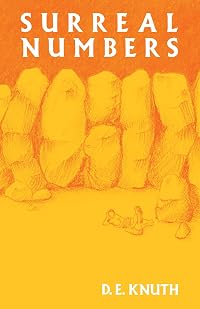
Surreal Numbers
by Donald E. Knuth
On This Page
Description
Shows how a young couple turned on to pure mathematics and found total happiness. This title is intended for those who might enjoy an engaging dialogue on abstract mathematical ideas, and those who might wish to experience how new mathematics is created.Tags
Recommendations








Member Reviews
A unique, quirky, playful book: two hippies on a beach invent the surreal numbers. Nominally an introduction to the surreal numbers themselves, but also an exposition of the joy (and pain) of mathematical discovery and invention.
The book is a dialogue where the characters rediscover the theory of surreal numbers. As a mathematical introduction to the subject, the book is inferior to Conway's On Numbers and Games, which covers more and is more in style of a classical mathematics text. The dialogues are too technical to have any literary value. If the book has any value, it has value as a recording of the process of mathematical discovery. (Although, for a working mathematician the methods presented are rather self-evident.)
The best math book ever. (It's not boring. It has sex in it.)
È stato molto bello vedere tradotto in italiano questo libretto, che ha inaugurato la collana Scienza FA di Franco Angeli. Io avevo letto l'edizione originale una ventina d'anni fa e l'ho sempre ricordata con piacere. Il libro tecnicamente è una "novelette", ma non si può leggere come un romanzo, perché di matematica ce n'è parecchia. Ma d'altra parte non è nemmeno un manuale di matematica, anche se alla fine surrettiziamente Knuth ha aggiunto qualche esercizio. In realtà è un modo per vedere come si fa davvero matematica. Si parte da una serie di regole - quelle di JHWH Conway sono solo due, proprio un insieme minimale - e si verifica da un lato che siano coerenti e dall'altro che creino una teoria interessante. Nel testo si show more vedono delle false strade, dei ripensamenti e a un certo punto ci si accorge di un errore fondamentale dovuto al pensare troppo per analogia: tutte cose che capitano, ma che i libri di testo nascondono accuratamente. Non è probabilmente un libro per tutti, ma gli appassionati di matematica non dovrebbero farne a meno. La traduzione di Francesco Oliveri è molto ben fatta dal punto di vista matematico, ma a mio parere avrebbe dovuto osare un po' di più nelle parti più discorsive, che sono rimaste un po' piatte. Sicuramente meglio così che una traduzione fiammeggiante ma incomprensibile, intendiamoci! show less
Oct 22, 2016Italian
A prima vista un divertissement matematico, ma in realtà un modo per vedere come si può creare una teoria, tra idee e false partenze.
Oct 7, 2016Italian
Indeholder "1. The Rock", "2. Symbols", "3. Proofs", "4. Bad Numbers", "5. Progress", "6. The Third Day", "7. Discovery", "8. Addition", "9. The Answer", "10. Theorems", "11. The Proposal", "12. Disaster", "13. Recovery", "14. The Universe", "15. Infinity", "16. Multiplication", "Postscript".
Pudsig bog. Knuth præsenterer sine hovedpersoner, Alice og Bill, for en klippe med inskriptioner om et talsystem og lader dem så udforske teorien, lidt i stil med Proofs and Refutations.
Vi følger deres glæde ved at opdage teorien og deres frustrationer, når de løber i en blindgyde eller bare går i stå.
Knuth har skrevet den som eksempel på hvad han mener der mangler i uddannelsessystemet for matematiks vedkommende.
Pudsig bog. Knuth præsenterer sine hovedpersoner, Alice og Bill, for en klippe med inskriptioner om et talsystem og lader dem så udforske teorien, lidt i stil med Proofs and Refutations.
Vi følger deres glæde ved at opdage teorien og deres frustrationer, når de løber i en blindgyde eller bare går i stå.
Knuth har skrevet den som eksempel på hvad han mener der mangler i uddannelsessystemet for matematiks vedkommende.
Sep 13, 2013 (Edited)Danish
schwer verständlich; Tex hat es auch aufgegeben
Jan 31, 2025German
Members
- Recently Added By
Lists

HS Mathematics class library
79 works; 6 members
Author Information

81 Works 9,666 Members
Donald E. Knuth is known throughout the world for his pioneering work on algorithms and programming techniques, for his invention of the TEX and METAFONT systems for computer typesetting, and for his prolific and influential writing. Professor Emeritus of The Art of Computer Programming at Stanford University, he currently devotes full time to the show more completion of these fascicles and the seven volumes to which they belong. show less
Common Knowledge
- Original publication date
- 1974
Classifications
Statistics
- Members
- 339
- Popularity
- 93,708
- Reviews
- 7
- Rating
- (3.82)
- Languages
- English, Italian, Portuguese, Spanish
- Media
- Paper
- ISBNs
- 4
- UPCs
- 1
- ASINs
- 2