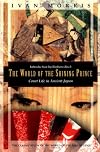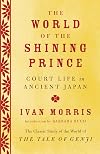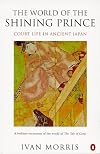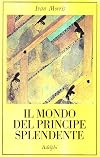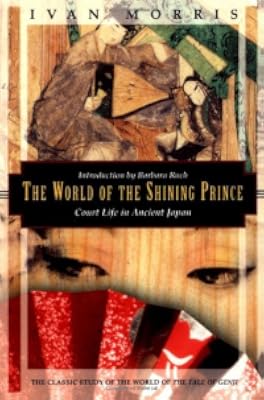
The World of the Shining Prince: Court Life in Ancient Japan
by Ivan Morris
On This Page
Description
The World of the Shining Prince, Ivan Morris's widely acclaimed portrait of the ceremonious, inbred, melancholy world of ancient Japan, has been a standard in cultural studies for nearly thirty years. Using as a frame of reference The Tale of Genji and other major literary works from Japan'sHeian period, Morris recreates an era when woman set the cultural tone. Focusing on the world of the emperor's court-the world so admired by Virginia Woolf and others-he describes the politics, society, show more religious life, and superstitions of the times, providing detailed portrayals of the daily lifeof courtiers, the cult of beauty they espoused, and the intricate relations between the men and women of this milieu. show lessTags
Recommendations





Member Reviews
This was a fascinating and fun little book about Japan's cultural high point in history: the Heian period. Not much is known about this era (or really any civilization from the 10th century), but Morris does a great job of spinning together what he's been able to gleam both from factual sources as well as fictional ones into a somewhat cohesive vision of what the era would have been like.
Morris's biggest source is Murasaki Shikibu's epic novel The Tale of Genji. While it is a fictional representation of the royal court, Murasaki painstakingly uses it to record the lives she observes. He freely admits that, as a result, his research only covers the upper echelons of society, but that's nothing new when it comes to studies like this. show more That said, Morris does a fantastic job of building up the society around Murasaki's novel. He covers the way Japan closed itself off from the outside world and how that isolation yet adoration of T'ang culture informed every aspect of their society. He paints a picture of the government structure, the religion, the festivals that ruled everyone's days, and the daily lives of the rich and powerful (or just the rich). While the picture is incomplete, it doesn't feel lacking.
Aside from setting up the Heian world for the reader, Morris spends a lot of time delving into the relationships of the people living at this time. After all, relationships were one of the defining things of this era of extreme leisure for the wealthy, and it's one Murasaki herself fixates on in her masterpiece, as well as her contemporaries. The Heian era is certainly unique in that romance is inextricably linked to relationships but in a performative sense rather than an emotional one. The position of men and women is ultra limiting for everyone unless you're the Fujiwara clan member in charge. It's as captivating as it is sad. I don't blame everyone for moping around and writing depressed poetry all the time.
The only odd thing about this book was the introduction, which I would recommend skipping. The majority of it was excusing Morris's behavior and "salvaging" his image. Now, I'm just a regular person. I'm not in academic circles, let alone Medieval Japanese circles. I didn't realize Morris was a problematic figure who needed his image to be cleaned up, and now that I've read this book, I still don't think there's anything alarming. His book was approachable. His arguments made sense, and I didn't get an overwhelming sense of racism, xenophobia, or sexism from the text. There might have been a couple small instances, but the introduction made it seem like his was some horribly outdated viewpoint that needed an apology, so I was expecting some pretty outlandish notions; yet, I didn't get that. I still rated this book 5 stars because I felt Morris did a fantastic job, and I don't think it's fair to rate a book based on what other people wrote in the introduction. show less
Morris's biggest source is Murasaki Shikibu's epic novel The Tale of Genji. While it is a fictional representation of the royal court, Murasaki painstakingly uses it to record the lives she observes. He freely admits that, as a result, his research only covers the upper echelons of society, but that's nothing new when it comes to studies like this. show more That said, Morris does a fantastic job of building up the society around Murasaki's novel. He covers the way Japan closed itself off from the outside world and how that isolation yet adoration of T'ang culture informed every aspect of their society. He paints a picture of the government structure, the religion, the festivals that ruled everyone's days, and the daily lives of the rich and powerful (or just the rich). While the picture is incomplete, it doesn't feel lacking.
Aside from setting up the Heian world for the reader, Morris spends a lot of time delving into the relationships of the people living at this time. After all, relationships were one of the defining things of this era of extreme leisure for the wealthy, and it's one Murasaki herself fixates on in her masterpiece, as well as her contemporaries. The Heian era is certainly unique in that romance is inextricably linked to relationships but in a performative sense rather than an emotional one. The position of men and women is ultra limiting for everyone unless you're the Fujiwara clan member in charge. It's as captivating as it is sad. I don't blame everyone for moping around and writing depressed poetry all the time.
The only odd thing about this book was the introduction, which I would recommend skipping. The majority of it was excusing Morris's behavior and "salvaging" his image. Now, I'm just a regular person. I'm not in academic circles, let alone Medieval Japanese circles. I didn't realize Morris was a problematic figure who needed his image to be cleaned up, and now that I've read this book, I still don't think there's anything alarming. His book was approachable. His arguments made sense, and I didn't get an overwhelming sense of racism, xenophobia, or sexism from the text. There might have been a couple small instances, but the introduction made it seem like his was some horribly outdated viewpoint that needed an apology, so I was expecting some pretty outlandish notions; yet, I didn't get that. I still rated this book 5 stars because I felt Morris did a fantastic job, and I don't think it's fair to rate a book based on what other people wrote in the introduction. show less
I was worried that this book was going to be a slog. The topic is a bit obscure - the aristocratic world of 10th century Japan at the time of Lady Murasaki's novel The Tale of Gengi. So some possiblity it would be one of those not terribly well written academic tomes, long on footnotes, short on readable prose, primarily concerned with scoring points in academic infighting over minutiae. You know the stuff, "Professor Walrus puts forth the absurd contention that Lord Hisagau was 5'3", ignoring the careful scholarship of Professor Carpenter who has demonstrated conclusively that he was of course 5'4"..." Feh.
Plus it was first published in 1964, which gave me some concerns about how the author was going to handle certain aspects of Heian show more culture particularly issues of sex - was the author going to feel the need to over explain or resort to cringe making euphemisms? But I'm really interested in Heian Japan so I figured I'd give it a shot.
I'm glad I did. There was a little bit of what I was worried about but not enough to ruin what turned out to be a fascinating and informative book. I learned a lot, and I had great fun imagining the world he was describing. For the most part he stuck with the facts and wrote very readably - only in a few places, mostly when dealing with polygamy and shamanism, did he run off the rails into trying to justify and over explain his material.
If you are interested in the world of Lady Murasaki I recommend this. show less
Plus it was first published in 1964, which gave me some concerns about how the author was going to handle certain aspects of Heian show more culture particularly issues of sex - was the author going to feel the need to over explain or resort to cringe making euphemisms? But I'm really interested in Heian Japan so I figured I'd give it a shot.
I'm glad I did. There was a little bit of what I was worried about but not enough to ruin what turned out to be a fascinating and informative book. I learned a lot, and I had great fun imagining the world he was describing. For the most part he stuck with the facts and wrote very readably - only in a few places, mostly when dealing with polygamy and shamanism, did he run off the rails into trying to justify and over explain his material.
If you are interested in the world of Lady Murasaki I recommend this. show less
There are lots of positive reviews of this on GR, so allow me to present the view for the prosecution. Morris's book is occasionally interesting, but there's very little here that you can't get better from reading the introductions and notes to the various Heian diaries, as well as the diaries themselves. Shining Prince is also a real period piece. It was first published in 1964, and reads like it was first published in some mythical 1954 when White People (other than Ivan Morris, of course) thought The Nips were all Emperor crazed psychopaths just waiting to Kamikaze down from the skies. If you think that, this book will be a very useful corrective. If you have a minimal understanding of history, however, you don't need to read this show more book. And oddly, if you don't have a minimal understanding of history, this book will be infuriating, because Morris feels obliged to explain the Heian period by comparing it to specific moments in European history. Was this like the Sun King? Yes and no. Was it like this German Emperor's court? Not really. Was it like the Medici?
Don't even get me started on the division he makes between "religion" and "superstition," which would be foreign to the entirety of the world's population outside protestant modernity.
None of this is really Morris' fault; he was writing for a specific audience. The educated layman (definitely 'man') of his time probably knew all about the Medici, and probably knew nothing about Japan. I suspect the educated layperson of our time is more likely to know about Japan than to have the kind of knowledge of European history needed to made all the analogies comprehensible.
Anyway, to restate: if you want to prepare yourself for Genji, which was my purpose in reading this book, you're better off reading the diaries in any responsible edition. Then cherry pick here. The chapters on religion (and "superstition") aren't bad, that on the cult of beauty is worth reading, and the chapter on the emperors might be worth looking at. Everything else you can get elsewhere without the 1950s baggage (again, I'm not accusing Morris of being racist or anything; the problem is that the audience he was writing to doesn't really exist anymore, and if it does, it shouldn't). show less
Don't even get me started on the division he makes between "religion" and "superstition," which would be foreign to the entirety of the world's population outside protestant modernity.
None of this is really Morris' fault; he was writing for a specific audience. The educated layman (definitely 'man') of his time probably knew all about the Medici, and probably knew nothing about Japan. I suspect the educated layperson of our time is more likely to know about Japan than to have the kind of knowledge of European history needed to made all the analogies comprehensible.
Anyway, to restate: if you want to prepare yourself for Genji, which was my purpose in reading this book, you're better off reading the diaries in any responsible edition. Then cherry pick here. The chapters on religion (and "superstition") aren't bad, that on the cult of beauty is worth reading, and the chapter on the emperors might be worth looking at. Everything else you can get elsewhere without the 1950s baggage (again, I'm not accusing Morris of being racist or anything; the problem is that the audience he was writing to doesn't really exist anymore, and if it does, it shouldn't). show less
A very excellent and richly detailed overview of court life in Japan’s Heian period approximately from the XVIII to the XII century which can serve as a companion to and is based on two novels, The Tale of Genji by Murasaki Shikibu, Sei Shonagon's The Pillow Book, written during the period by court ladies (who wrote in Japanese while the men were busying themselves writing in bad Chinese). This treatment of the period thoroughly portrays Court life in all its saucy and titillating details (gums blackened with charcoal to look sexy, midnight romps through the imperial compound, beatitude state and tears in response to something beautiful). Given the remoteness of the period, it is quite extraordinary that such material is available, show more although much of the information pertains exclusively to a restricted and elevated section of the population. I found this book to be utterly engrossing chiefly because it successfully depicts a human experience which is so foreign and removed from our own as to be barely comprehensible. show less
Several years ago I read the entirety of The Tale of Genji, a novel written by Murasaki Shikibu in the eleventh century. It was a pretty big undertaking, but absolutely worth it. I love the novel. Ever since finishing The Tale of Genji for the first time, I've been meaning to read Ivan Morris' The World of the Shining Prince: Court Life in Ancient Japan. The volume takes its title from the hero of The Tale of Genji who is referred to as the shining prince due to his exquisite visage and exceptional character. In many ways, The World of the Shining Prince serves as a companion to The Tale of Genji as Morris explores the historical reality of the aristocracy of Heian-era Japan. The World of the Shining Prince was originally published in show more 1964. Beginning in 1994, later editions of the work also include an introduction by Barbara Ruch. I recently read and was rather impressed by another of Morris' works, The Nobility of Failure: Tragic Heroes in the History of Japan, and so was looking forward to reading The World of the Shining Prince even more.
In addition to the introductions, preface, appendices, bibliography, and topical index, The World of the Shining Prince examines a number of different aspects of tenth-century Japan, Heian court society, and The Tale of Genji within it ten chapters. Morris begins with a broad overview of the era in the first chapter, "The Heian Period." Though the Heian Period lasted from 782 to 1167, The World of the Shining Prince largely, but not exclusively, focuses on the 900s. The next chapter, "The Setting" looks at Heian architecture, city planning, and geography. From there Morris delves into more detailed analysis of Heian culture in the chapters "Politics and Society," "Religions," and "Superstitions." Next, attention is specifically turned to the Heian nobility and aristocracy. "The Good People and Their Lives" details day-to-day activities, amusements, and ceremonies while "The Cult of Beauty" looks at the particular aesthetics of the era. The eighth chapter, "The Women of Heian and their Relations with Men" outlines household and family structures as well as the place of romantic liaisons. The World of the Shining Prince concludes with chapters devoted to Murasaki Shikibu and to The Tale of Genji itself.
Although written more than five decades ago, The World of the Shining Prince has held up remarkably well. Admittedly, it is nearly impossible to write a completely objective cultural study--Morris' analysis is informed and influenced by his own cultural subjectivity. In the half-century since The World of the Shining Prince was written, Western thought and scholarly approaches to cultural analysis have also changed. (For example, as Ruch mentions in her introduction, views on gender politics and the relationship between religion and superstition has shifted over the years.) The World of the Shining Prince is a product of its time, but that doesn't at all diminish its value as a resource on Heian-era Japan, and more specifically on Japanese court life in the tenth century. Additionally, the volume is written with a general audience in mind. It is quite approachable, even for the average reader, and is engagingly written. Granted, the subject mater of The World of the Shining Prince is fascinating to being with.
Although Morris does provide some important general context within which he situates The World of the Shining Prince, the volume's scope is relatively narrow, concentrating on a very specific part of Heian society. However, this specificity also allows him to explore that subject from several different perspectives. Information about the Heian Period is somewhat limited, especially in regards to the lower classes, which is another reason that The World of the Shining Prince is so focused on the era's nobility. The Tale of Genji is a major source for Morris' study of the Heian-era Japan, as are other works of contemporary literature--The Pillow Book of Sei Shōnagon especially features prominently--as well as diaries and court records from the time period. The World of the Shining Prince is an extremely informative and absorbing work. It's more than just a companion to The Tale of Genji and reaches beyond its literary connections. The volume should appeal to anyone interested in learning more about classical Japanese history.
Experiments in Manga show less
In addition to the introductions, preface, appendices, bibliography, and topical index, The World of the Shining Prince examines a number of different aspects of tenth-century Japan, Heian court society, and The Tale of Genji within it ten chapters. Morris begins with a broad overview of the era in the first chapter, "The Heian Period." Though the Heian Period lasted from 782 to 1167, The World of the Shining Prince largely, but not exclusively, focuses on the 900s. The next chapter, "The Setting" looks at Heian architecture, city planning, and geography. From there Morris delves into more detailed analysis of Heian culture in the chapters "Politics and Society," "Religions," and "Superstitions." Next, attention is specifically turned to the Heian nobility and aristocracy. "The Good People and Their Lives" details day-to-day activities, amusements, and ceremonies while "The Cult of Beauty" looks at the particular aesthetics of the era. The eighth chapter, "The Women of Heian and their Relations with Men" outlines household and family structures as well as the place of romantic liaisons. The World of the Shining Prince concludes with chapters devoted to Murasaki Shikibu and to The Tale of Genji itself.
Although written more than five decades ago, The World of the Shining Prince has held up remarkably well. Admittedly, it is nearly impossible to write a completely objective cultural study--Morris' analysis is informed and influenced by his own cultural subjectivity. In the half-century since The World of the Shining Prince was written, Western thought and scholarly approaches to cultural analysis have also changed. (For example, as Ruch mentions in her introduction, views on gender politics and the relationship between religion and superstition has shifted over the years.) The World of the Shining Prince is a product of its time, but that doesn't at all diminish its value as a resource on Heian-era Japan, and more specifically on Japanese court life in the tenth century. Additionally, the volume is written with a general audience in mind. It is quite approachable, even for the average reader, and is engagingly written. Granted, the subject mater of The World of the Shining Prince is fascinating to being with.
Although Morris does provide some important general context within which he situates The World of the Shining Prince, the volume's scope is relatively narrow, concentrating on a very specific part of Heian society. However, this specificity also allows him to explore that subject from several different perspectives. Information about the Heian Period is somewhat limited, especially in regards to the lower classes, which is another reason that The World of the Shining Prince is so focused on the era's nobility. The Tale of Genji is a major source for Morris' study of the Heian-era Japan, as are other works of contemporary literature--The Pillow Book of Sei Shōnagon especially features prominently--as well as diaries and court records from the time period. The World of the Shining Prince is an extremely informative and absorbing work. It's more than just a companion to The Tale of Genji and reaches beyond its literary connections. The volume should appeal to anyone interested in learning more about classical Japanese history.
Experiments in Manga show less
A very perceptive, well-written look at the cultural life of Heian Japan, c. 900-1100 AD. This was a society obsessed with aesthetics, where the colors on the sleeve of one's kimono were minutely analyzed for the coded messages they conveyed, and where poetry was an essential element of daily life (at least among the ruling elite). Highly recommended if you're thinking about reading The Pillow Book of Sei Shonagon or tackling Murasaki Shikibu's Tale of Genji.
Davvero un gran bel libro.
Consigliato a chi ha già letto il Genji monogatari e anche a chi si appresta a farlo ma forse si sente intimorito dalla complessità del testo.
Questo saggio di Morris, oltre ad analizzare bene molti aspetti della Storia di Genji, aiuta il lettore ad addentrarsi con cura meticolosa, anche se non specialistica, nell'èra Heian della storia del Giappone, un periodo estremamente affascinante e complesso.
Consigliato a chi ha già letto il Genji monogatari e anche a chi si appresta a farlo ma forse si sente intimorito dalla complessità del testo.
Questo saggio di Morris, oltre ad analizzare bene molti aspetti della Storia di Genji, aiuta il lettore ad addentrarsi con cura meticolosa, anche se non specialistica, nell'èra Heian della storia del Giappone, un periodo estremamente affascinante e complesso.
Members
- Recently Added By
Lists

Japanese Literature
230 works; 40 members
Author Information

8+ Works 1,135 Members
Awards and Honors
Awards
Series
Belongs to Publisher Series
Common Knowledge
- Canonical title
- The World of the Shining Prince: Court Life in Ancient Japan
- Original title
- The World of the Shinning Prince
- Original publication date
- 1964
- Important places
- Japan
- Dedication
- TO
Arthur Waley - First words
- In 784 the emperor gave orders that his capital should be moved from the temple city of Heijo (Nara), where it had been during most of the century, to Nagaoka, some thirty miles to the north. Like Heijo the new centre was to... (show all) be modelled on the Chinese capital of Ch'ang-an; but, in accordance with the increased wealth of the island kingdom, it was to be on a far larger and grander scale than any previous town in Japan.
- Last words
- (Click to show. Warning: May contain spoilers.)Her novel does not attempt to give a full picture of a period (few successful novels do); but it does provide an authentic picture of a beautiful and most intriguing world.
- Original language
- English
Classifications
Statistics
- Members
- 645
- Popularity
- 44,872
- Reviews
- 12
- Rating
- (4.01)
- Languages
- 6 — Dutch, English, French, German, Italian, Spanish
- Media
- Paper, Ebook
- ISBNs
- 15
- ASINs
- 11