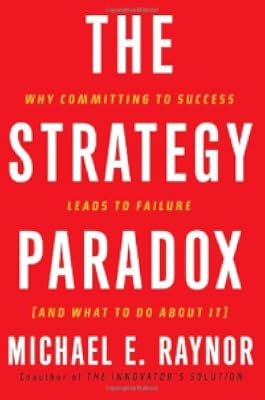
The Strategy Paradox: Why Committing to Success Leads to Failure (And What to do About It)
by Michael E. Raynor
On This Page
Description
A compelling vision. Bold leadership. Decisive action. Unfortunately, these prerequisites of success are almost always the ingredients of failure, too. In fact, most managers seeking to maximize their chances for glory are often unwittingly setting themselves up for ruin. The sad truth is that most companies have left their futures almost entirely to chance, and don?t even realize it. The reason? Managers feel they must make choices with far-reaching consequences today, but must base those show more choices on assumptions about a future they cannot predict. It is this collision between commitment and uncertainty that creates THE STRATEGY PARADOX. This paradox sets up a ubiquitous but little-understood tradeoff. Because managers feel they must base their strategies on assumptions about an unknown future, the more ambitious of them hope their guesses will be right? or that they can somehow adapt to the turbulence that will arise. In fact, only a small number of lucky daredevils prosper, while many more unfortunate, but no less capable managers find themselves at the helms of sinking ships. Realizing this, even if only intuitively, most managers shy away from the bold commitments that success seems to demand, choosing instead timid, unremarkable strategies, sacrificing any chance at greatness for a better chance at mere survival. show lessTags
Recommendations













Member Reviews
The Strategy Paradox is that it is hard to predict the future, yet you must commit fully to a strategy in order to reap the maximum reward; this runs the risk of total failure. The solution to this problem is something the author calls "strategic flexibility". Unfortunately this book was so heavy on consultant / business language ("facilitate the capture of synergies"?) that I found it hard to parse out clear steps to take. I did like the idea of increasing time horizons as you move higher up in the organisation structure; however it has to be emphasized that this requires senior management to have their own strategic planning staff.
Ratings
Members
- Recently Added By
Lists

Ryan Holiday's Books To Base Your Life On
97 works; 2 members
Author Information
4+ Works 1,178 Members
Classifications
- Genres
- Business, Nonfiction, General Nonfiction
- DDC/MDS
- 658.4012 — Applied science & technology Management & public relations General management Executive Planning, control, strategy Strategy
- LCC
- HD30.28 .R384 — Social sciences Industries. Land use. Labor Industries. Land use. Labor Management. Industrial management
- BISAC
Statistics
- Members
- 154
- Popularity
- 213,517
- Reviews
- 1
- Rating
- (3.31)
- Languages
- English
- Media
- Paper, Ebook
- ISBNs
- 2
- ASINs
- 1