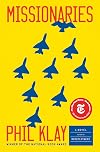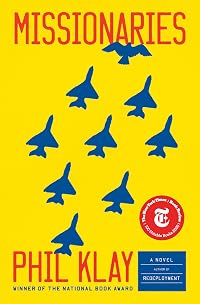
Missionaries
by Phil Klay
On This Page
Description
"Neither Mason, a U.S. Army Special Forces medic, nor Lisette, a foreign correspondent, has emerged from America's long post-9/11 wars in Iraq and Afghanistan unscathed. Yet war also exerts a terrible draw that neither can shake--the noble calling, the camaraderie, the life-and-death stakes. Where else in the world can such a person go? All roads lead to Colombia, where the US, with its patented fusion of intelligence dominance and quick-striking special operators, has partnered with local show more government to stamp out a vicious civil war and keep the predatory narco gangs at bay. Mason, now a liaison to the Colombian military, is ready for the good war, and Lisette is more than ready to cover it. For Juan Pablo, Mason's counterpart in the Colombian officer corps, translating reality into a language the Americans can understand requires a cartoonist's gift for caricature, but it's child's play next to the challenge of navigating the viper's nest of factions bidding for power, in the capital and far out in the field. And if Juan Pablo's view is dark, the outlook of Abel, a lieutenant in the militia Los Mil Jesuses, which controls territory in rural Norte de Santander, a region on the Venezuelan border where the writ of law scarcely runs, is positively Stygian. Abel has lost everything he loves in the carnage that for his entire life has flowed unceasingly in this region, where the lines between drug cartels, militias, and the state are semi-permeable. It is Abel's cruel fate to find safety only by serving a man he has come to fear and loathe. Missionaries is an astonishment, a novel of extraordinary suspense whose central, unsparing drama is infused by a geopolitical sophistication and a wisdom about the human heart that would be rare even in isolation. As Los Mil Jesuses make their move to fill a power vacuum in Norte de Santander, aided and abetted by the Colombian military for its own reasons, the Americans are made pawns of a game they don't even begin to understand. The result is an unfolding calamity that will leave no character unscathed, and will echo across the planet. A work whose accomplishment calls forth comparisons to Joseph Conrad, Graham Greene, and Robert Stone, Missionaries ultimately stands apart as its own electrifying new form of artistic reckoning with the forces we have unleashed in our world"-- show lessTags
Recommendations










Member Reviews
Missionaries is one of those books which take a few seemingly completely disparate characters, and over time manages to weave them into a cohesive narrative. This is a strategy which can work really well, or go disastrously wrong. It’s a technique I like when it works well, and luckily here it does. Klay further complicates things by introducing his major characters at different intervals in different years. Initially they tell their own stories.
Abel was a young boy, Abelito, in 1999 when the guerrilleros came to his Columbian village seeking “justice”, which Abelito knew was just another word for executions. His father hid him in a boat and pushed it downstream, saving Abelito, but the rest of the family was murdered. His story show more is told by the older disassociated Abel.
Lisette was a journalist in Kabul in 2015. Most of the other westerners had left long ago, but she found it difficult to live in the west, where no one seemed to care what was happening in places like Afghanistan. At least in Afghanistan, she felt able to act, to perhaps make someone care back home while they read the morning news and drank their morning coffee. Now she was looking for a war to cover “where we’re not losing”.
Then there was Mason, a miner’s son. In 2005, he was a medic with Special Forces in Iraq. He believed in the mission then, believed that he was “experiencing the violence and horror of this place so that they didn’t have to experience the same things in Fayetteville, North Carolina”. That was about to change.
Lastly there was Juan Pablo. a lieutenant colonel in the Colombian army. In 2016, his concern was what would happen with a pending treaty with FARC, and afterwards should it materialise.
Klay manages to bring all four together in a believable fashion, at which time the novel switches to third person narrative. There is ideological struggle here between Americans reared on democracy as a black and white concept, and the realties of South America, where just achieving consensus on what democracy is, may prove impossible. There is an unfiltered portrayal of American actions in foreign wars, yet the American characters are sympathetically drawn.
There are echoes of Robert Stone and Philip Caputo here, but some of Klay’s characters actually do believe there will be a better tomorrow, despite and maybe even because of what is happening today. Whichever side of the debate you fall on, it makes for powerful reading. show less
Abel was a young boy, Abelito, in 1999 when the guerrilleros came to his Columbian village seeking “justice”, which Abelito knew was just another word for executions. His father hid him in a boat and pushed it downstream, saving Abelito, but the rest of the family was murdered. His story show more is told by the older disassociated Abel.
Lisette was a journalist in Kabul in 2015. Most of the other westerners had left long ago, but she found it difficult to live in the west, where no one seemed to care what was happening in places like Afghanistan. At least in Afghanistan, she felt able to act, to perhaps make someone care back home while they read the morning news and drank their morning coffee. Now she was looking for a war to cover “where we’re not losing”.
Then there was Mason, a miner’s son. In 2005, he was a medic with Special Forces in Iraq. He believed in the mission then, believed that he was “experiencing the violence and horror of this place so that they didn’t have to experience the same things in Fayetteville, North Carolina”. That was about to change.
Lastly there was Juan Pablo. a lieutenant colonel in the Colombian army. In 2016, his concern was what would happen with a pending treaty with FARC, and afterwards should it materialise.
Klay manages to bring all four together in a believable fashion, at which time the novel switches to third person narrative. There is ideological struggle here between Americans reared on democracy as a black and white concept, and the realties of South America, where just achieving consensus on what democracy is, may prove impossible. There is an unfiltered portrayal of American actions in foreign wars, yet the American characters are sympathetically drawn.
There are echoes of Robert Stone and Philip Caputo here, but some of Klay’s characters actually do believe there will be a better tomorrow, despite and maybe even because of what is happening today. Whichever side of the debate you fall on, it makes for powerful reading. show less
4.5 stars. Simply excellent. It takes a lot for me to say the comparisons to Conrad are apt, but they are. While it’s likely the book could have been edited a bit, even the somewhat extraneous material is extremely well observed. Likewise, I’m not sure that all the threads are woven together as neatly as one might wish purely from a craftsperson’s point of view, yet even there, perhaps they’re woven as well as the grand subject matter admits. This is a fine novel, wide and deep, dark, brutal, and heartbreaking.
This was a hard book. I had read Klay's collection of short stories about Iraq "Redeploment" and totally enjoyed it(I won the National Book Award). so I wanted to read his first novel. Although this is not a subject matter that I normally read about, I chose it because of his first book. This was a well researched novel that dealt with a very serious subject matter. Namely, global warfare in the 21st century. It centers around Columbia in the months proceeding the vote on the settlement between FARC and the Columbian government meant to put an end to 50 years of violence. It is told through 4 main characters. Abel, a Columbian ex paramilitary, Lisette an American war correspondent, Mason an American soldier, and Juan Pablo a Columbian show more army officer. Klay does a good job of portraying 1st person narratives from each character against the backdrop of the Afghanistan, Iraq, and Columbian conflicts. You see the brutality of the war but you also the development of a global military group that consists of career soldiers and a growing number of contractors. There is more an allegiance to conflict than to the actual ideology that supports the conflict. Klay's problem is putting everything together. There is way too much detail and assumption of knowledge on the part of the reader. Because of the seriousness of the subject matter I felt a need to finish the book. It really felt more like a non-fiction description of reality wrapped in a fictional package in order to make it more palatable to the reader. My biggest takeaway was the knowledge I gained about the conflict in Columbian and how it continues despite the agreement with FARC. As always books like this increase your empathy with the non-military people that have to deal with the never ending violence. An educational book that is worthwhile for gaining knowledge but not an ultimate page turner. I do strongly recommend " Redeployment" which does a great job about the war in an Iraq and in an entertaining way. show less
A gratifyingly grim look at modern warfare. Reminded me a lot of Say Nothing, with the blurred lines between goodies and baddies. The plot zips along well enough but I’ll remember the mood a lot more than the characters.
I was not as engaged in this novel as I had hoped. It felt disorganized, although since chaos is part of war that may have been deliberate. Set in Latin America, the Middle East, and the US, the author paints a picture of the traits of war which are both universal and particular to geographic location. Meh.
Ratings
Members
- Recently Added By
Lists

Obama Reads
181 works; 3 members

Barack Obama's Summer Reading List 2020
17 works; 5 members

Books recommended by Barack Obama
295 works; 28 members
Author Information

7+ Works 2,048 Members
Phil Klay is a graduate of Dartmouth College and a veteran of the U.S. Marine Corps. He served in Iraq's Anbar Province as a Public Affairs Officer. After being discharged he went to Hunter College and received an MFA. His story "Redeployment" was originally published in Granta and is included in Fire and Forget: Short Stories from the Long War. show more His writing has also appeared in the New York Times, Newsweek, The Daily Beast, the New York Daily News, Tin House, and The Best American Nonrequired Reading 2012. (Bowker Author Biography) show less
Some Editions
Awards and Honors
Common Knowledge
- Canonical title
- Missionaries
- Original publication date
- 2020
Classifications
Statistics
- Members
- 285
- Popularity
- 113,107
- Reviews
- 5
- Rating
- (3.67)
- Languages
- English, French
- Media
- Paper, Audiobook, Ebook
- ISBNs
- 13
- ASINs
- 3