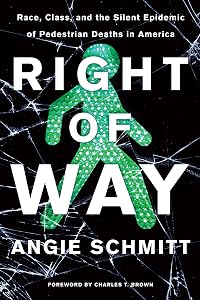
Right of Way: Race, Class, and the Silent Epidemic of Pedestrian Deaths in America
by Angie Schmitt
On This Page
Description
In Right of Way, journalist Angie Schmitt shows that pedestrian traffic deaths are not unavoidable "accidents." They are predictable, occurring in stark geographic patterns that tell a story about systemic inequality. These deaths are the forgotten faces of an increasingly urgent public health crisis that we have the tools, but not the will, to solve. Schmitt examines the increase in pedestrian deaths in the US as well as programs and movements that are beginning to respond to the epidemic. show more Right of Way is a call to reframe the problem, acknowledge the role of racism and classism in the public response to these deaths, and energize advocacy around road safety. Right of Way unveils a crisis that is rooted in both inequality and the undeterred reign of the automobile in our cities. It challenges us to imagine and demand safer and more equitable cities, where no one is expendable. show lessTags
Recommendations



Member Reviews
This is a topic I’ve read a fair bit about, so I don’t know how much of it was actually new to me, but it was well presented overall. I liked the focus on systemic issues and the analogies drawn to the nuclear power industry and aviation: both fields have evolved in their understanding of what causes accidents and are not so quick as they used to be in blaming humans. The traffic environment is a complex system and the more we can engineer the system to mitigate the risks of accidents, the better. We should not be blaming pedestrians for not wearing bright enough clothing or not crossing where they’re “supposed” to.
The global perspective was useful, demonstrating how woeful the U.S. traffic safety record is in comparison with show more other “developed” countries. The Canadian content was a bit insufficient though; Toronto may have a lot of transit, but in recent years the Toronto police seem to have stopped enforcing traffic laws. I wouldn’t necessarily hold the city up as a model of good design—it can and should do much better.
I also liked the chapter on autonomous vehicles and the solid analysis of why they aren’t a cure-all. (Also, why must we continue to perpetuate the individual vehicle? Invest more in better public transit, and in intercity transit so that people don’t need to have cars at all.) And the chapter about how cars have become bigger and deadlier over the years is especially well illustrated with photos of actual people (including the author and her son) beside cars to demonstrate how invisible a pedestrian is to a driver.
I raised an eyebrow at one line in the acknowledgements: the author stated that her mother proofread the early chapters, and then the author rejected all her changes. Given that this book contained a distracting number of typos (e.g., “censor” for “sensor”, “NSTB” for “NTSB” even though that was spelled correctly on the previous page), I would be curious to see the track changes that her mother made. I don’t normally comment on typos, because even the best proofreaders and editors will have only about a 95% save percentage, but the combination of this comment plus the typos gave me some pause.
Overall, I would recommend this book if you’re interested in urban planning that makes way for humans instead of cars. show less
The global perspective was useful, demonstrating how woeful the U.S. traffic safety record is in comparison with show more other “developed” countries. The Canadian content was a bit insufficient though; Toronto may have a lot of transit, but in recent years the Toronto police seem to have stopped enforcing traffic laws. I wouldn’t necessarily hold the city up as a model of good design—it can and should do much better.
I also liked the chapter on autonomous vehicles and the solid analysis of why they aren’t a cure-all. (Also, why must we continue to perpetuate the individual vehicle? Invest more in better public transit, and in intercity transit so that people don’t need to have cars at all.) And the chapter about how cars have become bigger and deadlier over the years is especially well illustrated with photos of actual people (including the author and her son) beside cars to demonstrate how invisible a pedestrian is to a driver.
I raised an eyebrow at one line in the acknowledgements: the author stated that her mother proofread the early chapters, and then the author rejected all her changes. Given that this book contained a distracting number of typos (e.g., “censor” for “sensor”, “NSTB” for “NTSB” even though that was spelled correctly on the previous page), I would be curious to see the track changes that her mother made. I don’t normally comment on typos, because even the best proofreaders and editors will have only about a 95% save percentage, but the combination of this comment plus the typos gave me some pause.
Overall, I would recommend this book if you’re interested in urban planning that makes way for humans instead of cars. show less
This book, Schmitt's debut, had a great deal of buzz among planners on its release, and I see why. Drivers hit pedestrians every day in the US, often fatally, and while we have extensive records of these horrible crashes, until now there hasn't been a unifying story of what is happening and why.
Schmitt offers this story at the scale of the individual person, and we learn much more about the frequent victims of driver-pedestrian crashes: people in the growing "Sunbelt" states, poor and homeless people, people with limited mobility, and seniors. This is a helpful call to action, to note that so many crash victims are our vulnerable neighbors. Some chapters also touch on how self-driving vehicles figure into this, which is immediately show more relevant to me as a planner. show less
Schmitt offers this story at the scale of the individual person, and we learn much more about the frequent victims of driver-pedestrian crashes: people in the growing "Sunbelt" states, poor and homeless people, people with limited mobility, and seniors. This is a helpful call to action, to note that so many crash victims are our vulnerable neighbors. Some chapters also touch on how self-driving vehicles figure into this, which is immediately show more relevant to me as a planner. show less
Ratings
Members
- Recently Added By
Lists

Urban Planning (Michelle TBR)
39 works; 3 members

The War on Cars podcast
108 works; 1 member
Author Information
1 Work 65 Members
Some Editions
Classifications
- Genres
- Nonfiction, General Nonfiction, Art & Design
- DDC/MDS
- 363.125 — Society, government, & culture Social problems and social services Public Safety - Police, Crime Investigation Public safety from hazards Transportation Roads
- LCC
- HE5614.2 .S36 — Social sciences Transportation and communications Transportation and communications Automotive transportation
- BISAC
Statistics
- Members
- 65
- Popularity
- 479,138
- Reviews
- 2
- Rating
- (4.22)
- Languages
- English
- Media
- Paper, Ebook
- ISBNs
- 2
- ASINs
- 1