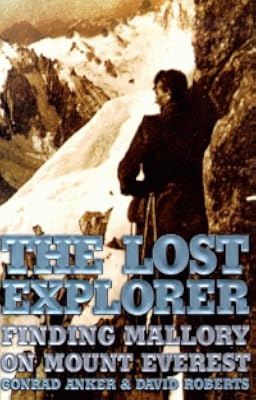
The Lost Explorer: Finding Mallory on Mount Everest
by Conrad Anker, David Roberts
On This Page
Description
This is the adventure story of the year -- how Conrad Anker found the body of George Mallory on Mount Everest, casting an entirely new light on the mystery of the explorer who may have conquered Everest seventy-five years ago. On June 8, 1924, George Leigh Mallory and Andrew "Sandy" Irvine were last seen climbing toward the summit of Mount Everest. Clouds soon closed around them, and they vanished into history. Ever since, mountaineers have wondered whether they reached the summit show more twenty-nine years before Edmund Hillary and Tenzing Norgay. On May 1, 1999, Conrad Anker, one of the world's strongest mountaineers, discovered Mallory's body lying facedown, frozen into the scree and naturally mummified at 27,000 feet on Everest's north face. The condition of the body, as well as the artifacts found with Mallory, including goggles, an altimeter, and a carefully wrapped bundle of personal letters, are important clues in determining his fate. Seventeen days later, Anker free-climbed the Second Step, a 90-foot sheer cliff that is the single hardest obstacle on the north ridge. The first expedition known to have conquered the Second Step, a Chinese team in 1975, had tied a ladder to the cliff, leaving unanswered the question of whether Mallory could have climbed it in 1924. Anker's climb was the first test since Mallory's of the cliff's true difficulty. In treacherous conditions, Anker led teammate Dave Hahn from the Second Step to the summit. Reflecting on the climb, Anker explains why he thinks Mallory and Irvine failed to make the summit, but at the same time, he expresses his awe at Mallory's achievement with the primitive equipment of the time. Stunningly handsome and charismatic, Mallory charmed everyone who met him during his lifetime and continues to fascinate mountaineers today. He was an able writer, a favorite of the Bloomsbury circle, and a climber of legendary gracefulness. The Lost Explorer is the remarkable story of this extraordinarily talented man and of the equally talented modern climber who spearheaded a discovery that may ultimately help solve the mystery of Mallory's disappearance. show lessTags
Recommendations

















Member Reviews
This is a dramatic account of both Mallory and Irvine's final and probably unsuccessful attempt to climb Mount Everest that ended in disaster in June 1924, and the discovery of Mallory's body on the mountain in May 1999 by a group of climbers including the co-author of this work, who actually discovered the body himself. There is a sharp contrast drawn between the differing attitudes and approaches of 1924 and 1999, and the very sharp difference in the techniques, equipment and clothing available to each climbing party. The extreme cold, the bitter winds, the thin, thin air getting more extreme and more thin as climbers near the summit comes across very clearly....so many climbers have had to give up even just a few hundred feet for the show more summit as they are very close to death in the extreme conditions of what is accurately called the Death Zone. What struck me about Mallory was his very driven and daredevil nature, combined with an alarming absentmindedness and technical gaucheness (the latter somewhat made up for by Irvine). I tend to agree with the author's conclusion that almost certainly they did not make it to the summit but that they literally fell somewhat short and thereby created probably the greatest mystery in the history of mountaineering. A great read. show less
On June 8, 1924, English climbers George Mallory and Andrew Irvine vanished without a trace while climbing toward the summit of Mt. Everest. The last person to see them alive, Noel Odell, saw them ascending the northeast ridge of the mountain. Then clouds closed in, and Mallory and Irvine disappeared into legend, until 1999 when Conrad Anker discovered Mallory's body at 27,000 feet on Everest's north face.
This book, cowritten by Anker and David Roberts, traces Mallory's storied history and relationship with Mt. Everest, and details the expedition that searched for and found his body. It is a tale that bridges two very different eras in mountaineering--eras distinguished by technology, technique, and attitude, yet united by a mountain show more that remains as daunting and dangerous as ever.
Well written and engaging, the only thing this book lacks is a satisfying conclusion, but that's not the fault of the authors. For although Mallory's body was found, Irvine's remains missing to this day, along with the camera that could establish without doubt whether or not they made it to the "top of the world" twenty-nine years before Edmund Hillary and Tenzing Norgay. Regardless, Anker explains in great detail why he believes Mallory and Irvine fell to their deaths before reaching the summit. Although his may not be the last word on the subject, he makes a strong case.
I highly recommend this book to anyone interested in the history of Everest or climbing in general. show less
This book, cowritten by Anker and David Roberts, traces Mallory's storied history and relationship with Mt. Everest, and details the expedition that searched for and found his body. It is a tale that bridges two very different eras in mountaineering--eras distinguished by technology, technique, and attitude, yet united by a mountain show more that remains as daunting and dangerous as ever.
Well written and engaging, the only thing this book lacks is a satisfying conclusion, but that's not the fault of the authors. For although Mallory's body was found, Irvine's remains missing to this day, along with the camera that could establish without doubt whether or not they made it to the "top of the world" twenty-nine years before Edmund Hillary and Tenzing Norgay. Regardless, Anker explains in great detail why he believes Mallory and Irvine fell to their deaths before reaching the summit. Although his may not be the last word on the subject, he makes a strong case.
I highly recommend this book to anyone interested in the history of Everest or climbing in general. show less
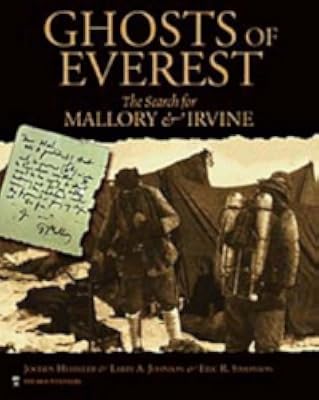
This is a companion book to The Ghosts of Everest, which tries to present as unsensationalised an account of the discovery of George Mallory's body as possible. Although the book has dated, Anker now believes that it is possible that Mallory and Irvine reached the summit, it is still an interesting addition to the Everest canon, and does at least attempt to separate the facts, as remembered by Anker, from the fiction, and provide some context to the decisions made at the time. By alternating the chapters between 1999 and 1924, whether deliberately or not, Anker and Roberts are able to reinforce Anker’s point that Everest is not a mountain to be underestimated and that the best equipped, most experienced climbers, can still get into show more serious trouble on the mountain. show less
This book is a nice companion to Ghosts of Everest - it takes a less romanticized view of the same project, and comes to what feels to me like a more likely conclusion. Ghosts of Everest brought me to my fascination with Everest, but I really like Anker's style and impressions. If you read one, I very much suggest reading the other.
The story of the disappearance of George Mallory and his climbing partner, Sandy Irvine, while ascending or descending Mount Everest on June 8, 1924 has fascinated mountain fans for decades. They were last seen ascending the upper reaches somewhere between the "First" and "Second Steps." Did they make it to the summit? Did the accident which took their lives occur on the way up or on the way down? Ultimately these questions cannot be answered; however, until the May 1999 NOVA/BBC sponsered search for Mallory's and Irvine's remains there was little evidence on which to base speculation. This book tells the story of Conrad's Anker's discovery of Mallory's body, his carefully reasoned suggestions about whether they were the first to summit show more Everest and the scenario of their demise; and it tells the story of George Mallory, the most gifted mountaineer of the first half of the twentieth century and the only man to have been a part of all three British reconnaissance and summit attempts of the 1920s. It's a good quick read for the armchair adventurist. show less
Definitely one of Robert's better works, due to the fact that he kept his ego in check.
Leigh-Mallory, George Herbert, 1886-1924/Mountaineers > Great Britain > Biography/Mountaineering > Everest, Mount (China and/Nepal)/Anker, Conrad/Mount Everest Expedition (1924)
Members
- Recently Added By
Author Information

7+ Works 318 Members

35+ Works 5,073 Members
David Roberts is a climber and mountaineer and the author of thirty books about mountaineering, exploration, and anthropology. His books have won the Boardman Tasker Award for Mountain Literature and the Grand Prize at the Banff Mountain Book Festival, and have been shortlisted for the PEN/ESPN Award for Literary Sports Writing. He lives in show more Massachusetts. show less
Series
Belongs to Publisher Series
Common Knowledge
- Canonical title
- The Lost Explorer: Finding Mallory on Mount Everest
- Original title
- The Lost Explorer: Finding Mallory on Mount Everest
- Alternate titles
- The Lost Explorer
- Original publication date
- 1989
- People/Characters
- George Mallory
- Important places
- Mount Everest / Sagarmatha; Himalayas
- Important events
- Disappearance of Mallory and Irvine 1924
Classifications
- Genres
- Sports and Leisure, Nonfiction, General Nonfiction, Travel, Biography & Memoir, History
- DDC/MDS
- 796.5220922 — Arts & recreation Recreation, sports, and performing arts Athletic and outdoor sports and games Outdoor leisure Walking and exploring by kind of terrain Mountains, hills and rocks standard subdivisions History, geographic treatment, biography
- LCC
- GV199.92 .L44 .A54 — Geography, Anthropology and Recreation Recreation. Leisure Recreation. Leisure
- BISAC
Statistics
- Members
- 258
- Popularity
- 126,323
- Reviews
- 7
- Rating
- (3.87)
- Languages
- 5 — Dutch, English, German, Hungarian, Spanish
- Media
- Paper, Audiobook, Ebook
- ISBNs
- 16
- ASINs
- 6