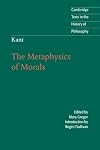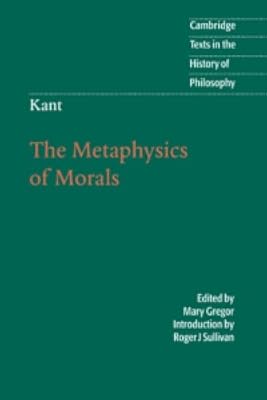
The Metaphysics of Morals
by Immanuel Kant
On This Page
Description
The Metaphysics of Morals is Kant's final major work in moral philosophy. In it, he presents the basic concepts and principles of right and virtue and the system of duties of human beings as such. The work comprises two parts: the Doctrine of Right concerns outer freedom and the rights of human beings against one another; the Doctrine of Virtue concerns inner freedom and the ethical duties of human beings to themselves and others. Mary Gregor's translation, lightly revised for this edition, show more is the only complete translation of the entire text, and includes extensive annotation on Kant's difficult and sometimes unfamiliar vocabulary. This edition includes numerous new footnotes, some of which address controversial aspects of Gregor's translation or offer alternatives. Lara Denis's introduction sets the work in context, explains its structure and themes, and introduces important interpretive debates. The volume also provides thorough guidance on further reading including online resources. show lessTags
Recommendations














Member Reviews
METAPHYSICAL FIRST PRINCIPLES
OF THE DOCTRINE OF R I G H T
Preface 35
Introduction to the Metaphysics of Morals 40
Introduction to the Doctrine of Right 55
Division of the Doctrine of Right 62
I Private Right 68
Chapter I. How to Have Something External as
One's Own 68
Chapter II. How to Acquire Something External 80
Section I. On Property Right 82
Section II. On Contract Right 90
Section III. On Rights to Persons Akin to Rights
to Things 95
On the Right of Domestic Society 96
Title I. Marriage Right 96
Title II. Parental Right 98
Title III. Right of a Head of the Household 100
Dogmatic Division of All Rights That Can Be
Acquired by Contract 101
Episodic Section 108
v
vi Contents
Chapter III. On Acquisition That Is Dependent
Subjectively upon the Decision of a show more Public
Court of Justice 113
II. Public Right 123
Section I. The Right of a State 123
Section II. The Right of Nations 150
Section III. Cosmopolitan Right 158
Conclusion 160
Appendix. Explanatory Remarks on The Metaphysical
First Principles of the Doctrine of Right 163
METAPHYSICAL FIRST PRINCIPLES
OF THE DOCTRINE OF VIRTUE
Preface 181
Introduction to the Doctrine of Virtue 185
I. Doctrine of the Elements of Ethics 214
Part I. On Duties to Oneself as Such 214
Introduction 214
Book I. Perfect Duties to Oneself 218
Chapter I. Man's Duty to Himself as an Animal
Being 218
Chapter II. Man's Duty to Himself Merely as a Moral
Being 225
Section I. On Man's Duty to Himself as His Own
Innate Judge 233
Section II. On the First Command of All Duties
to Oneself 236
Episodic Section 237
Book II. On Man's Imperfect Duties to Himself 239
Section I. On Man's Duty to Himself to Develop and
Increase His Natural Perfection, That Is, for a
Pragmatic Purpose 239
Contents vii
Section II. On Man's Duty to Himself to Increase
His Moral Perfection, That Is, for a Moral
Purpose Only 241
Part II. Duties of Virtue to Others 243
Chapter I. On Duties to Others Merely as Men 243
Section I. On the Duty of Love to Other Men 243
Section II. On Duties of Virtue toward Other Men
Arising from the Respect Due Them 254
Chapter II. On Ethical Duties of Men toward One
Another with Regard to Their Condition 260
Conclusion of the Elements of Ethics 261
Appendix 265
II Doctrine of the Methods of Ethics 266
Section I. Teaching Ethics 266
Section II. Ethical Ascetics 273 show less
OF THE DOCTRINE OF R I G H T
Preface 35
Introduction to the Metaphysics of Morals 40
Introduction to the Doctrine of Right 55
Division of the Doctrine of Right 62
I Private Right 68
Chapter I. How to Have Something External as
One's Own 68
Chapter II. How to Acquire Something External 80
Section I. On Property Right 82
Section II. On Contract Right 90
Section III. On Rights to Persons Akin to Rights
to Things 95
On the Right of Domestic Society 96
Title I. Marriage Right 96
Title II. Parental Right 98
Title III. Right of a Head of the Household 100
Dogmatic Division of All Rights That Can Be
Acquired by Contract 101
Episodic Section 108
v
vi Contents
Chapter III. On Acquisition That Is Dependent
Subjectively upon the Decision of a show more Public
Court of Justice 113
II. Public Right 123
Section I. The Right of a State 123
Section II. The Right of Nations 150
Section III. Cosmopolitan Right 158
Conclusion 160
Appendix. Explanatory Remarks on The Metaphysical
First Principles of the Doctrine of Right 163
METAPHYSICAL FIRST PRINCIPLES
OF THE DOCTRINE OF VIRTUE
Preface 181
Introduction to the Doctrine of Virtue 185
I. Doctrine of the Elements of Ethics 214
Part I. On Duties to Oneself as Such 214
Introduction 214
Book I. Perfect Duties to Oneself 218
Chapter I. Man's Duty to Himself as an Animal
Being 218
Chapter II. Man's Duty to Himself Merely as a Moral
Being 225
Section I. On Man's Duty to Himself as His Own
Innate Judge 233
Section II. On the First Command of All Duties
to Oneself 236
Episodic Section 237
Book II. On Man's Imperfect Duties to Himself 239
Section I. On Man's Duty to Himself to Develop and
Increase His Natural Perfection, That Is, for a
Pragmatic Purpose 239
Contents vii
Section II. On Man's Duty to Himself to Increase
His Moral Perfection, That Is, for a Moral
Purpose Only 241
Part II. Duties of Virtue to Others 243
Chapter I. On Duties to Others Merely as Men 243
Section I. On the Duty of Love to Other Men 243
Section II. On Duties of Virtue toward Other Men
Arising from the Respect Due Them 254
Chapter II. On Ethical Duties of Men toward One
Another with Regard to Their Condition 260
Conclusion of the Elements of Ethics 261
Appendix 265
II Doctrine of the Methods of Ethics 266
Section I. Teaching Ethics 266
Section II. Ethical Ascetics 273 show less
All moral relations of rational beings, which involve a principle of the harmony of the will of one with that of another, can be reduced to love and respect; and, insofar as this principle is practical, in the case of love the basis for determining one's will can be reduced to another's end, and in the case of respect, to another's right.
MADRID: TECNOS, 1994.
Jun 30, 2020Portuguese (Brazil)
Ratings
Members
- Recently Added By
Author Information

The greatest of all modern philosophers was born in the Baltic seaport of Konigsberg, East Prussia, the son of a saddler and never left the vicinity of his remote birthplace. Through his family pastor, Immanuel Kant received the opportunity to study at the newly founded Collegium Fredericianum, proceeding to the University of Konigsberg, where he show more was introduced to Wolffian philosophy and modern natural science by the philosopher Martin Knutzen. From 1746 to 1755, he served as tutor in various households near Konigsberg. Between 1755 and 1770, Kant published treatises on a number of scientific and philosophical subjects, including one in which he originated the nebular hypothesis of the origin of the solar system. Some of Kant's writings in the early 1760s attracted the favorable notice of respected philosophers such as J. H. Lambert and Moses Mendelssohn, but a professorship eluded Kant until he was over 45. In 1781 Kant finally published his great work, the Critique of Pure Reason. The early reviews were hostile and uncomprehending, and Kant's attempt to make his theories more accessible in his Prolegomena to Any Future Metaphysics (1783) was largely unsuccessful. Then, partly through the influence of former student J. G. Herder, whose writings on anthropology and history challenged his Enlightenment convictions, Kant turned his attention to issues in the philosophy of morality and history, writing several short essays on the philosophy of history and sketching his ethical theory in the Foundations of the Metaphysics of Morals (1785). Kant's new philosophical approach began to receive attention in 1786 through a series of articles in a widely circulated Gottingen journal by the Jena philosopher K. L. Reinhold. The following year Kant published a new, extensively revised edition of the Critique, following it up with the Critique of Practical Reason (1788), treating the foundations of moral philosophy, and the Critique of Judgment (1790), an examination of aesthetics rounding out his system through a strikingly original treatment of two topics that were widely perceived as high on the philosophical agenda at the time - the philosophical meaning of the taste for beauty and the use of teleology in natural science. From the early 1790s onward, Kant was regarded by the coming generation of philosophers as having overthrown all previous systems and as having opened up a whole new philosophical vista. During the last decade of his philosophical activity, Kant devoted most of his attention to applications of moral philosophy. His two chief works in the 1790s were Religion Within the Bounds of Plain Reason (1793--94) and Metaphysics of Morals (1798), the first part of which contained Kant's theory of right, law, and the political state. At the age of 74, most philosophers who are still active are engaged in consolidating and defending views they have already worked out. Kant, however, had perceived an important gap in his system and had begun rethinking its foundations. These attempts went on for four more years until the ravages of old age finally destroyed Kant's capacity for further intellectual work. The result was a lengthy but disorganized manuscript that was first published in 1920 under the title Opus Postumum. It displays the impact of some of the more radical young thinkers Kant's philosophy itself had inspired. Kant's philosophy focuses attention on the active role of human reason in the process of knowing the world and on its autonomy in giving moral law. Kant saw the development of reason as a collective possession of the human species, a product of nature working through human history. For him the process of free communication between independent minds is the very life of reason, the vocation of which is to remake politics, religion, science, art, and morality as the completion of a destiny whose shape it is our collective task to frame for ourselves. (Bowker Author Biography) Philosopher Immanuel Kant was born in 1724 in Konigsberg, East Prussia. He studied at the University of Konigsberg, where he would act as a lecturer and professor after a brief career as a private tutor. Kant was an incredibly influential philosopher, his theories having impact on the likes of Schopenhauer and Hegel. Kant's most prominent works include Critique of Pure Reason (1781), Foundations of the Metaphysics of Morals (1785) and Critique of Practical Reason (1788). He died in 1804. (Bowker Author Biography) show less
Some Editions
Series
Belongs to Publisher Series
Work Relationships
Common Knowledge
- Canonical title
- The Metaphysics of Morals
- Original title
- Die Metaphysik der Sitten
- Original publication date
- 1797
- Disambiguation notice
- Not to be confused with the Groundwork/Foundation to the Metaphysics of Morals.
Classifications
Statistics
- Members
- 535
- Popularity
- 55,933
- Reviews
- 3
- Rating
- (4.01)
- Languages
- 6 — English, French, German, Italian, Portuguese (Portugal), Spanish
- Media
- Paper, Ebook
- ISBNs
- 30
- ASINs
- 5