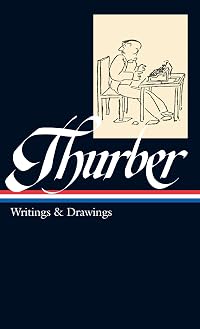
Thurber: Writings and Drawings
by James Thurber
On This Page
Description
James Thurber, whimsical fantasist and deadpan chronicler of everyday absurdities, brought American humor into the 20th century. His comic persona, a modern citydweller whose zaniest flights of free association are tinged with anxiety, remains hilarious, subtly disturbing, and instantly recognizable. Here, in over 1000 pages, editor Garrison Keillor presents the best and most extensive collection ever assembled. Over 100 pieces include "The Secret Life of Walter Mitty" and "The Catbird show more Seat," the brilliantly satirical Fables for Our Time, the classic My Life and Hard Times, and the best of The Owl in the Attic, Let Your Mind Alone!, My World--And Welcome to It, and the other famous books. Plus 500 wonderful drawings, including The Seal in the Bedroom and celebrated sequences like "The Masculine Approach" and "The War Between Men and Women." Rounding out the volume is a selection from The Years with Ross, a memoir of the New Yorker publisher, and a number of wonderful early pieces never collected by Thurber. LIBRARY OF AMERICA is an independent nonprofit cultural organization founded in 1979 to preserve our nation's literary heritage by publishing, and keeping permanently in print, America's best and most significant writing. The Library of America series includes more than 300 volumes to date, authoritative editions that average 1,000 pages in length, feature cloth covers, sewn bindings, and ribbon markers, and are printed on premium acid-free paper that will last for centuries. show lessTags
Recommendations















Member Reviews
I grew up with a couple of little books of Thurber highlights, and had the idea of him as an off-beat humorist, someone who would put surreal seals and hippopotami into domestic scenes and delicately undermine the staid course of mid-century American mediocrity by giving downtrodden husbands an escape into the world of the imagination (“Walter Mitty”) and office-workers a chance to fantasise about taking revenge on evil co-workers (“The cat-bird seat”). When you read him in bulk like this, you get a different perspective: the subversive humour is still there, of course, but it’s part of a systematic, organised journalistic career in which Thurber came to see that making people laugh was a marketable skill he had. Like any show more successful humorist, he had to be a disciplined, organised writer who could cut everything unnecessary out of his work and avoid treading on editors’ or readers’ toes, while meeting deadlines and wordcounts. Seeing “behind the scenes” might take some of the magic away, but it gives you more admiration for his professionalism.
I enjoyed revisiting the celebrated cartoons and comic stories, of course, but some of the most interesting writing here turned out to be from My life and hard times (1933), about his childhood and adolescence in Columbus, Ohio, and The years with Ross (1958), about the early days of the New Yorker when he worked with Harold Ross and E B White. In both cases there is obviously a certain amount of embroidery going on — Thurber is not the sort of person to let boring facts get in the way of a good anecdote — but he manages to give some fascinating glimpses into what it was like living in a provincial US city before the Great War and into how the world of weekly magazines worked in the 1920s and 30s.
Otherwise, there are a few fun things here I didn’t know about, like the apocalyptic graphic fable The last flower (1939), and an earlier graphic fable The race of life (1932), in which a protean family of man woman and child suffers all kinds of normal adventures (weather, hunger, etc.) before coming face to face with a totally unexplained Giant Rabbit. Both of these are also fun because of the way they manage to sneak in large amounts of nudity without ever being prurient or erotic about it. show less
I enjoyed revisiting the celebrated cartoons and comic stories, of course, but some of the most interesting writing here turned out to be from My life and hard times (1933), about his childhood and adolescence in Columbus, Ohio, and The years with Ross (1958), about the early days of the New Yorker when he worked with Harold Ross and E B White. In both cases there is obviously a certain amount of embroidery going on — Thurber is not the sort of person to let boring facts get in the way of a good anecdote — but he manages to give some fascinating glimpses into what it was like living in a provincial US city before the Great War and into how the world of weekly magazines worked in the 1920s and 30s.
Otherwise, there are a few fun things here I didn’t know about, like the apocalyptic graphic fable The last flower (1939), and an earlier graphic fable The race of life (1932), in which a protean family of man woman and child suffers all kinds of normal adventures (weather, hunger, etc.) before coming face to face with a totally unexplained Giant Rabbit. Both of these are also fun because of the way they manage to sneak in large amounts of nudity without ever being prurient or erotic about it. show less
I was in Portland for a week, and reading this book for an hour every morning over coffee in the lobby of Fifth Avenue Suites ranks as one of the most pleasant reading experiences I've ever had. Many of Thurber's stories take place in hotel lobbies, so the synchronicity was palpable. Thurber himself is much more acerbic and witty than I remember him from elementary school. Rediscovering him through this collection of his best pieces, assembled by Garrison Keillor, was a joy. His autobiographical pieces on growing up in Ohio are hilarious stand-outs. Comedic intelligence in American prose does exist, and this is a good place to start exploring it.
Vintage Thurber, collected from his many writings. Includes the entire Last Flower parable, which is a wonderful short work illustrated with the characteristically minimalist drawings that create additional delight in these works of humor. The work is at its best when he's writing about his childhood and the strange shenanigans and goings on of a very chaotic extended family. Although some of the works will not date well, because of the slang of the time, and numerous references to the technology of an earlier era, for those who enjoy turn of the century humor and dry wit, these works are an exercise in sheer delight. Some of his cartoons, though, fall totally flat, probably because they related to everyday events of the time, rather show more than the page-turners that entered the history books. Still, it is unusual that a book of this length (nearly 1000 pages) doesn't begin to feel too long until the final 200 pages, and that is a testament to the talent of the author (and probably the editor, as well). show less
Ratings
Members
- Recently Added By
Author Information

136+ Works 18,298 Members
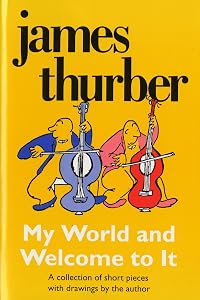
Born in Columbus, Ohio, Thurber was blinded in one eye in a childhood accident. He attended Ohio State University but left without earning a degree. In 1925 he moved to New York City, where he joined the staff of the New Yorker in 1927 at the urging of his friend E. B. White. For the rest of his lifetime, Thurber contributed to the magazine his show more highly individual pieces and those strange, wry, and disturbing pen-and-ink drawings of "huge, resigned dogs, the determined and sometimes frightening women, the globular men who try so hard to think so unsuccessfully." The period from 1925, when the New Yorker was founded, until the death of its creator-editor, Harold Ross, in 1951, was described by Thurber in delicious and absorbing detail in The Years with Ross (1959). Of his two great talents, Thurber preferred to think of himself primarily as a writer, illustrating his own books. He published "fables" in the style of Aesop (see Vol. 2) and La Fontaine (see Vol. 2)---usually with a "barbed tip of contemporary significance"---children's books, several plays (two Broadway hits, one successful musical revue), and endless satires and parodies in short stories or full-length works. "The Secret Life of Walter Mitty," included in My World---and Welcome to It (1942), is probably his best-known story and continues to be frequently anthologized. T. S. Eliot described Thurber's work as "a form of humor which is also a way of saying something serious." (Bowker Author Biography) show less
All Editions
Series
Belongs to Publisher Series
Library of America (090)
Work Relationships
Contains
Common Knowledge
- Canonical title
- Thurber: Writings and Drawings
- Original publication date
- 1996-10-1
- People/Characters
- James Thurber
- Publisher's editor
- Garrison Keillor
- Disambiguation notice
- This is an omnibus unique to the Library of America; therefore, all CK facts apply to this publication only.
Classifications
Statistics
- Members
- 602
- Popularity
- 48,721
- Reviews
- 3
- Rating
- (4.41)
- Languages
- English
- Media
- Paper, Ebook
- ISBNs
- 2
- ASINs
- 3