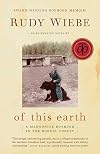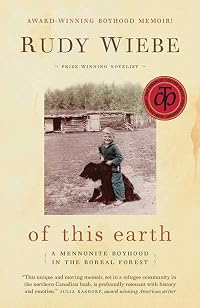
Of This Earth: A Mennonite Boyhood in the Boreal Forest
by Rudy Wiebe
On This Page
Description
Rudy Wiebe has written award-winning fiction for decades. He is recognized as one of Canada's finest literary treasures. Twice he has received Canada's most prestigious prize for fiction writing: The Governor-General's Award (equivalent to the Pulitzer Prize for fiction). Now comes new recognition for Wiebe's nonfiction writing. His recently released childhood memoir, Of This Earth: A Mennonite Boyhood in the Boreal Forest, has won the Charles Taylor Prize for Literary Nonfiction (considered show more to be the country's most prestigious literary nonfiction prize). The book holds Rudy's memoirs of growing up through age 12. His immigrant family cut a farm out of stony bushland in remote Saskatchewan. They hand-dug their well, climbed a ladder to their beds under the rafters, farmed with horses, and traveled by sleigh on the frontier. Stories and singing and food from their native Ukraine and Poland held them and filled their bodies and souls. Of This Earth is written with "spare and eloquent prose," say the jurors who chose the book for the Charles Taylor Prize. Wiebe "conveys the riches of a hardscrabble inheritance; a love of words, reading and music, a sustaining yet unsentimental faith, and a bond with the natural world, all of which have provided a compass for his writing life." One of the Taylor-Prize jurors reflected, "Rudy's book haunts you; it stays with you." show lessTags
Recommendations




































Member Reviews
I was unable to finish reading this book. I gave it a hundred-plus pages, but it just never seemed to go anywhere. Even the constant use of words, phrases and sentences rendered in the "Russian Mennonite Low German" dialect that Wiebe's family spoke at home quickly became tedious and redundant. I can see where OF THIS EARTH might be interesting to folks who grew up in that area during that era and perhaps to those who share the same ethnic background, but for me it was in the end a disappointment and just plain tedious. And I usually like to read about other people's early lives, how ever different they might be from my own. The narrative here just didn't move the reader forward. For a much more interesting and enjoyable book on growing show more up in the Canadian bush, I would recommend Farley Mowat's BORN NAKED. show less
Ratings
Members
- Recently Added By
Author Information

37+ Works 1,292 Members
A firm belief in the redemptive possibilities of history dominates Rudy Wiebe's fiction. His characters search for community, for a spiritual collective informed and strengthened by historical consciousness. This attempt to unite the present and the past stems from Wiebe's Mennonite religious background. Central to the Mennonite belief is the show more rejection of loyalty to contemporary and worldly government; personal commitment belongs, instead, to the religious community, with its hard-earned historical heritage as a nonconformist movement. Wiebe was born in a northern Saskatchewan farming community; in 1947 the family moved to Alberta, and he completed his education at the University of Alberta, where he teaches. Wiebe's first novel, Peace Shall Destroy Many (1962), addresses pacifism, a belief central to Mennonites. The novel's hero faces a moral quandary when forced to choose between religious convictions and Canadian nationalistic fervor during World War II. While The Blue Mountains of China (1970) records Mennonite history, The Temptations of Big Bear (1973) examines the destruction of Indian culture in white Canada, and The Scorched-Wood People (1977) takes up the plight of the Metis---those with mixed blood; all three novels focus on minorities who must struggle to maintain their sense of community. Ideas repugnant to the Mennonite sensibility, violence and self-destruction, figure in The Mad Trapper (1980), which recounts the hunt for a man whose isolation has driven him into madness. In 1980 Wiebe's short stories were collected in The Angel of the Tar Sands and Other Stories. Stylistically, Wiebe gives little ground to the reader, for his fiction is characterized by difficult dialects, a web of details, and a dense style. (Bowker Author Biography) Rudy Wiebe is the author of several short story collections and essays. He is also the author of eight novels, including A Discovery of Strangers and The Temptations of Big Bear, both winners of the Governor General's Award for Fiction. He lives in Edmonton, Alberta. (Publisher Provided) show less
Awards and Honors
Classifications
Statistics
- Members
- 95
- Popularity
- 339,962
- Reviews
- 1
- Rating
- (4.00)
- Languages
- English
- Media
- Paper, Ebook
- ISBNs
- 5
- ASINs
- 3