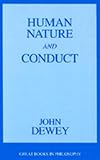
Human Nature and Conduct: An Introduction to Social Psychology
by John Dewey
On This Page
Description
Influential work by the great educator/philosopher maintains that the key to social psychology lies in an understanding of the many varieties of habit; individual mental activity is guided by subordinate factors of impulse and intelligence. His investigation focuses on three main areas of conduct: habit, impulse, and intelligence, with each factor receiving an incisive treatment.Tags
Recommendations
















































Member Reviews
332 pages hard back
A morality ''based on the study of human nature instead of upon disregard for it'' is the focus of this influential work by one of America's greatest educators and philosophers. John Dewey maintains that the key to social psychology lies in an understanding of the many varieties of habit; individual mental activity, on the other hand, is guided by the subordinate factors of impulse and intelligence.
''The mind,'' Dewey asserts, ''can be understood in the concrete only as a system of beliefs, desires, and purposes which are formed in the interaction of biological aptitudes with a social environment.'' His investigation focuses on three main areas: the place of habit in conduct; the place of impulse in conduct; and the place of show more intelligence in conduct. Each factor receives an incisive treatment, brimming with ideas, insights, and considered reflections.
This classic of its genre presents a rich banquet of food for thought, certain to be appreciated by educators, psycholo show less
''The mind,'' Dewey asserts, ''can be understood in the concrete only as a system of beliefs, desires, and purposes which are formed in the interaction of biological aptitudes with a social environment.'' His investigation focuses on three main areas: the place of habit in conduct; the place of impulse in conduct; and the place of show more intelligence in conduct. Each factor receives an incisive treatment, brimming with ideas, insights, and considered reflections.
This classic of its genre presents a rich banquet of food for thought, certain to be appreciated by educators, psycholo show less
Oct 29, 2021Dutch
Ratings
Members
- Recently Added By
Lists

Filosofía - Clásicos
217 works; 1 member

Trinity College Booklist (1951): Class Two, Social and Psychological Scienc
60 works; 3 members
Author Information

244+ Works 9,983 Members
John Dewey was born in 1859 in Burlington, Vermont. He founded the Laboratory School at the University of Chicago in 1896 to apply his original theories of learning based on pragmatism and "directed living." This combination of learning with concrete activities and practical experience helped earn him the title, "father of progressive education." show more After leaving Chicago he went to Columbia University as a professor of philosophy from 1904 to 1930, bringing his educational philosophy to the Teachers College there. Dewey was known and consulted internationally for his opinions on a wide variety of social, educational and political issues. His many books on these topics began with Psychology (1887), and include The School and Society (1899), Experience and Nature (1925), and Freedom and Culture (1939).Dewey died of pneumonia in 1952. (Bowker Author Biography) show less
Series
Belongs to Publisher Series
Modern Library (173)
Common Knowledge
- Canonical title
- Human Nature and Conduct: An Introduction to Social Psychology
- Original publication date
- 1922
Classifications
Statistics
- Members
- 458
- Popularity
- 66,797
- Reviews
- 3
- Rating
- (3.54)
- Languages
- English, German, Spanish, Swedish
- Media
- Paper, Ebook
- ISBNs
- 46
- UPCs
- 1
- ASINs
- 27