On This Page
Description
Captives of the Flame - The Original Classic EditionTags
Recommendations















Member Reviews
This first third of The Fall of the Towers trilogy is vintage early Delany, offering his unique blend of surrealism, brutality, optimism and naiveté. The characters are colorful and immediately likable. The plotting is simple yet still manages to be confusing at times, but then for this kind of book plotting almost doesn't matter. It is quite obviously a book of the Vietnam era, telling of a future society fighting a war against an unknown enemy for unknown reasons..
I liked it.
I liked it.
I believe the author's note explains some of the dementia I experienced throughout the novel—it was the result of the author doing too much "whittling".
From the first sentence through about chapter two, I felt as if the words were mesmerizing me, that I was experiencing each word, sentence, and picture painted in complete fullness. That wore off—I'm not sure what it was...
The W.H. Auden excerpt from his poem 'HORAE CANONICAE' makes it clear that Delany's novel was realized within that poem; or, at least it sure is a well-fitting shoe.
I felt as if though I was not getting a clear picture of everything going on in the novel; that confusion was being borne to sort out later in the sequels; that their was after the initial chapters a show more certain pervading abstractedness. The sequels may have sorted things out; and I am interested enough in The Dead City to read them.
I very much liked the idea of the forest people—made up of giants, little people, and even odder mutations from the radiation, such as Tloto—living apart from a horrid society of aquarium-slaves and bourgeoisie.
I also was impressed with Telphar, the city which builds and maintains itself. I was very pleased to find the same type of anarchist ideals flowing here that flow as a cool, refreshing, and very much awakening stream in the novels of Dick, Heinlein, Wilson, et cetera.
As stated, Toromon is an Empire, and the Queen a bitch. War was the solution to their self-fulfilling economic crisis. It's an old story... Gads at that poisoned fish and the death it reeked!!
It just struck me that the intensity and at times fog-like abstractedness that comes and goes may be explained by the following wikipedia quote on Delany:
"Delany has published several autobiographical/semi-autobiographical accounts of his life as a black, gay, and highly dyslexic writer."
As this was my very first Delany novel, I find that I am intrigued by what other other-worldliness may be penned by a "highly dyslexic writer" whose vision is set upon the future. show less
From the first sentence through about chapter two, I felt as if the words were mesmerizing me, that I was experiencing each word, sentence, and picture painted in complete fullness. That wore off—I'm not sure what it was...
The W.H. Auden excerpt from his poem 'HORAE CANONICAE' makes it clear that Delany's novel was realized within that poem; or, at least it sure is a well-fitting shoe.
I felt as if though I was not getting a clear picture of everything going on in the novel; that confusion was being borne to sort out later in the sequels; that their was after the initial chapters a show more certain pervading abstractedness. The sequels may have sorted things out; and I am interested enough in The Dead City to read them.
I very much liked the idea of the forest people—made up of giants, little people, and even odder mutations from the radiation, such as Tloto—living apart from a horrid society of aquarium-slaves and bourgeoisie.
I also was impressed with Telphar, the city which builds and maintains itself. I was very pleased to find the same type of anarchist ideals flowing here that flow as a cool, refreshing, and very much awakening stream in the novels of Dick, Heinlein, Wilson, et cetera.
As stated, Toromon is an Empire, and the Queen a bitch. War was the solution to their self-fulfilling economic crisis. It's an old story... Gads at that poisoned fish and the death it reeked!!
It just struck me that the intensity and at times fog-like abstractedness that comes and goes may be explained by the following wikipedia quote on Delany:
"Delany has published several autobiographical/semi-autobiographical accounts of his life as a black, gay, and highly dyslexic writer."
As this was my very first Delany novel, I find that I am intrigued by what other other-worldliness may be penned by a "highly dyslexic writer" whose vision is set upon the future. show less
Primer libro de la serie "La caída de la torres". Los tres volúmenes de "La Caída de las Torres" reflejan lo que luego sería una constante en la obra de Delany: una trama de aventuras unida a un estilo fulgurante y erudito. Aquí conocemos a los primeros personajes que luego darán vida a la historia: Jon Koshar, el único en poder escapar de la ciudad muerta; Tel, el valiente muchacho de los ojos verde-mar; la duquesa Petra, el poder tras el trono; Alter, la joven y bella acróbata; Clea, la audaz matemática; y la figura misteriosa y enigmática del Señor de las Llamas.
El rapto de un príncipe, la inconsciencia de un rey, y el peligro de guerra que se cierne sobre Toron, la decadente ciudad cuyo brillo es opacado por el "verde de show more las alas de los escarabajos... el rojo del carbunclo pulido... una red de fuego de plata". show less
El rapto de un príncipe, la inconsciencia de un rey, y el peligro de guerra que se cierne sobre Toron, la decadente ciudad cuyo brillo es opacado por el "verde de show more las alas de los escarabajos... el rojo del carbunclo pulido... una red de fuego de plata". show less
Nov 2, 2022Spanish
Ratings
Members
- Recently Added By
Author Information

194+ Works 28,956 Members
Samuel R. Delany Jr. was born in Harlem, New York on April 1, 1942. He is a science fiction and short story writer. His first novel, The Jewels of Aptor, was published in 1962. He has written more than 20 novels and collections of short stories, memoirs, and critical essays. He has received numerous awards including the Nebula Award for best novel show more for Babel-17 in 1966 and The Einstein Intersection in 1967, the Nebula Award for best short story for Aye, and Gomorrah and Time Considered as a Helix of Semi-Precious Stones, the Hugo Award for best short story for Time Considered as a Helix of Semi-Precious Stones in 1970 and for his non-fiction book, The Motion of Light in Water, and the Bill Whitehead Award for Lifetime Achievement in Gay Literature in 1993. He is as a professor in the department of English at the University at Buffalo, Buffalo, New York. (Bowker Author Biography) Samuel R. Delany is a professor of English & Creative Writing at Temple University in Philadelphia. (Publisher Provided) show less
Some Editions
Series

Belongs to Publisher Series
Work Relationships
Common Knowledge
- Canonical title*
- Sklaven der Flamme
- Original title
- Captives of the Flame
- Alternate titles
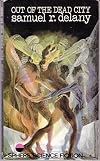
- Out of the Dead City
- Original publication date
- 1963-05
- First words
- The green of beetles' wings... the red of polished carbuncle... a web of silver fire.
- Last words*
- (Click to show. Warning: May contain spoilers.)Dann begann sie wieder zu schreiben.
- Publisher's editor*
- Schelwokat, Günter M.
- Original language*
- Englisch
- Disambiguation notice
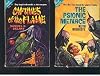
- Note that this work was also published as 'Captives of the Flame' in Ace Double F-199 (Captives of the Flame / The Psionic Menace). That work should NOT be combined with this one.
*Some information comes from Common Knowledge in other languages. Click "Edit" for more information.
Classifications
Statistics
- Members
- 205
- Popularity
- 159,880
- Reviews
- 3
- Rating
- (3.35)
- Languages
- 6 — English, French, German, Hungarian, Italian, Spanish
- Media
- Paper, Ebook
- ISBNs
- 17
- ASINs
- 14