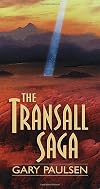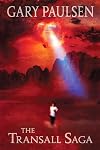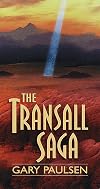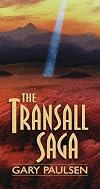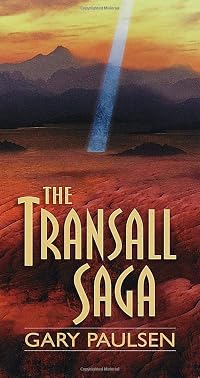
The Transall Saga
by Gary Paulsen
On This Page
Description
While backpacking in the desert, thirteen-year-old Mark falls into a tube of blue light and is transported into a more primitive world, where he must use his knowledge and skills to survive.Tags
Recommendations

Member Recommendations

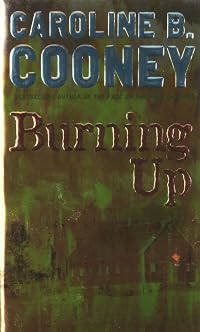
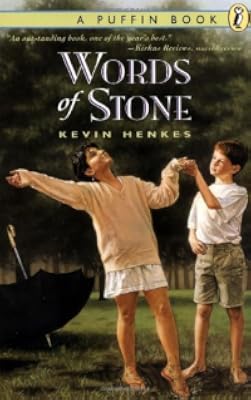
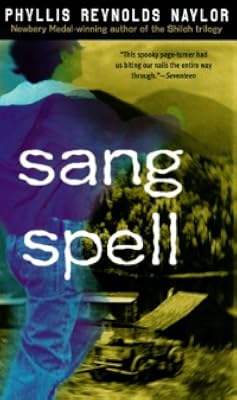
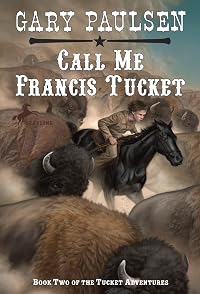
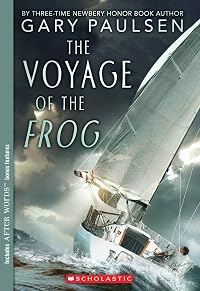
mybookshelf Antoher story about a boy who suddenly finds he's not on modern Earth any more, and struggles to fit in with the new culture and environment in which he finds himself.
sandstone78 Young adult science fiction with survival themes.
Member Reviews
i read this way back in elementary school (I think this was published in 1999) after picking it out from a bookshelf in my classroom. flash forward more than a decade later: The book has long been forgotten. I am washing dishes past midnight when something flickers in my brain. A book cover with a beam of light. A kid who has to survive on another planet. Or was it earth all along? I think I remember him finding a coke bottle but maybe I'm confusing this with Planet of the Apes or something. There are red plants. Definitely red plants. I never got the chance to finish it (we had limited reading time in class) and suddenly I'm dying to know what happened to the kid. After a fruitless online search, I tell my sister (who always finds the show more books from our childhood) who of course comes up with the title after a minute of googling.
"THAT'S IT!" I shrieked. I was surprised to see that Gary Paulsen (of "Hatchet" fame) had written it since he's known more for realist survival stories than sci-fi. (To be fair, "The Transall Saga" is basically a survivalist/coming-of-age story, albeit one set in a post-apocalyptic world.) I promptly DL'd it onto my kindle and spent the rest of the night reading it and marveling at everything I missed the first time around. The Coke bottle certainly is there, but I totally did not remember the different tribes of people.
Engaging story and pretty decent world-building. There are some intriguing anthropological concepts that I would like to have seen explored more. Endemic warfare and slavery run rampart among the tribal peoples of Transall and although our 20th century protagonist initially finds it repellent, he also understands that it is their way of life. This is definitely a tricky area and Paulsen handles it deftly and sensitively for the most part; the only parts that made me raise my eyebrows was the non-PC description of a cannibalistic tribe as "little more than animals" and the historically inaccurate description of a metal-working society as equivalent to "the Dark Ages" (pretty sure the Dark Ages had writing --which is unknown in Transall until Mark shows up).
Although the book does many things right, there still are a lot of holes. Merkon, the other time-traveler from the 20th century, has knowledge about the ebola virus that wiped out most of humanity and caused the nuclear meltdowns which caused the mutations in the humans and wildlife. And he knows this exactly...how? I also wanted to know more about the fate of Leeta, a girl who is taken into slavery by another tribal group. Although she eventually seems to enjoy a fairly decent life as the caretaker of the Tsook leader's son, it is never stated that she was given her freedom. This seems odd since she first she seems to be presented as Mark's love interest (for some reason, that storyline is never resolved) but even when that doesn't pan out, she's still his friend --wouldn't Mark, who eventually became a high-status warrior in the Tsook -- insist on Leeta's freedom? Also, while the ending is heart-breaking, it also doesn't make that much sense: if Mark is successful in finding a vaccine for Ebola, doesn't that mean that the reality of Transall will never happen? Ah, the time-traveling paradox.
3.5 stars, from the vantage point of adulthood. An older or adult reader probably will find the problems too big to ignore but younger readers should have a lot of fun reading this. show less
"THAT'S IT!" I shrieked. I was surprised to see that Gary Paulsen (of "Hatchet" fame) had written it since he's known more for realist survival stories than sci-fi. (To be fair, "The Transall Saga" is basically a survivalist/coming-of-age story, albeit one set in a post-apocalyptic world.) I promptly DL'd it onto my kindle and spent the rest of the night reading it and marveling at everything I missed the first time around. The Coke bottle certainly is there, but I totally did not remember the different tribes of people.
Engaging story and pretty decent world-building. There are some intriguing anthropological concepts that I would like to have seen explored more. Endemic warfare and slavery run rampart among the tribal peoples of Transall and although our 20th century protagonist initially finds it repellent, he also understands that it is their way of life. This is definitely a tricky area and Paulsen handles it deftly and sensitively for the most part; the only parts that made me raise my eyebrows was the non-PC description of a cannibalistic tribe as "little more than animals" and the historically inaccurate description of a metal-working society as equivalent to "the Dark Ages" (pretty sure the Dark Ages had writing --which is unknown in Transall until Mark shows up).
Although the book does many things right, there still are a lot of holes. Merkon, the other time-traveler from the 20th century, has knowledge about the ebola virus that wiped out most of humanity and caused the nuclear meltdowns which caused the mutations in the humans and wildlife. And he knows this exactly...how? I also wanted to know more about the fate of Leeta, a girl who is taken into slavery by another tribal group. Although she eventually seems to enjoy a fairly decent life as the caretaker of the Tsook leader's son, it is never stated that she was given her freedom. This seems odd since she first she seems to be presented as Mark's love interest (for some reason, that storyline is never resolved) but even when that doesn't pan out, she's still his friend --wouldn't Mark, who eventually became a high-status warrior in the Tsook -- insist on Leeta's freedom? Also, while the ending is heart-breaking, it also doesn't make that much sense: if Mark is successful in finding a vaccine for Ebola, doesn't that mean that the reality of Transall will never happen? Ah, the time-traveling paradox.
3.5 stars, from the vantage point of adulthood. An older or adult reader probably will find the problems too big to ignore but younger readers should have a lot of fun reading this. show less
“Hiking and backpacking were Mark’s one obsession”. One night, in the isolated desert, Mark is bitten by a rattlesnake as he investigates a mysterious blue light. When he next opens his eyes, everything has changed. The grass is red, he is surrounded by trees instead of desert, and he is attacked by unfamiliar creatures. The story tells of Mark’s reactions to his new environment, his interactions with the peoples of Transall, and his ongoing quest to return to Earth.
***
Like many of the writings of this author, The Transall Saga begins with a pre-adult, ill-equipped male facing incredible challenges to live without established comforts such as shelter, nourishment, or protective clothing. This novel differs from the Hatchet show more series, for example, in that Mark eventually encounters other people. There is more scope for character development in the interactions between people, as Mark struggles to learn new languages, and accept the differences in attitude between his culture and theirs, for example in relation to slavery, cannibalism, and literacy.
The novel is structured into three parts, with an additional epilogue. The first section describes Mark’s arrival on Transall, and his initial contact with a group he calls “the arrow people”. It concludes with the capture of that small community by the slave-trading Tsook race. Part Two describes Mark’s assimilation into Tsook society, as he progresses from slave to honoured warrior, though he can never be certain why the Tsook chief doesn’t kill him for his attempts to run away. The third section deals with Mark’s realisation that many of his key assumptions about the nature of Transall have been wrong, and his confrontation with the Merkon, self-proclaimed “ruler of the universe here”.
Although the tube of super-charged blue light that transports Mark to this new world is never satisfactorily explained, the other elements of the story combine in a surprisingly plausible fable based on a well thought-out chain of “what if?” The epilogue, two pages set twenty years after the conclusion of the rest of the story, neatly ties together a number of the scientific ideas alluded to in the book, and provides some insight into the impact his teenage adventure has had on Mark the adult. In addition, the reader cannot help but be intrigued by the way the story is left open - who knows what will happen next?
This book is a riveting read for anyone from the age of ten up, though I feel that an older reader would get more from the story, being able to look beyond the narration of the adventure to consider some of the more abstract philosophy underlying the tale. show less
***
Like many of the writings of this author, The Transall Saga begins with a pre-adult, ill-equipped male facing incredible challenges to live without established comforts such as shelter, nourishment, or protective clothing. This novel differs from the Hatchet show more series, for example, in that Mark eventually encounters other people. There is more scope for character development in the interactions between people, as Mark struggles to learn new languages, and accept the differences in attitude between his culture and theirs, for example in relation to slavery, cannibalism, and literacy.
The novel is structured into three parts, with an additional epilogue. The first section describes Mark’s arrival on Transall, and his initial contact with a group he calls “the arrow people”. It concludes with the capture of that small community by the slave-trading Tsook race. Part Two describes Mark’s assimilation into Tsook society, as he progresses from slave to honoured warrior, though he can never be certain why the Tsook chief doesn’t kill him for his attempts to run away. The third section deals with Mark’s realisation that many of his key assumptions about the nature of Transall have been wrong, and his confrontation with the Merkon, self-proclaimed “ruler of the universe here”.
Although the tube of super-charged blue light that transports Mark to this new world is never satisfactorily explained, the other elements of the story combine in a surprisingly plausible fable based on a well thought-out chain of “what if?” The epilogue, two pages set twenty years after the conclusion of the rest of the story, neatly ties together a number of the scientific ideas alluded to in the book, and provides some insight into the impact his teenage adventure has had on Mark the adult. In addition, the reader cannot help but be intrigued by the way the story is left open - who knows what will happen next?
This book is a riveting read for anyone from the age of ten up, though I feel that an older reader would get more from the story, being able to look beyond the narration of the adventure to consider some of the more abstract philosophy underlying the tale. show less
Three 1/2 stars? Starts out a sci-fi version of Hatchet, but turns out to be richer than that. Some boys will become more avid readers because of this - belongs in every Middle School library.
There's this subreddit "tip of my tongue", where people post half remembered book, songs, movies, whatever, and the rest of the internet chips in and remembers the book for you. It's amazing. I don't know why, but this book, the Transall Saga, shows up on there more often than any other book. My brother has had this book, and most Gary Paulsen books, for years, but I never read any of them but Hatchet. But since I kept seeing it online, I decided to see what all the fuss was about.
This book, for all the promises of scifi, is very much like Hatchet. Boy gets stranded in wilderness. Boy must survive in wilderness. This time in some sort of jungle rather than northern forest. But it turns out that the new place he's found himself in (the show more transportation to the wilderness is the scifi part) isn't empty of people. So he has to learn how to get along and get ahead in the society of humanoids he finds himself in.
The whole book felt like a high fantasy just wanting to break free of the wilderness survival story. I wish that would have happened. It would have made the quest and planet of the apes style reveal at the end more worth it. But I guess you can't expect a Gary Paulsen book without a wilderness story. show less
This book, for all the promises of scifi, is very much like Hatchet. Boy gets stranded in wilderness. Boy must survive in wilderness. This time in some sort of jungle rather than northern forest. But it turns out that the new place he's found himself in (the show more transportation to the wilderness is the scifi part) isn't empty of people. So he has to learn how to get along and get ahead in the society of humanoids he finds himself in.
The whole book felt like a high fantasy just wanting to break free of the wilderness survival story. I wish that would have happened. It would have made the quest and planet of the apes style reveal at the end more worth it. But I guess you can't expect a Gary Paulsen book without a wilderness story. show less
I Liked this book. I really did. The concept was intriguing, the writing wasn't bad, the characters were fairly realistic.
But there were these little thing that ticked me off.
1) Mark's use of expression. In this book, we meet people who speak a language other than English. And Mark learns this language, but he likes to use English expressions of speech. For instance: MArk is training with one these people, named Sarbo. Sarbo tells him to come back first thing tommorow morning. Mark says "Wild horses couldn't keep me away." --now, there are not horses in this world, so there obviosly aren't horses in these people's langauge. But they do have horse-like beasts, which I assume IS in their language. At this point, I assumed Mark was using show more their word for the horse-like beasts, and the author was just saying horse to simplify for the reader. But no.-- "Wild horses?" Sarbo asks, confused. "It's an expression, Sarbo. It means nothing will stop me from being here." Mark answers.
Not, my first problem. WHY WOULD USE AN EXPRESSION OF SPEECH??? These people are so Primitive, no offense to them, I love them, but expressions of speech are evolved. WHY??? My second problem, if you MUST use an expression of speech, why don't you use their word for their horse-like beasts? Why? Why, Mark?
2) The Merkon. It's not really that I'm ANNOYED, but I hope the author didn't expect me to be surprised by this plot twist.
3) Megaan. So I'm sort of predisposed to dislike people name Megan, and I was pronouncing Megaan Megan while reading this. Also, she was given NO character development other tan: she's the daughter of the village chief. she's hot. And she doesn't like Mark (except she does). That's all I know about her. And yet as soon as we met her I could sorta tell that she and Mark would be a thing, and thus the character Leeta was, for the most part, wasted. ARG.
Even though none of the 'plot twists' in this book surprised me and I found the language to be misused by the main character, the concept and setting of this book were phenomenal and I recommend it to fans of SF/Fantasy or dyst0opia. It's a different perspective on these genres, and was thoroughly enjoyable. show less
But there were these little thing that ticked me off.
1) Mark's use of expression. In this book, we meet people who speak a language other than English. And Mark learns this language, but he likes to use English expressions of speech. For instance: MArk is training with one these people, named Sarbo. Sarbo tells him to come back first thing tommorow morning. Mark says "Wild horses couldn't keep me away." --now, there are not horses in this world, so there obviosly aren't horses in these people's langauge. But they do have horse-like beasts, which I assume IS in their language. At this point, I assumed Mark was using show more their word for the horse-like beasts, and the author was just saying horse to simplify for the reader. But no.-- "Wild horses?" Sarbo asks, confused. "It's an expression, Sarbo. It means nothing will stop me from being here." Mark answers.
Not, my first problem. WHY WOULD USE AN EXPRESSION OF SPEECH??? These people are so Primitive, no offense to them, I love them, but expressions of speech are evolved. WHY??? My second problem, if you MUST use an expression of speech, why don't you use their word for their horse-like beasts? Why? Why, Mark?
2) The Merkon. It's not really that I'm ANNOYED, but I hope the author didn't expect me to be surprised by this plot twist.
3) Megaan. So I'm sort of predisposed to dislike people name Megan, and I was pronouncing Megaan Megan while reading this. Also, she was given NO character development other tan: she's the daughter of the village chief. she's hot. And she doesn't like Mark (except she does). That's all I know about her. And yet as soon as we met her I could sorta tell that she and Mark would be a thing, and thus the character Leeta was, for the most part, wasted. ARG.
Even though none of the 'plot twists' in this book surprised me and I found the language to be misused by the main character, the concept and setting of this book were phenomenal and I recommend it to fans of SF/Fantasy or dyst0opia. It's a different perspective on these genres, and was thoroughly enjoyable. show less
What can I say. I've read about 17 of Gary Paulsen's books in the last few months and this is the only one I disliked.
The idea is interesting-- it's standard sort of scifi fair; boy whisked away mysteriously to an alien world where he has to fight to fit in-- but the book is way too short to cover all the ground that Paulsen has lined up. As a consequence there's no character development, and scenes flip one to another without much to connect them at times.
I blame the YA publishers for this, btw, As Tamora Pierce has noted, it took Harry Potter to convince them that kids' attention was longer than a gnat's. And I'd be willing to bet that they required Gary to keep his word count down, which is a darn shame because I would have loved show more to have seen this book fleshed out.
BUT in any case, please let me add a caveat that if you are in the mood for a fast-pace adventure without anything of weight to slow you down, you might like this. If I were to give an equivalent it would probably be the old Robert E. Howard "Conan the Barbarian" books-- note no fur clad babe on the cover.
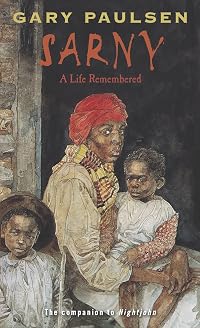
If you like "The Haymeadow" or "Sarny" give this one a miss, or check it out at the library.
Pam T~
one of the moms at booksforkids-reviews show less
The idea is interesting-- it's standard sort of scifi fair; boy whisked away mysteriously to an alien world where he has to fight to fit in-- but the book is way too short to cover all the ground that Paulsen has lined up. As a consequence there's no character development, and scenes flip one to another without much to connect them at times.
I blame the YA publishers for this, btw, As Tamora Pierce has noted, it took Harry Potter to convince them that kids' attention was longer than a gnat's. And I'd be willing to bet that they required Gary to keep his word count down, which is a darn shame because I would have loved show more to have seen this book fleshed out.
BUT in any case, please let me add a caveat that if you are in the mood for a fast-pace adventure without anything of weight to slow you down, you might like this. If I were to give an equivalent it would probably be the old Robert E. Howard "Conan the Barbarian" books-- note no fur clad babe on the cover.
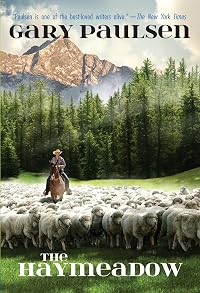
If you like "The Haymeadow" or "Sarny" give this one a miss, or check it out at the library.
Pam T~
one of the moms at booksforkids-reviews show less
A quick read, without much of a plot - but it's Paulsen, and so the ride is fun with or without too much tying it all together. I felt like if he had spent just a little more time on the other characters, it would have been a much better book. Perhaps Paulsen has just done one too many solo books :-)
It was a good blend of primitive survival and sci-fi adventure with a dash of romance.
It was a good blend of primitive survival and sci-fi adventure with a dash of romance.
Members
- Recently Added By
Lists

Time travel -- children's/young adult fiction
231 works; 11 members

Best Science Fiction Novels
816 works; 426 members
Author Information

226+ Works 100,133 Members
Gary Paulsen was born on May 17, 1939 in Minnesota. He was working as a satellite technician for an aerospace firm in California when he realized he wanted to be a writer. He left his job and spent the next year in Hollywood as a magazine proofreader. His first book, Special War, was published in 1966. He has written more than 175 books for young show more adults including Brian's Winter, Winterkill, Harris and Me, Woodsong, Winterdance, The Transall Saga, Soldier's Heart, This Side of Wild, and Guts: The True Stories Behind Hatchet and the Brian Books. Hatchet, Dogsong, and The Winter Room are Newbery Honor Books. He was the recipient of the 1997 Margaret A. Edwards Award for his lifetime achievement in writing for young adults. (Bowker Author Biography) show less
Awards and Honors
Awards
Distinctions
Common Knowledge
- People/Characters
- Mark Harrison; Megaan
- Important places
- Magruder Missle Range
- First words
- The desert was unusually quiet.
- Last words
- (Click to show. Warning: May contain spoilers.)"It's just a hike in the desert. What could happen?"
Classifications
- Genres
- Fiction and Literature, Kids, Tween
- DDC/MDS
- 813.54 — Literature & rhetoric American literature in English American fiction in English 1900-1999 1945-1999
- LCC
- PZ7 .P2843 .T — Language and Literature Fiction and juvenile belles lettres Fiction and juvenile belles lettres Juvenile belles lettres
- BISAC
Statistics
- Members
- 777
- Popularity
- 36,019
- Reviews
- 15
- Rating
- (3.90)
- Languages
- English
- Media
- Paper, Audiobook, Ebook
- ISBNs
- 16
- ASINs
- 5