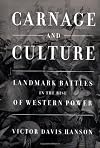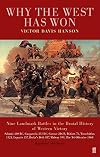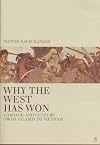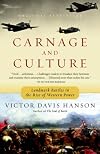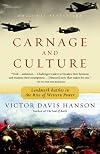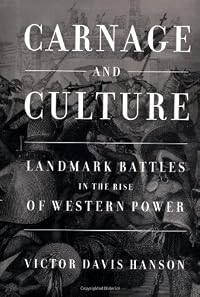
Carnage and Culture: Landmark Battles in the Rise to Western Power
by Victor Davis Hanson
On This Page
Description
Examining nine landmark battles from ancient to modern times-from Salamis, where outnumbered Greeks devastated the slave army of Xerxes, to Cortes's conquest of Mexico to the Tet offensive-Victor Davis Hanson explains why the armies of the West have been the most lethal and effective of any fighting forces in the world. Looking beyond popular explanations such as geography or superior technology, Hanson argues that it is in fact Western culture and values-the tradition of dissent, the value show more placed on inventiveness and adaptation, the concept of citizenship-which have consistently produced superior arms and soldiers. Offering riveting battle narratives and a balanced perspective that avoids simple triumphalism, Carnage and Culture demonstrates how armies cannot be separated from the cultures that produce them and explains why an army produced by a free culture will always have the advantage. show lessTags
Recommendations





































Member Reviews
Hanson's domain is Greek warfare. Whenever he strays from it, be it modern politics or, in this case, general military history, his bias limits the quality of his research. He certainly can write and his books are pleasant reads. But his methodology (and thus his results) are deeply flawed. Such "analysis" by Hanson's political friends has resulted in enough carnage in East and West. Readers beware.
Historians have identified ocean-going ships and guns as the inventions that catapulted the West to dominance. This parsimony does not suit Hanson who likes to see (and finds) a cultural dominance. His catalogue of Western assets (paradigms of freedom, decisive shock battle, civic militarism, technology, capitalism, individualism, civilian show more audit and open dissent) and his nine data points (spanning more than 2.000 years) only show his bias. Since when can one speak of Greek and Roman capitalists? How did the galley slaves at Lepanto express their freedom of speech?
For each and every example he lists, there exists a counter example -- both for supposed Westerness and his cases. His beloved Greeks were subjugated by Macedon barbarians. The Late Roman Westerners were crushed by Eastern hordes. Byzantium succumbed to the very civilized Ottoman Empire. The Japanese defeated the Russians in 1905. The Vietnamese whipped the French and the USA. When his thesis does not hold, Hanson retreats to the formulation that defeat only happened at the fringes of Western empires. What about the barbarians in Rome? The muslims in Spain? The Ottomans in Hungary? They don't suit Hanson's cultural supremacy idea and thus are not discussed. "Git there fastest with the mostest" and "firepower wins" remain better explanations. Read it for intellectual amusement. show less
Historians have identified ocean-going ships and guns as the inventions that catapulted the West to dominance. This parsimony does not suit Hanson who likes to see (and finds) a cultural dominance. His catalogue of Western assets (paradigms of freedom, decisive shock battle, civic militarism, technology, capitalism, individualism, civilian show more audit and open dissent) and his nine data points (spanning more than 2.000 years) only show his bias. Since when can one speak of Greek and Roman capitalists? How did the galley slaves at Lepanto express their freedom of speech?
For each and every example he lists, there exists a counter example -- both for supposed Westerness and his cases. His beloved Greeks were subjugated by Macedon barbarians. The Late Roman Westerners were crushed by Eastern hordes. Byzantium succumbed to the very civilized Ottoman Empire. The Japanese defeated the Russians in 1905. The Vietnamese whipped the French and the USA. When his thesis does not hold, Hanson retreats to the formulation that defeat only happened at the fringes of Western empires. What about the barbarians in Rome? The muslims in Spain? The Ottomans in Hungary? They don't suit Hanson's cultural supremacy idea and thus are not discussed. "Git there fastest with the mostest" and "firepower wins" remain better explanations. Read it for intellectual amusement. show less
A great history of the Western way of war. A riposte to works like Jared Diamond's Guns, Germs, and Steel and an extension of books like David Landes's The Wealth and Poverty of Nations, et cetera. Hanson believes that there is more than just geographical determinism that made the West "win." (The British title of the book is Why the West Was Won: Carnage and Culture from Salamis to Vietnam; the American title is Carnage and Culture: Landmark Battles in the Rise of Western Power.) Each chapter could be pulled from the book and assigned, as Hanson is quite repetitive in places with his thesis. But, this all serves to reinforce it. Basically, the West, since the Greeks, have had some sort of consensual government, a tradition of show more self-critique, secular rationalism, religious tolerance, individual freedom, free expression, free markets, and individualism. This coupled with wars of annihilation instead of "flower wars" or the like have contributed to Western dominance. Published right before the attacks of 9/11, it was a much ballyhooed (and poopooed) book in the 20-oughts. A classic text of military history that must be dealt with, whether you agree or disagree. show less
Hanson notes that historically, in general, Western militaries have consistently decisively defeated Eastern militaries. While Western militaries may loose an occasional battle (like Roarke's Drift or Pearl Harbor) against an Eastern foe, they virtually never go on to lose the war except by voluntary withdrawl, and almost always inflict grossly disproportionate casualties regardless of the situation. About the only time Western militaries stand a risk of being decisively defeated with large numbers of casualties, it's when they're fighting another Western military (witness World Wars One and Two).
In fact, Hanson argues that the idea of decisive battle, the fight-to-the-death, winner-take-all idea of combat, is an invention of the show more Greeks, the original "Westerners", and that cultures that have failed to adopt this idea, as well as other ideas like free scientific inquiry (which leads to more powerful weapons and technology) and political freedom (which leads to better motivated and more flexible soldiers), have ended up losing in the long run against cultures that have adopted these ideas wholeheartedly. He brings up examples from history that are hard to ignore, where Western militaries have, through personal discipline and initiative, superior technology, and a total-war philosophy, inflicted unsustainable casualties against their enemies, totally out of proportion to the number of soldiers involved on each side. He then shows how and why those cultural traits evolved, and why they have been so successful.
In my opinion, this makes an excellent companion book to Jared Diamond's Guns, Germs, and Steel. While Guns, Germs, and Steel shows why some groups of humans ended up with signifigant advantages through accidents of biogeography, Carnage and Culture shows how such accidents have specifically affected various cultures and had long-lasting impacts on the modern world. show less
In fact, Hanson argues that the idea of decisive battle, the fight-to-the-death, winner-take-all idea of combat, is an invention of the show more Greeks, the original "Westerners", and that cultures that have failed to adopt this idea, as well as other ideas like free scientific inquiry (which leads to more powerful weapons and technology) and political freedom (which leads to better motivated and more flexible soldiers), have ended up losing in the long run against cultures that have adopted these ideas wholeheartedly. He brings up examples from history that are hard to ignore, where Western militaries have, through personal discipline and initiative, superior technology, and a total-war philosophy, inflicted unsustainable casualties against their enemies, totally out of proportion to the number of soldiers involved on each side. He then shows how and why those cultural traits evolved, and why they have been so successful.
In my opinion, this makes an excellent companion book to Jared Diamond's Guns, Germs, and Steel. While Guns, Germs, and Steel shows why some groups of humans ended up with signifigant advantages through accidents of biogeography, Carnage and Culture shows how such accidents have specifically affected various cultures and had long-lasting impacts on the modern world. show less
Examining nine landmark battles from ancient to modern times--from Salamis, where outnumbered Greeks devastated the slave army of Xerxes, to Cortes’s conquest of Mexico to the Tet offensive--Victor Davis Hanson explains why the armies of the West have been the most lethal and effective of any fighting forces in the world.
Looking beyond popular explanations such as geography or superior technology, Hanson argues that it is in fact Western culture and values–the tradition of dissent, the value placed on inventiveness and adaptation, the concept of citizenship–which have consistently produced superior arms and soldiers. Offering riveting battle narratives and a balanced perspective that avoids simple triumphalism, Carnage and Culture show more demonstrates how armies cannot be separated from the cultures that produce them and explains why an army produced by a free culture will always have the advantage. -Good Reads.
A brilliant history of the rise to global dominance by the West, exploring the links between cultural values and military success.
Instead of weighing up the West through its cultural and literary accomplishments, Hanson engages with the much starker record of the battlefield. In place of The Great Books, he studies The Great Battles. With graphic representations of nine major clashes between West and non-West, Hanson argues that the West has won not just because of technology and military might, but because of its focus on individualism, democratic political structures and scientific rationalism. However, this is no mere Eurocentric account of the steady millennia-long rise of Western power. Rather, it is an explanation of why the West finds itself now militarily unmatched, its values spreading around the globe - sometimes with devastating effects on local cultures.- Google Books show less
Looking beyond popular explanations such as geography or superior technology, Hanson argues that it is in fact Western culture and values–the tradition of dissent, the value placed on inventiveness and adaptation, the concept of citizenship–which have consistently produced superior arms and soldiers. Offering riveting battle narratives and a balanced perspective that avoids simple triumphalism, Carnage and Culture show more demonstrates how armies cannot be separated from the cultures that produce them and explains why an army produced by a free culture will always have the advantage. -Good Reads.
A brilliant history of the rise to global dominance by the West, exploring the links between cultural values and military success.
Instead of weighing up the West through its cultural and literary accomplishments, Hanson engages with the much starker record of the battlefield. In place of The Great Books, he studies The Great Battles. With graphic representations of nine major clashes between West and non-West, Hanson argues that the West has won not just because of technology and military might, but because of its focus on individualism, democratic political structures and scientific rationalism. However, this is no mere Eurocentric account of the steady millennia-long rise of Western power. Rather, it is an explanation of why the West finds itself now militarily unmatched, its values spreading around the globe - sometimes with devastating effects on local cultures.- Google Books show less
Fascinating tour of history with details of some epic conflicts from B.C. to the '70's; presents some VERY interesting observations on democracy and freedoms (of choice, the press, etc.).
Hanson argues that liberal, free societies in the Western tradition have had a powerful military advantage over their autocratic opponents since the days of the ancient Greeks. I think that he's basically right but I'm bothered by the Soviets in WWII - but I suppose that although they were under a dictatorship you could still say that they remained in the Western tradition.
3852. Carnage and Culture: Landmark Battles in the Rise of Western Power, by Victor Davis Hanson (read 29 Jan 2004) I read this because John Keegan in his so interesting 3-hour interview on C-SPAN in December said good things about the author. Hanson examines 9 battles between "Western" and non-Western forces, ranging from Salamis on Sept 28, 480 B.C. through Alexander's victory at Gaugamela (known to Creasy as Arbela) on Oct. 1, 331 B.C., thru Cannae on Aug. 2, 216 B.C., Poitiers on Oct 11, 732, Cortez's victory in Mexico (1520-1521), Lepanto (Oct 7, 1571, Rorke's Drift (Jan 22-23, 1879), Midway (June 4-8, 1942), and Tet in Vietnam in Jan-Feb 1968. Much of what he says makes sense but I did not find his pontificating ad infinitum to be show more very interesting at times, and while I will read more John Keegan I have no present intention to read any more by Victor Davis Hanson even though he has the three names necessary for a serious historian. show less
Members
- Recently Added By
Lists

Best Military History Books
123 works; 21 members
Author Information

44+ Works 7,774 Members
Victor Davis Hanson is the military historian who is a professor of classics at California State University, Fresno. He has written several popular books on classic warfare, including "The Other Greeks", "Who Killed Homer?", & "The Western Way of War". He lives in Selma, California. (Bowker Author Biography)
Classifications
Statistics
- Members
- 805
- Popularity
- 34,218
- Reviews
- 13
- Rating
- (3.94)
- Languages
- 5 — English, French, Italian, Portuguese (Portugal), Spanish
- Media
- Paper, Audiobook, Ebook
- ISBNs
- 13
- ASINs
- 3