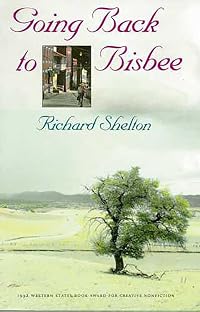
Going Back to Bisbee
by Richard Shelton
On This Page
Description
Reminiscences of a teacher and poet about his years in Southern Arizona, interwoven with descriptions of the area, its history, its people, and its climate.Tags
Recommendations














Member Reviews
Mr. Shelton's lovely non-fiction book never travels in a straight line, and the reader isn't going to get back to Bisbee any time soon. He rambles, digresses, and describes, explains and reflects, and throws in his own personal philosphy for good measure. And he anthropomorphizes. Boy, does he anthropomorphize, and not just animals but also his old van, buildings, plants, about anything that crosses his path. Since I tend to do that myself, I don't have a problem with it. And he encounters ghosts. I don't have a problem with that, either.
The author's love and respect for the southern Arizona desert makes this book a gem. I learned a bit of history of the area, about a early fort where the Buffalo Soldiers were sent, the Apaches who made show more the area so unsafe for settlers and miners, the booms and busts of mining in the area, and the resilience of the people who lived in and around Bisbee. I learned a great deal about this desert, and the things, sentient and otherwise, that populate it. And all in a wonderful, lyrical prose. I learned about the author and his tolerant wife, but this was not so much a memoir as it was a journey. The author apparently did not have an ideal childhood, but he did not delve into that part of his life, only alluded to it.
The author has respect for all the natural creatures of the desert, and his writing about our horrid treatment of coyotes, past and present, is especially poignant:
“I do not understand how the person who truly loves a dog, loves it enough sometimes to risk his or her life for it, can exterminate coyotes, the dog's cousin, in hideous and sadistic ways.”
“We love and cherish our dogs because they respond with loyalty and affection, and because they obey us. But the coyote, so much like the dog in appearance and even behavior, has refused to accept us as masters, has spurned us, and we can never forgive it.”
His stories of some of the children he taught can break a heart of stone. Mr. Shelton seems to be an idealist and a dreamer but also very down to earth, and the combination made this book highly readable for those of us who don't mind taking the long way 'round. show less
The author's love and respect for the southern Arizona desert makes this book a gem. I learned a bit of history of the area, about a early fort where the Buffalo Soldiers were sent, the Apaches who made show more the area so unsafe for settlers and miners, the booms and busts of mining in the area, and the resilience of the people who lived in and around Bisbee. I learned a great deal about this desert, and the things, sentient and otherwise, that populate it. And all in a wonderful, lyrical prose. I learned about the author and his tolerant wife, but this was not so much a memoir as it was a journey. The author apparently did not have an ideal childhood, but he did not delve into that part of his life, only alluded to it.
The author has respect for all the natural creatures of the desert, and his writing about our horrid treatment of coyotes, past and present, is especially poignant:
“I do not understand how the person who truly loves a dog, loves it enough sometimes to risk his or her life for it, can exterminate coyotes, the dog's cousin, in hideous and sadistic ways.”
“We love and cherish our dogs because they respond with loyalty and affection, and because they obey us. But the coyote, so much like the dog in appearance and even behavior, has refused to accept us as masters, has spurned us, and we can never forgive it.”
His stories of some of the children he taught can break a heart of stone. Mr. Shelton seems to be an idealist and a dreamer but also very down to earth, and the combination made this book highly readable for those of us who don't mind taking the long way 'round. show less
A powerful evocation of the Sonoran desert in Southern Arizona. The reader can almost smell the creosote in the desert rain as Shelton describes a nostalgic return to Bisbee with many intriguing side stories about nature, history and humor.
A story not just about Shelton going back to Bisbee but he reminisces about various things on his trip back.The reason why he is going back to Bisbee is not nearly as interesting as the stories he tells about the ghost towns, flora and fauna, storms and Bisbee history.
A wonderful book that fully exhibits a “sense of place.”. Shelton chronicles a day’s journey from Tucson to Bisbee – but packs in stories and facts from many such trips. This book won a Western Book Award for Creative Non-Fiction. Each chapter can stand alone but I read it straight through. Certainly makes me want to retrace his steps to see the wonderful places he talked about. He describes everything from the social life of coyotes to ghost towns to the history of mining in the west, but does it all in a descriptive and interesting style.
A kind of love story about Southern Arizona, by a poet who discovered the area during World War II. A splendid introduction to the area.
Poignant and engaging.
Members
- Recently Added By
Author Information

28+ Works 372 Members
Richard Shelton is a Regents' Professor in the Creative Writing Program at the University of Arizona, Tucson.
Awards and Honors
Awards
Distinctions
Notable Lists
Common Knowledge
- Important places
- Arizona, USA
Classifications
Statistics
- Members
- 182
- Popularity
- 179,977
- Reviews
- 7
- Rating
- (4.23)
- Languages
- English
- Media
- Paper, Ebook
- ISBNs
- 4
- ASINs
- 1