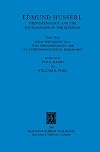
Ideas III: Phenomenology and the Foundation of the Sciences
by Edmund Husserl
Ideas Pertaining to a Pure Phenomenology and to a Phenomenological Philosophy (Book 3)
48 Members (3.00)
On This Page
Description
There is no author's introduction to Phenomenology and the Foundations of the Sciences,! either as published here in the first English translation or in the standard German edition, because its proper introduction is its companion volume: General Introduction to Pure Phenomenology. 2 The latter is the first book of Edmund Husserl's larger work: Ideas Toward a Pure Phenomenology and Phenomenological Philosophy, and is commonly referred to as Ideas I (or Ideen 1). The former is commonly called show more Ideen III. Between these two parts of the whole stands a third: Phenomeno 3 logical Investigations of Constitution, generally known as Ideen II. In this introduction the Roman numeral designations will be used, as well as the abbreviation PFS for the translation at hand. In many translation projects there is an initial problem of establish ing the text to be translated. That problem confronts translators of the books of Husserl's Ideas in different ways. The Ideas was written in 1912, during Husserl's years in Gottingen (1901-1916). Books I and II were extensively revised over nearly two decades and the changes were incorporated by the editors into the texts of the Husserliana editions of 1950 and 1952 respectively. Manuscripts of the various reworkings of the texts are preserved in the Husserl Archives, but for those unable to work there the only one directly available for Ideen II is the reconstructed one. show lessTags
Recommendations























Member Reviews
Members
- Recently Added By
Author Information

168+ Works 4,330 Members
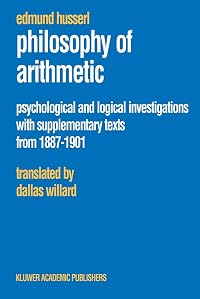
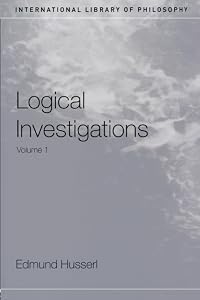
Born to Jewish parents in what is now the Czech Republic, Edmund Husserl began as a mathematician, studying with Karl Theodor Weierstrass and receiving a doctorate in 1881. He went on to study philosophy and psychology with Franz Brentano and taught at Halle (1887--1901), Gottingen (1901--16), and Freiburg (1916--29). Because of his Jewish show more background, he was subject to persecution by the Nazis, and after his death his unpublished manuscripts had to be smuggled to Louvain, Belgium, to prevent their being destroyed. Husserl is the founder of the philosophical school known as phenomenology. The history of Husserl's philosophical development is that of an endless philosophical search for a foundational method that could serve as a rational ground for all the sciences. His first major book, Philosophy of Arithmetic (1891), was criticized by Gottlob Frege for its psychologism, which changed the whole direction of Husserl's thinking. The culmination of his next period was the Logical Investigations (1901). His views took an idealistic turn in the Ideas Toward a Pure Phenomenology (1911). Husserl wrote little from then until the late 1920s, when he developed his idealism in a new direction in Formal and Transcendental Logic (1929) and Cartesian Meditations (1932). His thought took yet another turn in his late lectures published as Crisis of the European Sciences (1936), which emphasize the knowing I's rootedness in "life world." Husserl's influence in the twentieth century has been great, not only through his own writings, but also through his many distinguished students, who included Martin Heidegger, Maurice Merleau-Ponty, Jean-Paul Sartre, Eugen Fink, Emmanuel Levinas, and Roman Ingarden. (Bowker Author Biography) show less
Series

Belongs to Publisher Series
Edmund Husserl Collected Works (Vol. 1)
Common Knowledge
- Canonical title
- Ideas III: Phenomenology and the Foundation of the Sciences
- Original title
- Die Phänomenologie und die Fundamente der Wissenschaften
- Original publication date
- 1952
- Original language
- German
Classifications
- Genres
- Philosophy, Nonfiction, Science & Nature, General Nonfiction
- DDC/MDS
- 142.7 — Philosophy & psychology Philosophical schools of thought Critical philosophy Existentialism And Phenomenology
- LCC
- B3279 .H93 .I3313 — Philosophy, Psychology and Religion Philosophy (General) By period Modern By region or country
- BISAC
Statistics
- Members
- 48
- Popularity
- 627,124
- Rating
- (3.00)
- Languages
- 5 — Dutch, English, German, Italian, Spanish
- Media
- Paper, Ebook
- ISBNs
- 7
- ASINs
- 1