On This Page
Description
Naturalist Gerald Durrell recalls his expedition to South America to find exotic animals in this follow-up to A Zoo in My Luggage. After bringing multiple species of African animals back to the Channel Island of Jersey to populate their new zoo, British naturalist Gerald Durrell and his wife followed their passion for wildlife preservation on a journey to South America. With a team of helpers, they spent eight months on safari searching for exotic specimens. Through windswept Patagonian show more shores and tropical forests in the Argentine, from ocelots to penguins, fur seals to parrots to pumas, the author who inspired the public television drama The Durrells in Corfu captures the landscape and its inhabitants with his signature charm and humor. Filled with adventure, exploration, and the spirit of conservation, The Whispering Land is a memoir that animal lovers of all ages will enjoy. This ebook features an illustrated biography of Gerald Durrell including rare photos from the author's estate. Biography & Autobiography. Nonfiction. Nature. show lessTags
Recommendations























Member Reviews
"The Whispering Land" is the first of Gerald Durrell's books that I've ever read, and it may be the last. The guy reminds me of one of those extraordinary Englishmen you used to see every once in a while on public television, narrating some documentary or other. Typically, these individuals' extremely refined and extremely British accents and manners contrasted delightfully with their boundless enthusiasm and adventuresome spirit: they gentlemen of the old school gone back to nature, with a vengeance. While Durrell's affection for natural world is obvious and he writes fluidly, if a little formally, I didn't find too much else to like about him. In "The Whispering Land," he treats South America more or less as an animal supermarket, show more which doesn't sit so well in an age where most people think that we should, if possible, leave wild animals where we found them. His relationship with many of the Argentines he meets on his journeys is also kind of problematic: while he introduces us to a couple of fascinating characters -- including a former Hungarian nobleman and a dedicated amateur naturalist -- he's also rather unkind in his descriptions of the locals he meets only in passing. How much of a jerk do you have to be to make light of a non-native speaker's difficulties in English, Gerry? He's also something of an obvious bon vivant: there's a lot in here about beautiful women, delicious asados and gin and tonics, and readers' mileage there may vary: the author sometimes comes off as precisely the kind of oblivious, high-handed Englishman he purports to loathe. Durrell's descriptions of Argentina's landscape and of the animals he meets are occasionally quite good, and "The Whispering Land" reads easily, but he's also got a bad habit of personifying the animals he sees, which takes a lot of the "natural" out of the natural world, so to speak. I read this one mostly for local interest, since I live in Buenos Aires, and the book does provide a portrait, of sorts, of an Argentina that vanished as the country modernized. Durrell's work and institutional legacy are pretty much beyond criticism, so it doesn't much matter that I didn't like "The Whispering Land." And is genuinely touching to hear how he nursed a mistreated ocelot and a sick peccary back to health. But I imagine that there are better books on Argentine wildlife out there than this one show less
I dimly recalled quite liking 'My Family and Other Animals', but perhaps I was put off by how popular and celebrated the book had become over the years. This was an accidental read, in a way; it was part of my school's forgotten student library, and the pages were practically falling out by the time I began with it. But a few days later I was finished and felt so exhilarated by Durrell's prose - here he describes an adventure in Patagonia - that I immediately ordered another five of his books online.
An interesting read of something written 60 years ago. There is absolutely no qualms about keeping a zoo. I suppose it was "political correct" in 1961. What I found interesting was that Durrell was collecting single animals, either a male or female, which meant he was adding to their possible extinction.
Amazingly tender descriptions of the landscapes, animals and people of Argentina.
Durrell describes his travels to remote areas of Patagonia, where he tracks down local wildlife, mostly those being kept as pets in people's homes, to buy for his collection. He gathered monkeys, coatimundis, peccaries, some odd South American rodents, parrots, macaws, diminutive owls and numerous other birds. The rescue of a starving, abused ocelot and purchase of a gorgeous young puma rounded out his collection. I loved reading the detailed descriptions of wildilfe he observed- guanacos, rheas and armadillos in the forested areas, colonies of nesting penguins, fur seals and elephant seals on the beaches. There's a really funny passage about some foxes playing with a roll of pink toilet paper in one of their camps. Durrell's writing show more style isn't terribly eloquent, but the descriptions of the local culture, different people he encountered and the animals themselves make this a good read.
The Dog Ear Diary show less
The Dog Ear Diary show less
In Book 2 of The Zoo Memoir Trilogy, originally published in 1961, it appears that Gerald Durrell wanted to follow the path of Charles Darwin as recorded in "The Voyage of H.M.S. Beagle". Before getting to their first main destination, Patagonia, along the coastline of Southern Argentina in South America, he made a point to stop and stay over at a small town called Carmen de Patagones, one where Darwin had stayed and written about while on his adventure. Once reaching Patagonia, he, his wife Jacquie, and his secretary Sophie, stayed in Calilegua with a couple he had met. They actually let him store his collection in their garage, and even helped take care of the animals at times while he went on his own excursions in search of rare show more creatures.
Once again, his observations of the penguins and fur seals in the wild are very interesting and quite humorous. It is as if you were actually watching National Geographic with a commentary. But, unfortunately, this was the most interesting thing about his journey to Argentina.
In Part 2, he continues his travel down to Jujuy looking to collect more animals and birds for his zoo back on the Channel Isle in Jersey. His wife, Jacquie, had to be sent back home and didn't make this part of the adventure because upon first arriving in Patagonia, they were involved in an automobile accident which left her with severe migraines.
The focus in this book seemed to be more on the people he met and his travelling adventures getting from one place to another. Still quite an adventure, but just not quite as interesting. His strong suit in writing seems to be in his descriptions of animal behavior.
He was able to collect about 150 rare birds and animals to ship back to his zoo. You might want to have your phone nearby so you can Google images of the wild animals he crosses paths with and mentions, such as the variety of parrots, guans, seriemas, coatimundis, puma, agouti, his favorite...a very young peccary he named Juanita (common species of wild pig), tree frogs and a baby coral snake, pigmy owl, a pair of douroucoulis from the monkey tribe, etc...
Now on to Book 3: Menagerie Manor... show less
Once again, his observations of the penguins and fur seals in the wild are very interesting and quite humorous. It is as if you were actually watching National Geographic with a commentary. But, unfortunately, this was the most interesting thing about his journey to Argentina.
In Part 2, he continues his travel down to Jujuy looking to collect more animals and birds for his zoo back on the Channel Isle in Jersey. His wife, Jacquie, had to be sent back home and didn't make this part of the adventure because upon first arriving in Patagonia, they were involved in an automobile accident which left her with severe migraines.
The focus in this book seemed to be more on the people he met and his travelling adventures getting from one place to another. Still quite an adventure, but just not quite as interesting. His strong suit in writing seems to be in his descriptions of animal behavior.
He was able to collect about 150 rare birds and animals to ship back to his zoo. You might want to have your phone nearby so you can Google images of the wild animals he crosses paths with and mentions, such as the variety of parrots, guans, seriemas, coatimundis, puma, agouti, his favorite...a very young peccary he named Juanita (common species of wild pig), tree frogs and a baby coral snake, pigmy owl, a pair of douroucoulis from the monkey tribe, etc...
Now on to Book 3: Menagerie Manor... show less
An entertaining account of Gerald Durrell's trip to Argentina to collect animals for his zoo. Easy reading.
Members
- Recently Added By
Lists

Global Reads: Books Set South and Central America
40 works; 7 members

Best Travel Writing - Non-Fiction
110 works; 6 members

Books about Animals
86 works; 4 members

Authors from England
147 works; 4 members

Books Read in 2023
5,547 works; 145 members
Author Information

107+ Works 21,780 Members
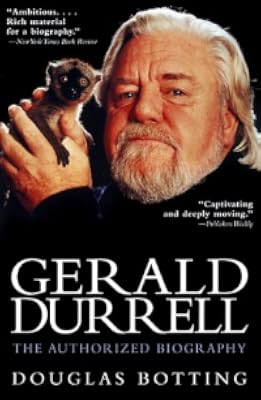
Gerald Durrell was born on January 7, 1925 in Jamshedpur, India to British parents. After the death of his father in 1928, the family lived in England and Europe before settling in Corfu, where he spent much of his childhood. Educated by private tutors, he became interested in natural history and amassed a private collection of dozens of creatures show more from scorpions to owls. He went on numerous wildlife expeditions and founded the Jersey Zoological Park and the Jersey Wildlife Preservation Trust with the purpose of breeding endangered species. His first book, The Overloaded Ark, was published in 1953. He wrote 37 books during his lifetime including My Family and Other Animals, The Bafut Beagles, A Zoo in My Luggage, Rosy Is My Relative, and The Mockery Bird. He received the Order of the British Empire in 1982 and was featured in the United Nations' Roll of Honor for Environmental Achievement in 1988. He died from complications related to a liver transplant on January 30, 1995 at the age of 70. (Bowker Author Biography) show less
Some Editions
Series

Work Relationships
Is contained in
The Bafut Beagles / The Drunken Forest / Encounters with Animals / Menagerie Manor / My Family and Other Animals / Three Singles to Adventure / The Whispering Land / A Zoo in My Luggage by Gerald Durrell
The Drunken Forest / The Whispering Land / Three Singles to Adventure / Menagerie Manor by Джеральд Даррелл
Common Knowledge
- Canonical title*
- Tierra de murmullos
- Original title
- The whispering land
- Original publication date
- 1961
- People/Characters
- Gerald Durrell; Jacquie Durrell
- Important places
- Patagonia, Argentina; Argentina; South America
- Dedication
- This is for
Bebita
who, by leaving Argentia, has deprived me of
my best reason for returning
*Some information comes from Common Knowledge in other languages. Click "Edit" for more information.
Classifications
Statistics
- Members
- 726
- Popularity
- 38,881
- Reviews
- 11
- Rating
- (3.86)
- Languages
- 7 — Czech, English, German, Hungarian, Italian, Japanese, Spanish
- Media
- Paper, Audiobook, Ebook
- ISBNs
- 26
- ASINs
- 31