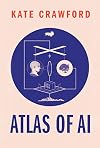
Atlas of AI: Power, Politics, and the Planetary Costs of Artificial Intelligence
by Kate Crawford
On This Page
Description
"What happens when artificial intelligence saturates political life and depletes the planet? How is AI shaping our understanding of ourselves and our societies? Drawing on more than a decade of research, award-winning scholar Kate Crawford reveals how AI is a technology of extraction: from the minerals drawn from the earth, to the labor pulled from low-wage information workers, to the data taken from every action and expression. This book reveals how this planetary network is fueling a shift show more toward undemocratic governance and increased inequity. Rather than taking a narrow focus on code and algorithms, Crawford offers us a material and political perspective on what it takes to make AI and how it centralizes power. This is an urgent account of what is at stake as technology companies use artificial intelligence to reshape the world."-- show lessTags
Recommendations


















Member Reviews
Back in the day, when William Gibson was in his prime and "cyberpunk" as sub-genre was still the hot thing, Gibson, when asked whether he considered the world depicted in "Neuromancer" to be a dystopia, thought not. Gibson believed that a true dystopia based on the concepts he was playing with would be an exercise in "corporate feudalism."
Flash forward to the 2020s and, guess what, the new captains of industry like Mark Zuckerburg, Peter Thiel, and Jeff Bezos, seem to be in the process of reducing civil society to nothing but data for their commercial enterprises to exploit. Many of the issues that Crawford is dealing with in regards to AI as the next expression of "Big Data" are not unfamiliar to me; the massive consumption of show more expensive raw materials and energy, the exploited workforce needed to tie these enterprises together, and the running roughshod over personal privacy and intellectual property rights. This is not even getting into the whole issue of dubious product output as a result of lack of self-examination of preconceptions by the proprietors. However, this book does a good job of tying all these issues together for the individual not previously aware that there is a big issue here; it's not the last word on the subject, but it's a start.
The depressing issue is that between the burgeoning Cold War 2.0, and the relative weakness of contemporary anti-trust mechanisms, I'm not hopeful that the wake-up call for the issues here are going to show up in time to stave off the worst outcomes. show less
Flash forward to the 2020s and, guess what, the new captains of industry like Mark Zuckerburg, Peter Thiel, and Jeff Bezos, seem to be in the process of reducing civil society to nothing but data for their commercial enterprises to exploit. Many of the issues that Crawford is dealing with in regards to AI as the next expression of "Big Data" are not unfamiliar to me; the massive consumption of show more expensive raw materials and energy, the exploited workforce needed to tie these enterprises together, and the running roughshod over personal privacy and intellectual property rights. This is not even getting into the whole issue of dubious product output as a result of lack of self-examination of preconceptions by the proprietors. However, this book does a good job of tying all these issues together for the individual not previously aware that there is a big issue here; it's not the last word on the subject, but it's a start.
The depressing issue is that between the burgeoning Cold War 2.0, and the relative weakness of contemporary anti-trust mechanisms, I'm not hopeful that the wake-up call for the issues here are going to show up in time to stave off the worst outcomes. show less
Despite the promise of the subtitle, much of the critique has very little to do with Artificial Intelligence. Crawford starts by decrying the environmental impact of mining rare earth minerals, and includes a site visit to a lithium mine in Nevada to underscore the point. But it turns out that the largest consumer of the mine's produce is batteries for electric vehicles, which has essentially zero connection to AI. And then she uses the example of the first transatlantic cables using up the world's source of natural rubber, which predates AI by almost a century.
She proceeds to excoriate the deplorable labor practices at places like Amazon warehouses and Chinese Foxconn factories where they make the chips for consumer products. Again, show more the link to AI is tenuous at best. And again, she spends most of the time griping about general issues with worker exploitation from industrial era factories to the modern gig economy. The one place where AI would naturally fit in to the discussion is the looming wave of unemployment as more and more jobs are taken over by AI, but this complicated issue barely gets a mention.
Subsequent chapters list a variety of other Bad Things, including a couple of AI applications, but again the issues are all socioeconomic or disagreements with policies, all of which long predate the introduction of AI, and many of them preexist electric lighting, let alone powerful computers. It's as if she conveniently forgot that hiring managers and police forces managed to discriminate and persecute quite effectively for centuries with no advanced technology at all.
She then dilutes the even more by attacking a bunch of other stuff she doesn't like, including space travel, rocket scientists, container ships, billionaires, and 19th century quack science.
So broadly, this is a book about the deplorable business practices of late stage capitalism, and applies equally to call center workers, meat packing plants, automobile factories, gold mines, gig workers, etc. Which is mostly legitimate criticism, but she barely even tries to make most of it relevant to AI, and the strident scolding tone makes it feel like the airing of grievances, enshrouded by woke academese (e.g. phrases that sound like "…thus centering the ontological intersectional microaggressions of the colonializing surveillance capitalism patriarchy").
Finally, for a book with AI in the title, it's use of the moniker is awfully sloppy, inconsistently applied to everything from traditional search engines and data centers, the cloud, machine learning, automation, data processing, traditional machine vision, statistical analytics, and surveillance systems.
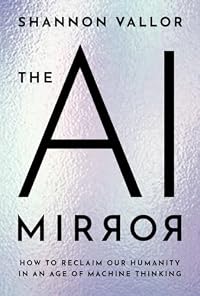
Skip this one and read The AI Mirror: How to Reclaim Our Humanity in an Age of Machine Thinking instead. show less
She proceeds to excoriate the deplorable labor practices at places like Amazon warehouses and Chinese Foxconn factories where they make the chips for consumer products. Again, show more the link to AI is tenuous at best. And again, she spends most of the time griping about general issues with worker exploitation from industrial era factories to the modern gig economy. The one place where AI would naturally fit in to the discussion is the looming wave of unemployment as more and more jobs are taken over by AI, but this complicated issue barely gets a mention.
Subsequent chapters list a variety of other Bad Things, including a couple of AI applications, but again the issues are all socioeconomic or disagreements with policies, all of which long predate the introduction of AI, and many of them preexist electric lighting, let alone powerful computers. It's as if she conveniently forgot that hiring managers and police forces managed to discriminate and persecute quite effectively for centuries with no advanced technology at all.
She then dilutes the even more by attacking a bunch of other stuff she doesn't like, including space travel, rocket scientists, container ships, billionaires, and 19th century quack science.
So broadly, this is a book about the deplorable business practices of late stage capitalism, and applies equally to call center workers, meat packing plants, automobile factories, gold mines, gig workers, etc. Which is mostly legitimate criticism, but she barely even tries to make most of it relevant to AI, and the strident scolding tone makes it feel like the airing of grievances, enshrouded by woke academese (e.g. phrases that sound like "…thus centering the ontological intersectional microaggressions of the colonializing surveillance capitalism patriarchy").
Finally, for a book with AI in the title, it's use of the moniker is awfully sloppy, inconsistently applied to everything from traditional search engines and data centers, the cloud, machine learning, automation, data processing, traditional machine vision, statistical analytics, and surveillance systems.
Skip this one and read The AI Mirror: How to Reclaim Our Humanity in an Age of Machine Thinking instead. show less
In Crawford's grim but justified view, "AI is technical and social practices, institutions and infrastructures, politics and culture." We've allowed it to become a harmful "extractive industry" in more ways than one. It's all part, I'd say, of our being on a very wrong road to the future technologically. The book, in some aspects such as the sixth chapter's account of the appallingly privacy-destroying practices surrounding automatic license-plate reading and facial recognition, would make a worthy companion to Zuboff's _The Age of Surveillance Capitalism_.
Depressing, but fascinating and informative.
How can humankind apply the brakes to avoid the inevitable train wreck ahead? Only those with wealth and power can do it, which is why this is a depressing read.
How can humankind apply the brakes to avoid the inevitable train wreck ahead? Only those with wealth and power can do it, which is why this is a depressing read.
Loved this book, very well researched and engaging. Did get a bit tricky to stay engaged with the data sections but otherwise an absolute gem of a book for people who want to dig deeper into artificial intelligence and its social and economic impacts on our future. The main takeaway for me is the deeper understanding that AI is neither artificial nor intelligent.
Important book looking at the broader contexf of AI work, its dependencies and application. It offers many important critiques to actors from companies to states that are applying the technology without a sense of the potential risks.
The problem with the book is that it offers a critique that is impractical and unrealistic in its high ground standing. The style is typical of the kind of jiurnalistic expose’ that leaves you asking for a rational alternative.
Nevertheless this is a must read for anyone working with AI.
The problem with the book is that it offers a critique that is impractical and unrealistic in its high ground standing. The style is typical of the kind of jiurnalistic expose’ that leaves you asking for a rational alternative.
Nevertheless this is a must read for anyone working with AI.
"More troubling still is that in the field of the study of emotions, there is no consensus among researchers about what an emotion actually is. What emotions are, how they are formulated within us and expressed, what their physiological or neurobiological functions could be, their relation to stimuli, even how to define them – all of this in its entirety remains stubbornly unsettled."
Members
- Recently Added By
Author Information

5+ Works 388 Members
Kate Crawford is a leading scholar of the social implications of AI. She is a research professor at USC Annenberg, a senior principal researcher at Microsoft Research, and the inaugural visiting chair of AI and justice at the cole Normale Suprieure.
Awards and Honors
Classifications
- Genres
- Technology, Nonfiction, General Nonfiction, Science & Nature
- DDC/MDS
- 006.3 — Computer science, information & general works Computer science, knowledge & systems Special computer methods (AI, barcoding, VR, web design, social media) Artificial Intelligence
- LCC
- Q335 .C63 — Science Science (General) Cybernetics
- BISAC
Statistics
- Members
- 362
- Popularity
- 86,505
- Reviews
- 11
- Rating
- (3.95)
- Languages
- English, French, German, Spanish
- Media
- Paper, Audiobook, Ebook
- ISBNs
- 15
- ASINs
- 7