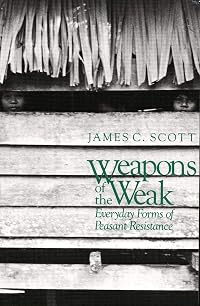
Weapons of the Weak: Everyday Forms of Peasant Resistance
by James C. Scott
On This Page
Description
This sensitive picture of the constant and circumspect struggle waged by peasants materially and ideologically against their oppressors shows that techniques of evasion and resistance may represent the most significant and effective means of class struggle in the long run. "A major contribution to peasant studies, Malaysian studies, and the literature on revolutions and class consciousness."--Benedict R. Anderson, Cornell University "The book is a splendid achievement. Because Scott listens show more closely to the villagers of Malaysia, he enormously expands our understanding of popular ideology and therefore of popular politics. And because he is also a brilliant analyst, he draws upon this concrete experience to develop a new critique of classical theories of ideology."-Frances Fox Piven, Graduate Center of the City University of New York"An impressive work which may well become a classic."-Terence J. Byres, Times Literary Supplement "A highly readable, contextually sensitive, theoretically astute ethnography of a moral system in change.... Weapons of the Weak is a brilliant book, combining a sure feel for the subjective side of struggle with a deft handling of economic and political trends."-John R. Bown, Journal of Peasant Studies"A splendid book, a worthy addition to the classic studies of Malay society and of the peasantry at large.... Combines the readability of Akenfield or Pig Earth with an accessible and illuminating theoretical commentary."-A.F. Robertson, Times Higher Education Supplement"No one who wants to understand peasant society, in or out of Southeast Asia, or theories of change, should fail to read [this book]."-Daniel S. Lev, Journal of Asian Studies"A moving account of the poor's refusal to accept the terms of their subordination.... Disposes of the belief that theoretical sophistication and intelligible prose are somehow at odds."-Ramachandra Guha, Economic and Political Weekly"A seminally important commentary on the state of peasant studies and the global literature.... This enormously rich work in Asian and comparative studies is... an essential contribution to participatory development theory and practice."-Guy Gran, World DevelopmentJames C. Scott is professor of political science at Yale University. show lessTags
Recommendations




Member Reviews
Scott studies a Malaysian village in the late 1970s/early 80s, when the Green Revolution had fully arrived, creating a substantial disruption in the lives of the poor and the (locally) wealthy. While increased crop yields had initially been a boon for everyone, the arrival of the combine harvester made much of poor laborers’ historical work obsolete, which led to the consolidation of land and related changes that increased inequality. They resisted as best they could, using gossip, petty theft, and appeals to Islamic values that had previously been the justification for charity/interdependence with the rich. Scott writes against the idea that peasants have false consciousness; they knew quite well that they were being harmed, but they show more didn’t see much they could do about it. They were also circumspect about admitting to disagreement with people who could hurt them. show less
Weapons of the Weak is a provocatively framed book about peasants survive under systems that would exploit and oppress them, which loses its way in an exhaustively detailed ethnographic case study of a Malaysian village, and a dense mass of Marxist analysis leavened with Gramsci. As Scott argues, peasant rebellions are rare events, but outbreaks of revolt are interspersed with a dense array of survival techniques, most unmarked by histories which are preforce written by elites for other elites. Despite their foundational role in human history, and prominence in the dueling literatures of People’s War/Counter-Insurgency from the 1950s onwards, peasant voices are rarely heard.
Scott’s focuses his study on Sedaka, a rice-farming village show more in Malaysia which in the years just prior to his case study saw the effects of the Green Revolution. Irrigation meant two rice crops a year, a chance for doubled incomes for all, but in practice the now more capital intensive farming strategies benefited rich farmers, who could most benefit from the combine harvester, fertilizer supplied by partisan corrupt rural development agencies, and most key, could manipulate the basic structure of field rents and leaseholding in their favor.
Against this, the poorer quartiles of Sedaka have few weapons. Derision and scorn are most prominent, as they use tradition and Muslim norms of charity to castigate the rich as stingy and greedy. There are moments of solidarity and sabotage, which fail to stop the combine harvester or their decline in real wages. But the sense that I get is one where in all the terms that matter, the rich farmers of Sedaka have won all the benefits from the Green Revolution, and talk about “counter-hegemonies” is so much air.
I admire Scott most as a synthesist, so seeing this careful case study shows another side of his ability. But unless you specifically care about rural Malaysia circa 1980, this is a tedious work that does not generalize well. show less
Scott’s focuses his study on Sedaka, a rice-farming village show more in Malaysia which in the years just prior to his case study saw the effects of the Green Revolution. Irrigation meant two rice crops a year, a chance for doubled incomes for all, but in practice the now more capital intensive farming strategies benefited rich farmers, who could most benefit from the combine harvester, fertilizer supplied by partisan corrupt rural development agencies, and most key, could manipulate the basic structure of field rents and leaseholding in their favor.
Against this, the poorer quartiles of Sedaka have few weapons. Derision and scorn are most prominent, as they use tradition and Muslim norms of charity to castigate the rich as stingy and greedy. There are moments of solidarity and sabotage, which fail to stop the combine harvester or their decline in real wages. But the sense that I get is one where in all the terms that matter, the rich farmers of Sedaka have won all the benefits from the Green Revolution, and talk about “counter-hegemonies” is so much air.
I admire Scott most as a synthesist, so seeing this careful case study shows another side of his ability. But unless you specifically care about rural Malaysia circa 1980, this is a tedious work that does not generalize well. show less
Interesting study of peasant response to state power in Malaysia.
Ratings
Members
- Recently Added By
Lists

Books in the Bibliography of Digital Lethargy by Tung-Hui Hu
151 works; 3 members
Author Information

17+ Works 4,864 Members
James C. Scott is Sterling Professor of Political Science and codirector of the Agrarian Studies Program at Vale University. His previous books include Domination and the Arts of Resistance, Seeing Like a State, and The Art of Not Being Governed.
Classifications
- Genres
- Anthropology, Nonfiction, Politics and Government, General Nonfiction, History
- DDC/MDS
- 322.4 — Society, government, & culture Political science Relation of the state to organized groups and their members Political action groups
- LCC
- HD1537 .M27 .S38 — Social sciences Industries. Land use. Labor Industries. Land use. Labor Agriculture Agricultural classes
- BISAC
Statistics
- Members
- 393
- Popularity
- 79,477
- Reviews
- 3
- Rating
- (4.38)
- Languages
- English
- Media
- Paper, Audiobook, Ebook
- ISBNs
- 5
- ASINs
- 6