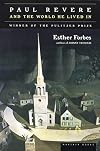
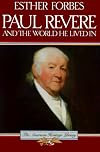
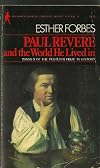
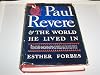
Paul Revere and the World He Lived In
by Esther Forbes
On This Page
Description
Recounts the life and times of Paul Revere of Massachusetts.Tags
Recommendations


















Member Reviews
While ostensibly a biography of Paul Revere, this work is so much more. It avoids the trap of some biographies to fall into a dry recitation of facts, and instead managers to bring the 18th century to life. Author Esther Forbes deftly weaves proven facts about Revere with what is known about life in Boston at that time period. She describes the famous - and even the less-famous - names of the day so that they become real people, not just historical figures. Daily life in Boston is recounted, including what would have been seen in local shops, what Revere's father's shop would have been like, probably relationships between residents, etc. So much more than a history book, this one reads more like a historical novel; bonus points that show more it's all true! show less
Esther Forbes wrote Paul Revere with a good natured, almost folksy tone. I could almost see the twinkle in her eye by her choice of words. Here are some quotes to illustrate my point, "Like so many men of his years and period, Mr. Coney was enjoying his third wife - 'Prudent Mary,' Judge Sewall calls her" (p 8), "Boston had not yet run out of either rum or religion fervor" (p 13), and "Only once did she save labor by twinning" (p 21). I could go on and on.
But, just because Ms. Forbes wasn't didactic in her tone doesn't mean she wasn't informative. Her narrative paints a thoroughly detailed and informative account of Paul Revere's life and times. As an added bonus, the city of Boston also is biographied. One such fun detail is about show more Boston's streets: If the present day street is straight it probably used to be sea bottom. "Wherever the streets are snarled up, you are standing in the ancient town itself" (p 49). show less
But, just because Ms. Forbes wasn't didactic in her tone doesn't mean she wasn't informative. Her narrative paints a thoroughly detailed and informative account of Paul Revere's life and times. As an added bonus, the city of Boston also is biographied. One such fun detail is about show more Boston's streets: If the present day street is straight it probably used to be sea bottom. "Wherever the streets are snarled up, you are standing in the ancient town itself" (p 49). show less
A well-rounded look at a man who most of us just know as the guy who rode a horse at night. I enjoyed learning about his family background, as well as the culture of 18th century Massachusetts. I know it's cheesy, but now when I go to look at his portrait at the Museum of Fine Arts (Boston), I feel like I'm looking at a friend. I always feel that way after reading a good biography. :-)
The writing style of the book took a little bit getting used to since it was very informal. Forbes does a great job explaining the use of mobs leading up the American Revolution and gives a more "people's" perspective. Most of the sources for the book seems to come from newspaper advertisements and personal remembrances of pre-revolution Boston. I learned a few new things about Paul Revere that I did not know in the past, such as Revere usually just modifying his newspaper plates rather than creating them from scratch. The book also has several moments of pure eloquence in explaining complicated principles. I particularly enjoyed the paragraph on page 62 explaining the British Empire after the French and Indian War.
Forbes won the Pulitzer Award for this book and then wrote a story set in Paul Revere's world. That book, Johnny Tremain, won the Newbery Medal, and is one of the finest children's novels ever written. Forbes is an excellent writer. Readers will find her book informative and challenging.
1926. Paul Revere & the World He Lived In, by Esther Forbes (read 9 May 1985) (Pulitzer History prize in 1943) I've wanted to read this book since 1942, when it was a Book of the Month Club selection. It is really well done. Paul Revere lived till 1818, and the book is good genealogically as well as historically.
"Paul Revere and the World He Lived In was published during the height of World War II, and the author’s tone and occasional asides suggest that the book was heavily influenced by the United States’ entrance into the war. There is no question where Forbes’s sympathy lies: Although she will acknowledge that the British were baited and maligned in Boston, and the Tories abused, she is on the side of those Bostonians struggling for liberty and a just society. They will not kneel to tyrant or kaiser or führer, she cheers. In addition, her implied comparisons between the ways in which Boston and Berlin treated those who disagreed with the majority allows her to excuse the vilification of the Tories and British as rather harmless show more excesses.
Her sympathy extends most especially to Revere himself. In Forbes’s hands, he becomes a true Renaissance man. He was first an artist, and Forbes’s intricate descriptions of his silverwork suggest the quality of his craft. He was also a dentist, whose work allowed the identification of Joseph Warren’s body. He was a coppersmith who sheathed the bottom of the Constitution (known as “Old Ironsides”) and the dome of the new statehouse. He was a bell maker whose experiments produced bells still being rung in New England. He was the kind and gentle master who paid his apprentices very well, who took in a single mother, who provided for an insane son-in-law, and who supported the renowned Sarah Bishop.
In all these roles, Revere is portrayed as an individual of courage, of stubbornness, of common sense, of practicality, and of generosity. He tended to the task before him, so that even as the Battle of Lexington was taking place, he was carrying John Hancock’s trunk of state papers. Of all Revere’s jobs, certainly it is his role as a revolutionary that is central to the book. Rarely the initiator of events, Revere is seen as the most prominent agent of the revolutionaries, the one who can speak for much of Boston’s large artisan class. His ride to Lexington is the most dramatic event in Revere’s life that Forbes chronicles, but it is only one ride among many, just as his role as a revolutionary figure is only one role among many.
While much of Paul Revere and the World He Lived In focuses on the exciting and sometimes desperate events that consumed the interests of Boston society, especially those events leading to the revolutionary war and the War of 1812, again and again Forbes returns to the everyday events of Revere’s domestic life. Boston may have been enraged by the Intolerable Acts, and Revere might have been as well, but he was also at work crafting a silver tea service for the Hancocks.".
Paul Revere and the World He Lived In - Ed. Frank Northen Magill. eNotes.com, Inc. 1993 1 Dec, 2019 show less
Her sympathy extends most especially to Revere himself. In Forbes’s hands, he becomes a true Renaissance man. He was first an artist, and Forbes’s intricate descriptions of his silverwork suggest the quality of his craft. He was also a dentist, whose work allowed the identification of Joseph Warren’s body. He was a coppersmith who sheathed the bottom of the Constitution (known as “Old Ironsides”) and the dome of the new statehouse. He was a bell maker whose experiments produced bells still being rung in New England. He was the kind and gentle master who paid his apprentices very well, who took in a single mother, who provided for an insane son-in-law, and who supported the renowned Sarah Bishop.
In all these roles, Revere is portrayed as an individual of courage, of stubbornness, of common sense, of practicality, and of generosity. He tended to the task before him, so that even as the Battle of Lexington was taking place, he was carrying John Hancock’s trunk of state papers. Of all Revere’s jobs, certainly it is his role as a revolutionary that is central to the book. Rarely the initiator of events, Revere is seen as the most prominent agent of the revolutionaries, the one who can speak for much of Boston’s large artisan class. His ride to Lexington is the most dramatic event in Revere’s life that Forbes chronicles, but it is only one ride among many, just as his role as a revolutionary figure is only one role among many.
While much of Paul Revere and the World He Lived In focuses on the exciting and sometimes desperate events that consumed the interests of Boston society, especially those events leading to the revolutionary war and the War of 1812, again and again Forbes returns to the everyday events of Revere’s domestic life. Boston may have been enraged by the Intolerable Acts, and Revere might have been as well, but he was also at work crafting a silver tea service for the Hancocks.".
Paul Revere and the World He Lived In - Ed. Frank Northen Magill. eNotes.com, Inc. 1993 1 Dec, 2019 show less
Members
- Recently Added By
Lists

Favorite Childhood Books
1,646 works; 513 members

A Boston Reading List
120 works; 10 members

Armed Services Editions
150 works; 1 member

End of Your Life Book Club
134 works; 4 members

Newbery Adjacent
747 works; 3 members
Author Information

Forbes was the author of six historical novels and four books of nonfiction for adults, as well as the recipient of the Pulitzer Prize in history in 1942 for her adult biography, Paul Revere and the World He Lived In Paul Revere and the World He Lived In (1942). Yet Forbes's reputation is primarily as a children's writer, resting particularly on show more Johnny Tremain (1942), an offshoot of her research for the adult Paul Revere biography and considered by many the best example of historical fiction ever written for children. Johnny Tremain follows the story of a silversmith's apprentice as he stumbles into the American Revolution and gains insight into his own character. In writing about the life of an ordinary citizen of Boston at that time, Forbes wanted to show, in her words, "not merely what was done but why and how people felt." Originally intending to keep Johnny neutral during the Revolution, she changed her mind as a result of the advent of World War II, because she saw parallels between the two wars and wanted to show young readers those parallels. Although this may have resulted in some pushing of contemporary ideology onto a historical setting, most critics have praised the story's accuracy. It was and remains an important book for promoting the idea that young readers can grasp mature writing. Forbes's only other book for children, America's Paul Revere, summarizes that man's life. (Bowker Author Biography) show less
Awards and Honors
Awards
Distinctions
Common Knowledge
- Original publication date
- 1942
- People/Characters
- Paul Revere; Apollos Rivoire; Dr. Joseph Warren; Samuel Adams; John Adams; John Hancock (show all 7); Benjamin Church
- Important places
- Boston, Massachusetts, USA; Massachusetts, USA; Lexington, Massachusetts, USA; Concord, Massachusetts, USA; Cambridge, Massachusetts, USA; Portsmouth, New Hampshire, USA
- Important events
- American Revolution (1775 | 1783); Battles of Lexington and Concord; Battle of Concord; Battle of Lexington
- First words
- There had been week upon week of the cold grey fury of the North Atlantic, for it was midwinter when the little refugee, Apollos Rivoire, made his crossing.
- Last words
- (Click to show. Warning: May contain spoilers.)But Longfellow, so responsible for the excitement, wrote of that day: 'Bad day for me; neuralgia raging. In the evening my girls drive over to Prospect Hill to see the lighting of Paul Revere's lanterns in the belfry of Old North Church.
Classifications
- Genres
- History, Nonfiction, Biography & Memoir, General Nonfiction
- DDC/MDS
- 974.4 — History & geography History of North America Northeastern United States (New England and Middle Atlantic states) Massachusetts
- LCC
- F69 .R43 .F67 — Local History of the United States, Canada and Latin America United States local history Massachusetts
- BISAC
Statistics
- Members
- 716
- Popularity
- 39,448
- Reviews
- 7
- Rating
- (3.91)
- Languages
- Czech, English
- Media
- Paper
- ISBNs
- 7
- UPCs
- 2
- ASINs
- 31