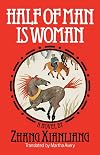
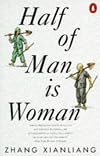
Half of Man Is Woman
by Xianliang Zhang
On This Page
Description
As the Cultural Revolution rages, Zhang falls in love with a peasant woman jailed for promiscuity. After becoming separated for years, they unite, but Zhang has been made impotent, half a man, which eventually destroys their relationship."Tags
Recommendations


















Member Reviews
In 1956 during the Hundred Flowers Movement, the author, Zhang Xianliang, was imprisoned for writing rightist poetry. He was shuttled between prison, labor camps, and state farms for the next twenty years and was only rehabilitated after Mao's death. This novel takes place in the same places he was held, and his protagonist is also named Zhang. This is not, however, a memoir, it's a philosophical novel about the emasculation of the intelligentsia by the waves of repression that swept the country and about the cost of survival in such a regime.
One night in 1966, Zhang is out inspecting the irrigation canals and hoping to bag a duck, when he sees a naked woman bathing in a secluded spot. He is mesmerized. Having been in prison and labor show more camps since he was a youth, he is a virgin and has rarely even seen women in the last decade. Their eyes meet and Zhang feels that he has met the feminine ideal. She is more crude about it. Ten years later they meet again. This time they make a connection and although he has been "hatted" as a counter-revolutionary and rightist, and she has been married and divorced twice, they decide to marry. Unfortunately, Zhang is impotent and their relationship is tested.
This novel was very popular in China when it was published in 1985, but Zhang's writings were later banned during the crackdowns on writers for being "vulgar" . Although the novel is critical of the regime of the time, his protagonist remains a committed Communist and struggles with how best to help his country get back on the right track. I wish there had been a few more footnotes, because some of the allusions to contemporaneous events and personages were difficult to place. Despite the grim circumstances, the novel is funny at times and not a slog to read. The most philosophical passages are exchanges between Zhang and his horse. Although I wouldn't recommend it as the first book to read about the time period, it is an interesting take on the absurdities of life at the time. show less
One night in 1966, Zhang is out inspecting the irrigation canals and hoping to bag a duck, when he sees a naked woman bathing in a secluded spot. He is mesmerized. Having been in prison and labor show more camps since he was a youth, he is a virgin and has rarely even seen women in the last decade. Their eyes meet and Zhang feels that he has met the feminine ideal. She is more crude about it. Ten years later they meet again. This time they make a connection and although he has been "hatted" as a counter-revolutionary and rightist, and she has been married and divorced twice, they decide to marry. Unfortunately, Zhang is impotent and their relationship is tested.
This novel was very popular in China when it was published in 1985, but Zhang's writings were later banned during the crackdowns on writers for being "vulgar" . Although the novel is critical of the regime of the time, his protagonist remains a committed Communist and struggles with how best to help his country get back on the right track. I wish there had been a few more footnotes, because some of the allusions to contemporaneous events and personages were difficult to place. Despite the grim circumstances, the novel is funny at times and not a slog to read. The most philosophical passages are exchanges between Zhang and his horse. Although I wouldn't recommend it as the first book to read about the time period, it is an interesting take on the absurdities of life at the time. show less
This is a semi-autobiographical novel about an intellectual sent to a work camp. At the time it was released in China, the book was considered shocking, since it raised sexual issues (impotence), which it tacitly linked to the emasculation of the intelligensia during the Cultural Revolution. The position of the intelligensia is illustrated by this description:
'At the beginning, the nickname people gave him was 'stupid.' Unfortunately, at that time, the adjective 'stupid' had taken on a complimentary character, and was used as a term of commendation. For example, the person who came daily to clean the Headquarter's toilets--this person was encouraged and praised as being 'stupid.' He had previously been a hydraulic engineer, and had with show more some difficulty overcome the appellation 'intellectual.' Now after much work, he had obtained the glorious status of 'stupid,' and been allowed to enter the Party.
The story is the simple depiction of day-to-day life on the labor farm. Most of the inhabitants feel themselves lucky to be beyond the notice of the excesses of the Cultural Revolution. With few exceptions (the loudspeaker announcing communal meals, the broken-down tractor), the laborers could be living and working in the 19th century. As a former member of the intelligensia, the protagonist feels alone and isolated. He discusses political issues and his personal problems with a talking horse.
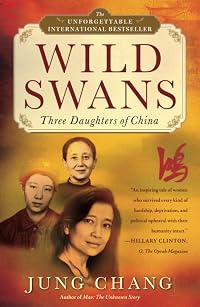
The book is poetically written, and I recommend it. However, I have yet to read any work about China as lyrical and as informative as Wild Swans by Jung Chang. show less
'At the beginning, the nickname people gave him was 'stupid.' Unfortunately, at that time, the adjective 'stupid' had taken on a complimentary character, and was used as a term of commendation. For example, the person who came daily to clean the Headquarter's toilets--this person was encouraged and praised as being 'stupid.' He had previously been a hydraulic engineer, and had with show more some difficulty overcome the appellation 'intellectual.' Now after much work, he had obtained the glorious status of 'stupid,' and been allowed to enter the Party.
The story is the simple depiction of day-to-day life on the labor farm. Most of the inhabitants feel themselves lucky to be beyond the notice of the excesses of the Cultural Revolution. With few exceptions (the loudspeaker announcing communal meals, the broken-down tractor), the laborers could be living and working in the 19th century. As a former member of the intelligensia, the protagonist feels alone and isolated. He discusses political issues and his personal problems with a talking horse.
The book is poetically written, and I recommend it. However, I have yet to read any work about China as lyrical and as informative as Wild Swans by Jung Chang. show less
A Thoughtful Look at Life in Prison Labor Camp
Zhang Xianliang's semi-autobiographical "Half of Man Is Woman" is a sentimental, pensive look at Zhang's journey through labor camps during the Cultural Revolution.
The bulk of the story occurs between Lin Biao's death and the fall of the Gang of Four, a time when change was hopeful but uncertain. That shows in the writing, which is well-translated by Martha Avery.
Starting in 1957, the author spent 22 years moving through prisons and labor camps. He has every reason to write bitterly and aggressively about the political situation in China, but he does not. Instead, this book is introspective and pensive, giving wonderful environmental and geographic clues about his life on the labor farm. show more
It has been difficult for me to find books about life in China from the end of the Cultural Revolution through the '90s, so this book filled a good hole.
Unfortunately, because he spent 22 years locked away, we have been deprived of a writer who was, literary, prohibited from writing. show less
Zhang Xianliang's semi-autobiographical "Half of Man Is Woman" is a sentimental, pensive look at Zhang's journey through labor camps during the Cultural Revolution.
The bulk of the story occurs between Lin Biao's death and the fall of the Gang of Four, a time when change was hopeful but uncertain. That shows in the writing, which is well-translated by Martha Avery.
Starting in 1957, the author spent 22 years moving through prisons and labor camps. He has every reason to write bitterly and aggressively about the political situation in China, but he does not. Instead, this book is introspective and pensive, giving wonderful environmental and geographic clues about his life on the labor farm. show more
It has been difficult for me to find books about life in China from the end of the Cultural Revolution through the '90s, so this book filled a good hole.
Unfortunately, because he spent 22 years locked away, we have been deprived of a writer who was, literary, prohibited from writing. show less
Zhang, a worker on a collective farm, lusts for a woman he has spied on, meets her, marries her, suffers erectile dysfunction, becomes a hero for plugging a dyke, is miraculously cured of EDF, becomes mentally ill with a bizarre martyrdom complex, ceases to love his wife, divorces her, convinces a higher up friend to sign carte blanche documentation, and wanders away to fulfill his desire to rebel against the state. This book is a mishmash of maudlin sentimentality.
I missed a large part of this story by not understanding the various movements and revolutions and counter-revolution. Yes, this is a love story, but it is in the context of Chinese "movements" and, at times, is overpowered by them.
Very illuminating semi-autobiographical tale of the authors experience throughout revolutionary China.
Members
- Recently Added By
Lists

CHINESE FICTION (in translation)
33 works; 1 member

Writers at Risk
106 works; 17 members
Author Information

Some Editions
Awards and Honors
Common Knowledge
- Canonical title
- Half of Man Is Woman
- Original title
- 男人的一半是女人
- Original publication date
- 1985
- People/Characters
- Zhang Yonglin; Huang Xiangjiu
- Important places*
- China
- Dedication*
- Aan mijn dierbare Nederlandse lezers
Het leven is zwaar. Zolang wij mensen het nog niet geheel doorzien hebben, is er nog veel over te zeggen.
Zhang Xianliang
Brussel, 8 maart 1988 - First words
- I may have seen her before and never noticed.
- Last words
- (Click to show. Warning: May contain spoilers.)How large, how round the moon!
- Original language*
- Chinees
*Some information comes from Common Knowledge in other languages. Click "Edit" for more information.
Classifications
- Genres
- General Fiction, Fiction and Literature
- DDC/MDS
- 895.1 — Literature & rhetoric Literatures of other languages Literatures of East and Southeast Asia Chinese
- LCC
- PL2837 .H762 .N313 — Language and Literature Languages and literatures of Eastern Asia, Africa, Oceania Languages of Eastern Asia, Africa, Oceania Chinese language and literature Chinese literature Individual authors and works
- BISAC
Statistics
- Members
- 206
- Popularity
- 158,782
- Reviews
- 7
- Rating
- (3.23)
- Languages
- 8 — Danish, Dutch, English, French, German, Italian, Norwegian (Bokmål), Spanish
- Media
- Paper, Ebook
- ISBNs
- 16
- ASINs
- 2