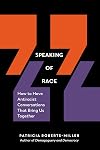
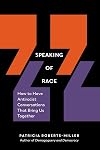
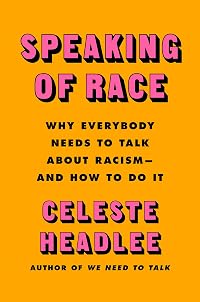
Speaking of Race: Constructive Conversations About an Explosive Topic
by Patricia Roberts-Miller
On This Page
Description
Language Arts. Politics. Sociology. Nonfiction. HTML:It’s easy to say that racism is wrong. But it’s surprisingly hard to agree on what it is. Does a tired stereotype in your favorite movie make it racist? Does watching it anyway mean you’re racist? Even among like-minded friends, such discussions can quickly escalate to hurt feelings all around—and when they do, we lose valuable opportunities to fight racism.Patricia Roberts-Miller is a scholar of rhetoric—the art of show more understanding misunderstandings. In Speaking of Race, she explains why the subject is a “third rail” and how we can do better: We can acknowledge that, in a racist society, racism is not the sole provenance of “bad people.” We can focus on the harm it causes rather than the intent of offenders. And, when someone illuminates our own racist blind spots, we can take it not as a criticism, but as a kindness—and an opportunity to learn and to become less racist ourselves. show less
Tags
Recommendations


















Member Reviews
Speaking of Race: How to Have Antiracist Conversations That Bring Us Together by Patricia Roberts-Miller is a very accessible look at how we can work toward making the world a better place.
I found the strength of this book is less the information itself, though it is very useful, and more the accessibility. There is little jargon and what there is is explained in clear terms. This truly is a book for anyone interested in having the difficult conversations with others.
I have a bit of an issue with labeling everything racist. The term carries so much negative weight that to label stating facts without knowing that those facts carry some unease for others as racist is counterproductive. I am thinking in particular of the central event in show more chapter three of the book. No doubt she should have clarified that making her statements of fact in no way made the comparison that would spark unease, but she was unaware of the conflict. When made aware, she qualified her statements the next day in class. I don't think of her comments as racist but ignorantly insensitive, as did, it seems, her student. Going around to every person and labeling every ignorant comment, even when readily acknowledged and owned when pointed out, as racist seems counterproductive to making change. We are all, whether we realize it or not, racist to some extent. It is whether we are willing to acknowledge it when pointed out and make changes to how we speak or what we do that makes the difference.
This is essential reading for anyone wanting to have these discussions. If you haven't read many of the other antiracist books available, there will be quite a bit of new information here for you. If you have read those books, you will hopefully learn additional ways to approach the subject, both internally and interactively.
Reviewed from a copy made available by the publisher via NetGalley. show less
I found the strength of this book is less the information itself, though it is very useful, and more the accessibility. There is little jargon and what there is is explained in clear terms. This truly is a book for anyone interested in having the difficult conversations with others.
I have a bit of an issue with labeling everything racist. The term carries so much negative weight that to label stating facts without knowing that those facts carry some unease for others as racist is counterproductive. I am thinking in particular of the central event in show more chapter three of the book. No doubt she should have clarified that making her statements of fact in no way made the comparison that would spark unease, but she was unaware of the conflict. When made aware, she qualified her statements the next day in class. I don't think of her comments as racist but ignorantly insensitive, as did, it seems, her student. Going around to every person and labeling every ignorant comment, even when readily acknowledged and owned when pointed out, as racist seems counterproductive to making change. We are all, whether we realize it or not, racist to some extent. It is whether we are willing to acknowledge it when pointed out and make changes to how we speak or what we do that makes the difference.
This is essential reading for anyone wanting to have these discussions. If you haven't read many of the other antiracist books available, there will be quite a bit of new information here for you. If you have read those books, you will hopefully learn additional ways to approach the subject, both internally and interactively.
Reviewed from a copy made available by the publisher via NetGalley. show less
a good intro to these concepts with accessible, easy to understand language and examples. includes some good resources to continue to learn, although most of them are also your more intro/basic level.
"People can engage in racism by failing to object to racism."
"To frame the problem of racism as though it is a question of individual feelings (racists feel hostility, and the victims feel offended) misses the whole point of our shared world being damaged by racism." (italics in the original)
"Privilege is such a vexed issue, not because it's anti-white (it isn't), but because it says that our outcomes aren't necessarily entirely the consequence of our own actions."
"People can engage in racism by failing to object to racism."
"To frame the problem of racism as though it is a question of individual feelings (racists feel hostility, and the victims feel offended) misses the whole point of our shared world being damaged by racism." (italics in the original)
"Privilege is such a vexed issue, not because it's anti-white (it isn't), but because it says that our outcomes aren't necessarily entirely the consequence of our own actions."
Members
- Recently Added By
Lists

BLM
210 works; 1 member
Author Information

7 Works 193 Members
Patricia Roberts Miller is a professor of rhetoric and writing and the director of the writing center at the University of Texas at Austin. She is the author of Fanatical Schemes: Proslavery Rhetoric and the Tragedy of Consensus; Deliberate Conflict: Argument, Political Theory, and Composition Classes; and Voices in the Wilderness: Public show more Discourse and the Paradox of Puritan Rhetoric. show less
Common Knowledge
- Canonical title
- Speaking of Race: Constructive Conversations About an Explosive Topic
- Original publication date
- 2021-01-19
Classifications
- Genres
- Anthropology, Nonfiction, Politics and Government, General Nonfiction
- DDC/MDS
- 305.8 — Society, government, & culture Social sciences, sociology & anthropology Social group - Age, Gender, Ethnicity Ethnic and national groups
- LCC
- HT1521 .R6255 — Social sciences Communities. Classes. Races Communities. Classes. Races Races
- BISAC
Statistics
- Members
- 32
- Popularity
- 880,872
- Reviews
- 2
- Rating
- (4.00)
- Languages
- English
- Media
- Paper, Audiobook, Ebook
- ISBNs
- 4
- ASINs
- 1