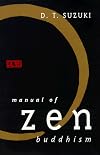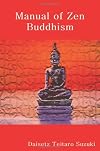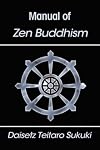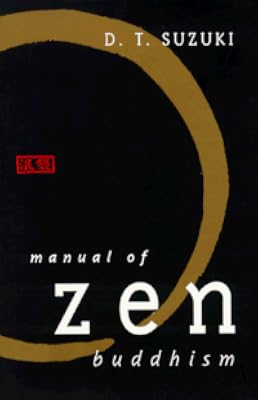
Manual of Zen Buddhism
by Daisetz Teitaro Suzuki
On This Page
Description
Religion & Spirituality. Nonfiction. Here are the famous sutras, or sermons, of the Buddha; the gathas, or hymns; the intriguing philosophical puzzles known as koan; and the dharanis, or invocations to expel evil spirits. Included also are the recorded conversations of the great Buddhist monks — intimate dialogues on subjects of momentous importance. In addition to the written selections, all of them translated by Dr. Suzuki, there are reproductions of many Buddhist drawings and paintings, show more including religious statues found in Zen temples, each with an explanation of its significance, and the great series of allegorical paintings “The Ten Oxherding Pictures.". show lessTags
Recommendations






















Member Reviews
Here are the famous sutras, or sermons, of the Buddha, the gathas, or hymns, the intriguing philosophical puzzles known as koan, and the dharanis, or invocations to expel evil spirits. Included also are the recorded conversations of the great Buddhist monks—intimate dialogues on the subjects of momentous importance. In addition to the written selections, all of them translated by Dr. Suzuki, there are reproductions of many Buddhist drawings and paintings, including religious statues found in Zen temples, each with an explanation of its significance, and the great series of allegorical paintings “The Ten Oxherding Pictures.”
In recent years, much has been written about Zen for Western audiences, but here, at last, are the original Zen texts themselves. In this single comprehensive volume, D.T. Suzuki has compiled a much needed anthology from Zen Buddhism's most important original sources.
Here are the famous sutras or sermons of the Buddha; the gathas or hymns; the intriguing philosophical puzzles known as koan; and the dharanis, or invocations to expel evil spirits. And here also are the recorded conversations of the great Buddhist monks-intimate dialogues on subjects of momentous importance.
In addition to the written selections, all of them translated by Dr. Suzuki, there are reproductions of many Buddhist drawings and paintings, including religious show more statues found in Zen temples, each with an explanation of its significance, and the great series of allegorical paintings, the Ten Oxherding Pictures.
Daisetz Teitaro Suzuki is the world's leading authority on Zen Buddhism. Born in Japan in 1870, he received his training as a Buddhist disciple at the great Zen monastery at Kamakura. He is the author of more than one hundred works on Zen and Buddhism in both Japanese and English.
Contents
Editor's note
Author's preface
I Gathas and prayers
On opening the sutra
Confession
The threefold refuge
The four great vows
The worshipping of the Sarora
The teaching of the Seven Buddhas
The Gatha of Impermanence
The Yemmei Kwannon ten-clause sutra
Prayer on the occasion of feeding the hungry ghosts
General prayer
Prayer of the bell
II The Dharanis
Dharani of removing disasters
Dharani of the great compassionate one
Dharani of the victorious Buddha-Crown
III The sutras
The Prajnaparamita-hridaya-sutra, or Shingyo (complete)
The Kwannongyo, or 'Samantamukha Parivarta' (complete)
The Kongokyu, or Vajracchedika (the first half and extracts from the second half)
The Lankavatara sutra, or Ryogakyo (extracts)
The Ryongonkyo, or Surangama sutra (resume)
IV From the Chinese Zen masters
Bodhidharma on the twofold entrance to the Tao
The third patriarch on 'Believing in mind'
From Hui-neng's Tan-ching
Yoka Daishi's 'Song of enlightenment'
Baso (Ma-tsu) and Sekito (Shih-tou)
Obaku's (Huang-po) sermon from 'Treatise on the essential's of the transmission of mind'
Gensha on the three invalids (from the Heikaganshu or Pi-yen Chi)
The ten oxherding pictures, I
The ten oxherding pictures, II
V From the Japanese Zen masters
Daio Kokushi on Zen
Daio Kokushi's admonition
Daito Kokushi' admonition and last poem
Kwanzan Kokushi's admonition
Muso Kokushi's admonition
Hakuin's 'Song of meditation'
VI The Buddhist statues and pictures in a Zen monastery
Buddhas; Bodhisattvas; Arhats; Protecting Gods; Historical figures
Index show less
> MANUEL DE BOUDDHISME ZEN, de D. T. Suzuki. — Réédition d’un ouvrage publié en 1974, ce manuel intéressera en priorité les adeptes de la pratique zen. « On y trouvera un matériel varié, lié à la vie monastique ». Des prières, des soutras, de nombreux écrits très purs de maîtres zen chinois (Hui-Neng, Yoga Daishi, “les 10 tableaux du dressage de la vache”, etc.) au japonais (Hakuin) sont rassemblés, offrant ainsi un aperçu de l’essentiel de cette Tradition. Editions Dervy, 1999 - 171 p.
—3e millénaire, (52), Été 1999
> Reix A. (Revue Philosophique de la France et de l'Étranger) : https://drive.google.com/file/d/1Ymx81J7bhFNwW4g2dChuvbVkbGavDHJH/view?usp=shari...
> Peyraube Alain. Suzuki (Daisetz Teitaro). show more — Manuel de Bouddhisme Zen.
In: Archives de sciences sociales des religions, n°52/2, 1981. p. 291. … ; (en ligne),
URL : https://www.persee.fr/doc/assr_0335-5985_1981_num_52_2_2238_t1_0291_0000_2
> Daisetsu Teitaro Suzuki (1870-1966) est un auteur japonais d'ouvrages et d'essais sur le Bouddhisme Zen.
Il fut aussi un traduteur prolifique du chinois, du japonais et de la littérature sanscrite. Il donna de nombreux cours et conférences dans les universités occidentales et fut professeur à l’université d’Otani, une école bouddhiste japonaise.
Parmi ses ouvrages traduits : Essais sur le Bouddhisme Zen, séries I, II, III, Albin Michel (1940-2003) ;
Introduction au Bouddhisme Zen (Préface de C.G. Jung, 24 pages), Buchet/Chastel, 1978 ; Le non-mental selon la pensée zen (traduit par Hubert Benoit), Le Courrier du Livre, 1970. show less
—3e millénaire, (52), Été 1999
> Reix A. (Revue Philosophique de la France et de l'Étranger) : https://drive.google.com/file/d/1Ymx81J7bhFNwW4g2dChuvbVkbGavDHJH/view?usp=shari...
> Peyraube Alain. Suzuki (Daisetz Teitaro). show more — Manuel de Bouddhisme Zen.
In: Archives de sciences sociales des religions, n°52/2, 1981. p. 291. … ; (en ligne),
URL : https://www.persee.fr/doc/assr_0335-5985_1981_num_52_2_2238_t1_0291_0000_2
> Daisetsu Teitaro Suzuki (1870-1966) est un auteur japonais d'ouvrages et d'essais sur le Bouddhisme Zen.
Il fut aussi un traduteur prolifique du chinois, du japonais et de la littérature sanscrite. Il donna de nombreux cours et conférences dans les universités occidentales et fut professeur à l’université d’Otani, une école bouddhiste japonaise.
Parmi ses ouvrages traduits : Essais sur le Bouddhisme Zen, séries I, II, III, Albin Michel (1940-2003) ;
Introduction au Bouddhisme Zen (Préface de C.G. Jung, 24 pages), Buchet/Chastel, 1978 ; Le non-mental selon la pensée zen (traduit par Hubert Benoit), Le Courrier du Livre, 1970. show less
Apr 5, 2019 (Edited)French
Ratings
Members
- Recently Added By
Author Information

152+ Works 6,991 Members
A student of the Zen master Shaku Soen, who addressed the 1893 World's Parliament of Religions held in Chicago, D. T. Suzuki did more to introduce Zen to Westerners than any other representative of that tradition. Shaku Soen sent the young Suzuki to America in 1897 to help Paul Carus translate the Chinese text the Dao De Jing. Suzuki remained in show more America for about a decade, working at Carus' Open Court Publishing Company outside Chicago. After Suzuki returned to Japan, he married an American woman, Beatrice Lane, in 1911, and they began publishing an English journal, The Eastern Buddhist, in 1921. During this time in Japan, Suzuki translated into Japanese a number of Swedenborgian texts. He traveled to China in 1934, and he went to London in 1936 to attend the World Congress of Faiths. Suzuki recognized that the West had much to offer the East, but like Swami Vivekananda, he was convinced that the East had much to offer the West in its religion and philosophy. On this basis he was motivated to write about Zen in English. Suzuki wrote about 30 books in English and many more in Japanese. Suzuki's first books in English were a translation of Ashvaghosha's Discourse on the Awakening of Faith in the Mahayana (1900) and Outlines of Mahayana Buddhism (1907). A practitioner of Rinzai Zen Buddhism, Suzuki, in his writings about the ultimate experience of satori and the meditative use of koans, made Zen terms almost household words in the United States. In the early part of the twentieth century, Suzuki devoted himself to the propagation of Zen via his writings. After World War II he became a noted lecturer on Zen at American and European universities. That Suzuki's work was effective can be seen in the fact that Zen was picked up in the 1950s by California beatniks, producing what was termed Beat Zen. From that time on, Americans increasingly began to go to Japan to study Zen, and more Zen masters began to come to the United States to teach. The earliest institutions devoted to the practice of Zen in America were established in San Francisco in 1928, in Los Angeles in 1929, and in New York City in 1931. Zen centers remain an important part of the American urban scene, and several of them have established rural Zen retreat centers. (Bowker Author Biography) show less
Series
Belongs to Publisher Series
Work Relationships
Is contained in
Common Knowledge
- Original title
- Manual of Zen Buddhism
- Original publication date
- 1934
- Original language
- English
Classifications
- Genres
- Religion & Spirituality, Nonfiction, Philosophy
- DDC/MDS
- 294.329 — Religion Other religions Buddhism/Hinduism Buddhism Buddhism of the north
- LCC
- BL1432 .Z4 .S82 — Philosophy, Psychology and Religion Religions. Mythology. Rationalism Religions. Mythology. Rationalism History and principles of religions Asian. Oriental By religion
- BISAC
Statistics
- Members
- 587
- Popularity
- 49,964
- Reviews
- 4
- Rating
- (3.90)
- Languages
- English, French, Italian, Spanish
- Media
- Paper, Ebook
- ISBNs
- 32
- ASINs
- 17