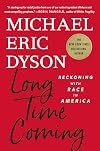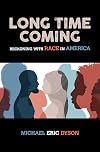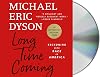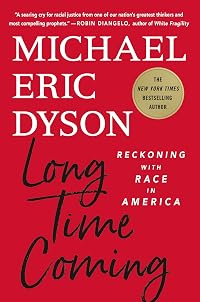
Long Time Coming: Reckoning with Race in America
by Michael Eric Dyson
On This Page
Description
"From the New York Times bestselling author of Tears We Cannot Stop, a passionate call to America to finally reckon with race and start the journey to redemption. The night of May 25, 2020 changed America. George Floyd, a 43-year-old Black man, was killed during an arrest in Minneapolis when a white cop suffocated him. The video of that night's events went viral, sparking the largest protests in the nation's history and the sort of social unrest we have not seen since the sixties. While show more Floyd's death was certainly the catalyst, (heightened by the fact that it occurred during a pandemic whose victims were disproportionately of color) it was in truth the fuse that lit an ever-filling powder keg. Long Time Coming grapples with the cultural and social forces that have shaped our nation in the brutal crucible of race. In five beautifully argued chapters--each addressed to a black martyr from Breonna Taylor to Rev. Clementa Pinckney-Dyson traces the genealogy of anti-blackness from the slave ship to the street corner where Floyd lost his life--and where America gained its will to confront the ugly truth of systemic racism. Ending with a poignant plea for hope, Dyson's exciting new book points the way to social redemption. Long Time Coming is a necessary guide to help America finally reckon with race"-- show lessTags
Recommendations





Member Reviews
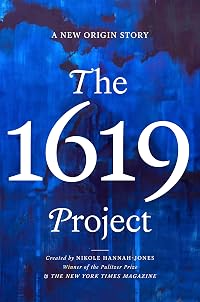
Dyson addresses Black martyrs Elijah McClain, Emmett Till, Eric Garner, Breonna Taylor, Hadiya Pendleton, Sandra Bland, and Rev. Clementa Pinckney in what is basically a series of essays about white supremacy, police brutality, and the Black Lives Matter movement. Among other things, he also touches on the backlash against the Hamilton musical and the 1619 project, the Gayle King interview that brought up sexual assaults after Kobe Bryant's death, cancel culture, and white comfort.
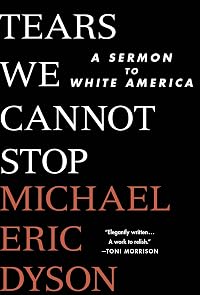
As with his Tears We Cannot Stop: A Sermon to White America, the writing style feels odd at times on the page, as if intended for oral presentation, as if this were more a transcription of a speech or sermon. The audiobook version may be a better presentation show more of the material, and I'll probably try his next book in that format.
Still, even on paper, Dyson's voice is compelling. I don't always agree with everything he says this time around -- such as a rationalization for looting during protests -- but I find his arguments powerful and persuasive, and I know I will dwell on them and use them to question my own positions and belief. And if I find myself in the wrong, I take comfort from his emphasis on fallibility, forgiveness and redemption. show less
As with his Tears We Cannot Stop: A Sermon to White America, the writing style feels odd at times on the page, as if intended for oral presentation, as if this were more a transcription of a speech or sermon. The audiobook version may be a better presentation show more of the material, and I'll probably try his next book in that format.
Still, even on paper, Dyson's voice is compelling. I don't always agree with everything he says this time around -- such as a rationalization for looting during protests -- but I find his arguments powerful and persuasive, and I know I will dwell on them and use them to question my own positions and belief. And if I find myself in the wrong, I take comfort from his emphasis on fallibility, forgiveness and redemption. show less
there is some real beauty in his words and his attitude of hope and forgiveness, and there are obviously a lot of important things he talks about here. i found so much of this kind of surface level and not really adding much new to the conversation, though, while still agreeing with what he was saying, until i got to the kobe bryant section. i have really thought about what he says there because i want to do the work and make sure it's not my biases talking but i remember the amount of blood on the hotel floor, i remember the evidence and i remember the way she was dragged through the mud in public and why she dropped the charges. i remember. and i won't ever forget. so i tried, but thought his take on kobe was awful and offensive. but show more i hear what he's saying about black bodies and justice, it just doesn't apply to kobe.
the framework he uses here also really doesn't work for me. these are ostensibly essays to killed black people but really they're to white people who need to hear this, and the pretense really doesn't work for me. this would have been stronger without trying to make it fit in this way.
the strongest pieces worth remembering, for me:
"If justice is what love sounds like when it speaks in public, then patience is what mercy sounds like out loud, and forgiveness is the accent with which grace speaks."
"The sheer black exhaustion sometimes sounds like cranky disregard for white awakening when it fact it may only be our refusal to any longer consider white comfort."
"It should be plain by now that there are different levels of membership in the community of white allies. There is the introductory membership, through which white allies get woke and realize they've got a great deal of work to do and must read and reflect to become more familiar with the racial problems of our culture. Associate membership builds on white folk reading, while they also attend gatherings of like-minded white folk in book clubs, civic groups, or church associations to further clarify their unique roles in the struggle for racial justice. Within the corporate world, they make efforts to deepen diversity and broaden inclusion of black and other voices in the reimagining of corporate goals and practices. Advanced membership pushes the envelope further and finds white folk in positions of power atop corporate and political structures leveraging their influence to bring far greater racial justice to the social and political realm. This includes a concerted effort to challenge white privilege, white fragility, and white comfort and to argue for the overhaul of unjust social relationships in all communities of color and wherever else injustice prevails. Finally, lifetime membership is for white folks seeking to embody the principles of radical justice while dismantling oppressive systems and racist structures. The police have recently been in the crosshairs of such allies. Lifetime membership often puts white allies next to black folk at social protests and if necessary it puts their bodies in line to get arrested, to endure police brutality, and in some cases to make the ultimate sacrifice." show less
the framework he uses here also really doesn't work for me. these are ostensibly essays to killed black people but really they're to white people who need to hear this, and the pretense really doesn't work for me. this would have been stronger without trying to make it fit in this way.
the strongest pieces worth remembering, for me:
"If justice is what love sounds like when it speaks in public, then patience is what mercy sounds like out loud, and forgiveness is the accent with which grace speaks."
"The sheer black exhaustion sometimes sounds like cranky disregard for white awakening when it fact it may only be our refusal to any longer consider white comfort."
"It should be plain by now that there are different levels of membership in the community of white allies. There is the introductory membership, through which white allies get woke and realize they've got a great deal of work to do and must read and reflect to become more familiar with the racial problems of our culture. Associate membership builds on white folk reading, while they also attend gatherings of like-minded white folk in book clubs, civic groups, or church associations to further clarify their unique roles in the struggle for racial justice. Within the corporate world, they make efforts to deepen diversity and broaden inclusion of black and other voices in the reimagining of corporate goals and practices. Advanced membership pushes the envelope further and finds white folk in positions of power atop corporate and political structures leveraging their influence to bring far greater racial justice to the social and political realm. This includes a concerted effort to challenge white privilege, white fragility, and white comfort and to argue for the overhaul of unjust social relationships in all communities of color and wherever else injustice prevails. Finally, lifetime membership is for white folks seeking to embody the principles of radical justice while dismantling oppressive systems and racist structures. The police have recently been in the crosshairs of such allies. Lifetime membership often puts white allies next to black folk at social protests and if necessary it puts their bodies in line to get arrested, to endure police brutality, and in some cases to make the ultimate sacrifice." show less
There are only so many ways to slice and dice racism. There is the pathetic legal trail, the shameful political trail, tragic straight history, personal memoirs and the legacy of civil rights efforts, to name the top few. Michael Eric Dyson has taken pages from each of them and sewn them into “letters” to Blacks who have been murdered, mostly by whites, in Long Time Coming.
Each chapter is addressed to a different victim: Elijah McLain, Breonna Taylor, Sandra Bland, Ahmaud Arbery, Hadiya Pendleton, and Clementa Pinckney. In the letter (Dear Elijah, etc.), Dyson recaps the way they died to them, and launches into a discourse on some aspect of racism from slavery and Jim Crow lynchings to Black Lives Matter. It’s a different show more approach, but the content is largely the same. There is no new ground broken here, but the usual sick feeling over 400 years of abuse, physical, mental and sexual, is ever-present.
Early on, in what might be the only really memorable development, Dyson explains the “law of white racist physics”: “A Black body and a white body cannot exist in the same space and same time without white permission.” “Black bodies that violate the rules of play automatically revert back to the conventions of slavery and the protocol of the plantation.” I had not seen that anywhere before.
The hero of the story, if it can be called that, is the cell phone. Dyson does not examine it very closely, but the cellphone has produced real time, definitive, unimpeachable, blow by blow documentation of the murders of ordinary Blacks, out in public. The videos show what are more like executions than arrests. They prove conclusively what Blacks have complained about since Reconstruction: police brutality on top of racial discrimination. Cell phone videos have mobilized whites as nothing ever has before. They have certainly provided much of the story Dyson presents in his book.
I found three complaints buried in the letters. Dyson bemoans the fact that Blacks are not a unified group. They have the same range of opinions and attitudes as anyone else, and do not speak with one voice. It is, of course, unreasonable to think it would ever be otherwise. He also confronts the pickiness whereby whites’ awakening to the continuing discrimination of Blacks might have the effect of reducing the work to cure it, as in the attitude of once it’s out in the open, it is therefore being dealt with. It is not, any more than #metoo has stopped sexual assaults or Congressional hearings have made Facebook a safe place, or listing Trump’s lies has stopped them. Lastly, he does not approve of cancel culture, whereby social media simply avoids mention if not denying the existence of those who offend. What with all the various opinions and attitudes, Dyson most reasonably calls for dealing with structural issues instead of canceling.
The final chapter/letter is addressed to the Reverend Clementa Pinckney, who was gunned down in his church by Dylan Roof, who hoped to somehow start a race war by doing so. In it, Dyson tells of his own preaching and love of God. He can’t understand how white churches condone all the hate of other races and cultures. But he is full of hope. He sees the possibility of civility and equality, and he clings to it enthusiastically. It is a relief after a litany of crimes against humanity.
David Wineberg show less
Each chapter is addressed to a different victim: Elijah McLain, Breonna Taylor, Sandra Bland, Ahmaud Arbery, Hadiya Pendleton, and Clementa Pinckney. In the letter (Dear Elijah, etc.), Dyson recaps the way they died to them, and launches into a discourse on some aspect of racism from slavery and Jim Crow lynchings to Black Lives Matter. It’s a different show more approach, but the content is largely the same. There is no new ground broken here, but the usual sick feeling over 400 years of abuse, physical, mental and sexual, is ever-present.
Early on, in what might be the only really memorable development, Dyson explains the “law of white racist physics”: “A Black body and a white body cannot exist in the same space and same time without white permission.” “Black bodies that violate the rules of play automatically revert back to the conventions of slavery and the protocol of the plantation.” I had not seen that anywhere before.
The hero of the story, if it can be called that, is the cell phone. Dyson does not examine it very closely, but the cellphone has produced real time, definitive, unimpeachable, blow by blow documentation of the murders of ordinary Blacks, out in public. The videos show what are more like executions than arrests. They prove conclusively what Blacks have complained about since Reconstruction: police brutality on top of racial discrimination. Cell phone videos have mobilized whites as nothing ever has before. They have certainly provided much of the story Dyson presents in his book.
I found three complaints buried in the letters. Dyson bemoans the fact that Blacks are not a unified group. They have the same range of opinions and attitudes as anyone else, and do not speak with one voice. It is, of course, unreasonable to think it would ever be otherwise. He also confronts the pickiness whereby whites’ awakening to the continuing discrimination of Blacks might have the effect of reducing the work to cure it, as in the attitude of once it’s out in the open, it is therefore being dealt with. It is not, any more than #metoo has stopped sexual assaults or Congressional hearings have made Facebook a safe place, or listing Trump’s lies has stopped them. Lastly, he does not approve of cancel culture, whereby social media simply avoids mention if not denying the existence of those who offend. What with all the various opinions and attitudes, Dyson most reasonably calls for dealing with structural issues instead of canceling.
The final chapter/letter is addressed to the Reverend Clementa Pinckney, who was gunned down in his church by Dylan Roof, who hoped to somehow start a race war by doing so. In it, Dyson tells of his own preaching and love of God. He can’t understand how white churches condone all the hate of other races and cultures. But he is full of hope. He sees the possibility of civility and equality, and he clings to it enthusiastically. It is a relief after a litany of crimes against humanity.
David Wineberg show less
If we’ve been following the news for a few years and know a bit of American history with regards to white supremacy and racism, this book might not offer anything new but sometimes, we do need a reminder. The sheer repetition that I felt while listening to the audiobook is proof of how much racism permeates the so-called law and order/justice system in this country. I couldn’t bookmark a lot of the hard hitting lines because I didn’t have an ebook with me, but there were many moments where the author’s words made me emotional. Definitely worth a listen.
Ratings
Members
- Recently Added By
Lists

List of Removed Books from Nimitz Library
353 works; 1 member
Author Information

42+ Works 4,041 Members
Michael Eric Dyson dives deeply into the true meaning of Barack Obama's historic presidency and its effects on the changing landscape of race and blackness in America. How has race shaped Obama's identity, career, and presidency? What can we learn from his major race speeches about his approach to racial conflict and the black criticism it show more provokes? Dyson was granted an exclusive interview with the president for this book, and Obama's own voice shines through. Along with interviews with Eric Holder, Al Sharpton, Maxine Waters, and others, this intimate access provides a unique depth to this engrossing analysis of the nation's first black president, and how race shapes and will shape our understanding of his achievements and failures alike. Michael Eric Dyson is a New York Times op-ed contributor, a Georgetown University professor, an MSNBC political analyst, and the best-selling author of seventeen books, including the American Book Award-winning Come Hell or High Water: Hurricane Katrina and the Color of Disaster. show less
Awards and Honors
Common Knowledge
- Original publication date
- 2020
- People/Characters
- Michael Eric Dyson; Elijah McClain; Emmett Till; Eric Garner; Breonna Taylor; Hadiya Pendleton (show all 93); Sandra Bland; Clementa Pinckney; George Floyd; Myrlie Evers-Williams; Medgar Evers; Mamie Till-Mobley; Oprah Winfrey; Derek Chauvin; Martin Luther King, Jr.; Ahmaud Arbery; Travis McMichael; Gregory McMichael; William "Roddie" Bryan; Christian Cooper; Amy Cooper; Philippe Kahn; Michael Brown, Jr.; Walter Scott (Black American shot by police officer Michael Slager); Michael Slager; Darren Wilson; Rodney King; Everett Dyson-Bey (brother of Michael Eric Dyson); Alton Sterling; Walter E. Brown; Cornelius Brown; Theodoric Johnson; Leroy Perry; Tycel Nelson; Tyisha Shenee Miller; Margaret Laverne Mitchell; LaTanya Haggerty; Alfred "Akuba" Sanders; Kendra James; Kathryn Johnston; Tarika Wilson; Thurgood Marshall; Shawanda Hill; Maurice Lester Hall; Thomas Lane; J. Alexander Keung; Tou Thao; Darnella Frazier; Donald Williams; Genevieve Hansen; Tim Walz (Minnesota governor); Keith Ellison (Minnesota attorney general); Donald Trump; Jacob Blake (Kenosha); Kenneth Walker; Thomas Jefferson; Roger B. Taney; Sally Hemings; Edward Gorsuch; Little Richard; Willie Edwards; Nikole Hannah-Jones; Tom Cotton; Ida B. Wells-Barnett; Colin Kaepernick; Daniel Prude; Barack Obama; R. Kelly; Beyoncé Knowles; Jay-Z (Shawn Carter); Michel Foucault; John Rawls; Kanye West; Cynthia Erivo; Lisa Leslie (WNBA); Gayle King; Kobe Bryant; Gianna Bryant (daughter of Kobe Bryant); Evan Rachel Wood; Felicia Sonmez; Snoop Dogg; LeBron James; Trayvon Martin; George Zimmerman; Jemele Hill; Ralph Northam; Fannie Lou Hamer; Mookie [Do the Right Thing]; Pino Frangione; Jeremiah Wright; Henry Louis Gates, Jr.; Dylann Roof; Philando Castile
- Important places
- Colorado, USA; Mississippi, USA; Minnesota, USA; Minneapolis, Minnesota, USA; Georgia, USA; New York, New York, USA (show all 9); South Carolina, USA; Ferguson, Missouri, USA; Charleston, South Carolina, USA
- Important events
- Charleston church shooting; Black Lives Matter; Lynching of Emmett Till
- Epigraph
- It's been a long, a long time coming
But I know a change gon' come,
oh yes it will
- Sam Cooke, "A Change is Gonna Come"
For the Lord of hosts will have a day of reckoning
Against everyone who is proud and lofty
And against everyone who is lifted up
That he may be abased.
- Isaiah 2:12
When my sons were in high school and pictures of Philando Castile were on the front page of the Times, I wanted to burn all the newspapers so they would not see the gun coming in the window, the blood on Castile's T-sh... (show all)irt, the terror in his partner's face, and the eyes of his witnessing baby girl. But I was too late, too late generationally, because they were not looking at the newspaper; they were looking at their phones, where the image was a house of mirrors straight to Hell.
- Elizabeth Alexander - Dedication
- To
LeBron James
Greatest basketball player on the globe
In the conversation for G.O.A.T.
Founder of the I Promise School for at-risk children
Media mogul
Global business magnate
Transformative phi... (show all)lanthropist
Outspoken social activist who refused to shut up and dribble
Started at the bottom, now you're here
For standing with Black people without excuse or apology
And for embracing people of all races around the world
"Black men, Black women, Black kids, we are terrified . . . You have no idea how that cop that day left the house . . . You don't know if he had an argument at home with his significant other. You don't know if his kids said something crazy to him and he left the house steaming. Or maybe he just left the house thinking that today is going to be the end for one of these Black people. That's what it feels like. It hurts."
- LeBron James - First words
- Dear Elijah McClain,
I write to you out of profound grief. - Last words
- (Click to show. Warning: May contain spoilers.)I will keep fighting and reckoning with our past and present to make a better future. I hope you will too.
- Blurbers
- DiAngelo, Robin; Stevenson, Bryan
- Original language
- English
Classifications
- Genres
- Anthropology, Nonfiction
- DDC/MDS
- 305.800973 — Society, government, & culture Social sciences, sociology & anthropology Social group - Age, Gender, Ethnicity Ethnic and national groups standard subdivisions / Ethnic and national groups with ethnic origins from more than one continent, of European descent standard subdivisions Biography And History North America United States
- LCC
- E185.615 .D947 — History of the United States United States
- BISAC
Statistics
- Members
- 179
- Popularity
- 182,316
- Reviews
- 4
- Rating
- (3.22)
- Languages
- English
- Media
- Paper, Audiobook, Ebook
- ISBNs
- 7
- ASINs
- 2