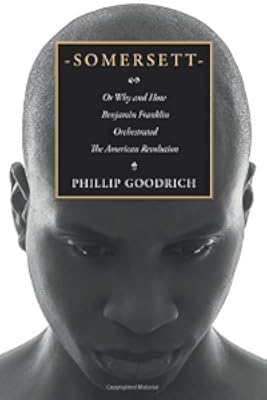
Somersett: Or Why and How Benjamin Franklin Orchestrated the American Revolution
by Phillip Goodrich
On This Page
Description
An Audiobook OriginalThere is no dearth of writings about the founding of America, but in this under-reported and under-taught story of the American Revolution, light is shed on the role Benjamin Franklin played in bringing the northern and southern colonies together against corrupt British rule. Along with an “Inner Circle” of British Abolitionists, Franklin worked behind the scenes to secure the freedom of a single American slave, James Somersett; and then, in cooperation with a vast show more network of colonial allies, set in motion a series of events that provided the impetus for northern patriots and politically cautious southern slaveholders to join forces.In 1757, Benjamin Franklin cared most about the security and prosperity of his beloved adopted home of Philadelphia. Threatened by the French during King George’s War and with little help from the proprietors of Pennsylvania, the hated Penn family, Franklin sought assistance and support in London to no avail, thus leading him to develop a secret plan to gain freedom from Great Britain for Pennsylvania, and ultimately all the colonies. The success of this plot would hinge upon politically motivating the northern and southern colonies, each with vastly different interests. In the end, it was two unrelated historical events: that of the freeing of the slave Somersett in London’s highest court; and the discovery, and leaking of, the Hutchinson letters, that turned the tide in favor of independence.Part courtroom drama, part political thriller, this assiduously researched work of American history is enacted by a cast of award-winning actors who electrify the drama as they bring to life over thirty historical characters in intermittent scenes presented in stage play form. In the London Courtroom of King’s Bench, we meet the most brilliant legal minds of the era as both sides argue their case for or against Somersett’s manumission. In the drawing room of London’s most prestigious physician, John Fothergill, we are witness to Franklin and the members of his Inner Circle as they grapple with, and meet, the massive challenges that planning a revolution entail.Here is a critically important, little known story that adds to our understanding of yet another complicated founding father. By laying out Franklin’s audacious plan to convince southern slaveholders that revolution, and only revolution, was sufficient to ensure their right to chattel labor, we are offered further evidence that the ugly stain of racism and slavery is embedded in every moment of our history. show lessTags
Member Reviews
Often wandering all over the map in terms of topic, as well as always very pro-Franklin, is very good on his doings in Britain and in Congress, as well as those of Paine, and on factions within the revolutionary movement. The major reason for his trip to Britain was the try to improve things with the corrupt Penn family who owned Pennsylvania. It was while enlisting the help of Quakers that he started giving support to abolition, at first as merely part of a quid pro quo. He also deserves credit for discovering and helping Thomas Paine during this period. His year in Congress was rather uncomfortable as many thought him a spy for the crown and he saw posts for which he was best suited go to others.
Says that the list of attendees at the show more Continental Congress that framed the Declaration of the Independence reads like a who's who of the founding fathers. Well, yeah, that's a large part of why they're called founders. The statement is mere tautology.
Makes offhandedly the claim that Jefferson as Vice President used to attend Cabinet meetings until he became too bored and quit because Adams persisted in ignoring him. The orthodoxy about this is that Adams invited Jefferson to attend the Cabinet, even be a sort of co-president, and Jefferson was tempted, but Madison, who never liked Adams, talked him out of it. So I wonder where the author got this. I suspect the author is confusing this with the time that Jefferson as Secretary of State was having his ideas rejected by Washington in favor of those of Hamilton and thus resigned.
There is also shading by deciding what to include and what not. For example, there is almost nothing on the negotiations to end the war. So don't trust this book without double checking its claims. show less
Says that the list of attendees at the show more Continental Congress that framed the Declaration of the Independence reads like a who's who of the founding fathers. Well, yeah, that's a large part of why they're called founders. The statement is mere tautology.
Makes offhandedly the claim that Jefferson as Vice President used to attend Cabinet meetings until he became too bored and quit because Adams persisted in ignoring him. The orthodoxy about this is that Adams invited Jefferson to attend the Cabinet, even be a sort of co-president, and Jefferson was tempted, but Madison, who never liked Adams, talked him out of it. So I wonder where the author got this. I suspect the author is confusing this with the time that Jefferson as Secretary of State was having his ideas rejected by Washington in favor of those of Hamilton and thus resigned.
There is also shading by deciding what to include and what not. For example, there is almost nothing on the negotiations to end the war. So don't trust this book without double checking its claims. show less
Members
- Recently Added By
Author Information
1 Work 3 Members
Some Editions
Awards and Honors
Awards
Common Knowledge
- Important events
- American Revolution
Classifications
- Genres
- Nonfiction, History
- DDC/MDS
- 973.3092 — History & geography History of North America United States Revolutionary War (1775-89) Personal narratives--American Revolution
- LCC
- E302.6 .F8 — History of the United States United States Revolution to the Civil War, 1775/1783-1861 Biography (Late eighteenth century)
Statistics
- Members
- 3
- Popularity
- 4,736,279
- Reviews
- 1
- Rating
- (4.00)
- Languages
- English
- Media
- Paper, Audiobook, Ebook
- ISBNs
- 5
- ASINs
- 1