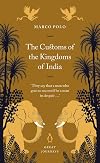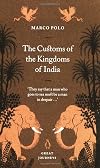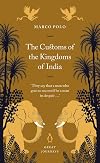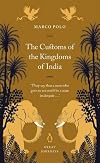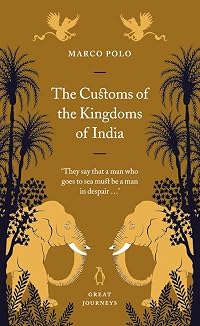
The Customs of the Kingdoms of India (Penguin Great Journeys)
by Marco Polo
Penguin Great Journeys Collection (3)
On This Page
Description
As Marco Polo (1254-1324) returned home across the Indian Ocean, after years in the service of Genghis Khan, he picked up a fabulous array of stories from sailors and merchants, about the peoples of the region, some reliable, some wholly implausible, but all fascinating. Great Journeys allows readers to travel both around the planet and back through the centuries - but also back into ideas and worlds frightening, ruthless and cruel in different ways from our own. Few reading experiences can show more begin to match that of engaging with writers who saw astounding things- Great civilisations, walls of ice, violent and implacable jungles, deserts and mountains, multitudes of birds and flowers new to science. Reading these books is to see the world afresh, to rediscover a time when many cultures were quite strange to each other, where legends and stories were treated as facts and in which so much was still to be discovered. show lessTags
Recommendations





















Member Reviews
It's basically ridiculous to "rate" a book of this sort. First of all, it is barely a book, being a selection from Polo's travel writings, one of a group of five or six I acquired somewhere or other, put out by Penguin in a "Great Journeys" series. "India" in this case, includes the eastern coast of Africa, down as far as Madacasgar. Second, it is intrinsically fascinating, no matter how stilted the writing because these are Polo's own words and descriptions (and interpretations) of what he saw first-hand (although I suspect some bits were related to him by others). Third, it isn't possible to disentangle what is accurate, what is cultural misunderstanding, and what is fabrication, and yet even so, the narrative fascinates, as it is all show more of a piece with the late medieval mind. Magic was real and existed, in this case, there are weatherworkers in Zanzibar, so beware! Why not have a male and a female island where men and women live alone nine months of the year and only mingle (on female island) long enough for procreation and corn planting! (Boy children being handed over at the age of 14). One somewhat chilling and no doubt accurate item is to learn that there have been pirates in that part of the Indian Ocean between Africa and India for a thousand years (and more?). Polo's writing style is somewhat repetitive, but rather hypnotic and reassuring in its own way and, at 85 pages, I can pretty much endure anything. I wouldn't seek out the whole of Polo's work, but I'm glad to have had a taste of it and I'll be keeping it. The covers and general appearance of the series are very appealing. **** show less
This third of the twenty paperbacks in the series "Penguin Great Journeys" is, thankfully, rather less demanding than the first two. Fewer proper names of kings, sultans and other leaders, indeed hardly any, but geographical names in abundance. Some names are familiar to us today - and, in May 2026 when I write this, none moreso than Hormuz, that name in the very first line of the text proper.
What is missing with this book is not only an index - that's a common complaint of mine - but a map and some footnotes/endnotes to help the reader navigate the Indian Ocean of Marco Polo's time, c.1310 AD. This book is perfect for bedtime reading - it's size, especially - but one need's an atlas to hand and that's no good in bed or for preparation show more for sleep!
The introduction to this book is essential. Marco Polo (1254-1324) was a Venetian merchant who spent many years in the service of Kubilai Khan (sic - (1215-1294)) who was the founder and first emperor of the Mongol-led Yuan Dynasty of China. 'Messer' Marco Polo "picked up immense amounts of direct and indirect knowledge about Asia. After his return to Europe, he became involved in fighting between Venice and Genoa, was made a prisoner-of-war and in prison met Rustichello da Pisa, who wrote down the story of Polo's adventures."
"This selection recounts Polo's knowledge of the countries around the Indian Ocean - a hectic blend of correct, careful information and the wildest fantasy." It's sometimes rather difficult to tell what is fantasy and what is not and it would have been helpful if the publisher has provided some help in this regard. Three blank pages at the back of the book provide space for a map and some endnotes!
Trouble between Christian countries and the Saracens, who profess the faith of Mahomet, is common - war, fighting, killing, all in the name of one deity or another. Those not professing these faiths are frequently mentioned, idolaters a common name for them. Marco Polo details the faith, the clothing, the dress, food, manner and trade of the peoples he tells us about, and remarks on the flora and fauna too. He mentions the unbearable heat and the sea voyages and how some ventilation was afforded. A common ending to his telling us about one place is "As there is nothing else worth mentioning, we shall go on to tell of ..."!
The blurb on the book's back cover states "He heard tales of rubies as thick as a man's arm. He knew of the king, naked but for a jewelled loincloth and a necklace of dazzling pearls, who had five hundred wives. He described birds of every colour, and could explain the true appearance of the legendary gryphon. As Marco Polo explored the Indian Ocean, his reports of wonderful creatures, strange tribes and far-away lands astounded all who hear them."
Marco Polo does not hold back with descriptions of some of the people he met or saw. Some are "horrible to look at", "very ugly" and "repulsive". Others are handsome or beautiful, e.g. "a good-looking race" and "the women ... are of outstanding beauty." No chance of such descriptions being allowed by publishers 700 and more years on! show less
What is missing with this book is not only an index - that's a common complaint of mine - but a map and some footnotes/endnotes to help the reader navigate the Indian Ocean of Marco Polo's time, c.1310 AD. This book is perfect for bedtime reading - it's size, especially - but one need's an atlas to hand and that's no good in bed or for preparation show more for sleep!
The introduction to this book is essential. Marco Polo (1254-1324) was a Venetian merchant who spent many years in the service of Kubilai Khan (sic - (1215-1294)) who was the founder and first emperor of the Mongol-led Yuan Dynasty of China. 'Messer' Marco Polo "picked up immense amounts of direct and indirect knowledge about Asia. After his return to Europe, he became involved in fighting between Venice and Genoa, was made a prisoner-of-war and in prison met Rustichello da Pisa, who wrote down the story of Polo's adventures."
"This selection recounts Polo's knowledge of the countries around the Indian Ocean - a hectic blend of correct, careful information and the wildest fantasy." It's sometimes rather difficult to tell what is fantasy and what is not and it would have been helpful if the publisher has provided some help in this regard. Three blank pages at the back of the book provide space for a map and some endnotes!
Trouble between Christian countries and the Saracens, who profess the faith of Mahomet, is common - war, fighting, killing, all in the name of one deity or another. Those not professing these faiths are frequently mentioned, idolaters a common name for them. Marco Polo details the faith, the clothing, the dress, food, manner and trade of the peoples he tells us about, and remarks on the flora and fauna too. He mentions the unbearable heat and the sea voyages and how some ventilation was afforded. A common ending to his telling us about one place is "As there is nothing else worth mentioning, we shall go on to tell of ..."!
The blurb on the book's back cover states "He heard tales of rubies as thick as a man's arm. He knew of the king, naked but for a jewelled loincloth and a necklace of dazzling pearls, who had five hundred wives. He described birds of every colour, and could explain the true appearance of the legendary gryphon. As Marco Polo explored the Indian Ocean, his reports of wonderful creatures, strange tribes and far-away lands astounded all who hear them."
Marco Polo does not hold back with descriptions of some of the people he met or saw. Some are "horrible to look at", "very ugly" and "repulsive". Others are handsome or beautiful, e.g. "a good-looking race" and "the women ... are of outstanding beauty." No chance of such descriptions being allowed by publishers 700 and more years on! show less
Ratings
Members
- Recently Added By
Author Information

102+ Works 6,857 Members
All Editions
Series

Belongs to Publisher Series
Great Journeys (3)
Work Relationships
Common Knowledge
- Original publication date
- c. 1300
- People/Characters
- Marco Polo
- Important events
- 13th century
Classifications
Statistics
- Members
- 166
- Popularity
- 197,972
- Reviews
- 2
- Rating
- (3.20)
- Languages
- English
- Media
- Paper, Ebook
- ISBNs
- 3
- ASINs
- 2