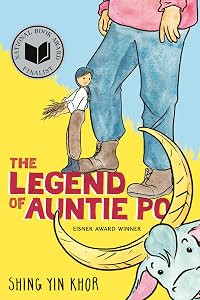
The Legend of Auntie Po
by Shing Yin Khor
On This Page
Description
"Aware of the racial tumult in the years after the passage of the Chinese Exclusion Act, Mei tries to remain blissfully focused on her job, her close friendship with the camp foreman's daughter, and telling stories about Paul Bunyan--reinvented as Po Pan Yin (Auntie Po), an elderly Chinese matriarch"--Tags
Recommendations








Member Reviews
I have been following Thor online for ages, so this was a book that I pre-ordered as soon as I knew it existed. And I'm so glad that I did!
Mei is growing up in a logging camp in the Sierra Nevadas, dealing with anti-Chinese prejudice, realizing that she is gay, and navigating the physical and interpersonal challenges of lumber camp work. Throughout all this she reimagines the myths of Paul Bunyan as starring a Chinese woman -- Auntie Po. I love the illustrations, especially the coloring style, and I love Mei SO MUCH that when I showed up to social media to rate this I was ready to fight anyone who rated this any less than five stars.
I will be forcing both of my children to read this, but clearly I loved it, too! So don't let its middle show more grade designation scare you away. show less
Mei is growing up in a logging camp in the Sierra Nevadas, dealing with anti-Chinese prejudice, realizing that she is gay, and navigating the physical and interpersonal challenges of lumber camp work. Throughout all this she reimagines the myths of Paul Bunyan as starring a Chinese woman -- Auntie Po. I love the illustrations, especially the coloring style, and I love Mei SO MUCH that when I showed up to social media to rate this I was ready to fight anyone who rated this any less than five stars.
I will be forcing both of my children to read this, but clearly I loved it, too! So don't let its middle show more grade designation scare you away. show less
Sierra Nevadas, 1885. Mei tells amazing stories about a Paul Bunyan-esque figure named Auntie Po and is talented at making pie. She lives at a logging camp and navigates anti-Chinese racism, her crush on her best friend, and daily life as camp cook with her father.
There are so many great things to say about this book --love the art. Love the storytelling, and how it allows Mei to cope. Love that Mei as a person is done with coping and excuses and is willing to speak her truth. Love that Bee (the best friend), while maybe not queer, is round and sweet and fond of pie, and that the question of her future is an open one. I love how hard Hels works to be an ally, and that he learns some hard lessons and that Ah Hao is not willing to let show more him off the hook of standing up for what is right. Mei experiences some tension as an immigrant child -- traditions she doesn't know or believe in, new traditions taking their place. Auntie Po and Pei Pei are magical. Not always an easy story, but a captivating one. show less
There are so many great things to say about this book --love the art. Love the storytelling, and how it allows Mei to cope. Love that Mei as a person is done with coping and excuses and is willing to speak her truth. Love that Bee (the best friend), while maybe not queer, is round and sweet and fond of pie, and that the question of her future is an open one. I love how hard Hels works to be an ally, and that he learns some hard lessons and that Ah Hao is not willing to let show more him off the hook of standing up for what is right. Mei experiences some tension as an immigrant child -- traditions she doesn't know or believe in, new traditions taking their place. Auntie Po and Pei Pei are magical. Not always an easy story, but a captivating one. show less
The story centers on a young Chinese American girl who works as a cook in a logging camp in the 1880s Sierra Nevadas in California. Interspersed with this narrative is a mythical fable about Auntie Po, “the mother of all loggers,” and her blue buffalo Pei Pei. Although it may sound cliché, this book truly makes history come alive! The graphic novel format is particularly effective for historical fiction. Each chapter begins with an annotated illustration of an artifact from the era, such as a wood stove or various logging tools, showcasing the author's meticulous research. This powerful people's history book vividly details the experiences of Chinese workers in logging camps during the period of the Chinese Exclusion Act.
A middle grade graphic novel featuring a queer Chinese girl cook in a logging camp, yes please- this has been on my radar for a while, and I'm so glad to have it in my hands. The watercolors are vivid, and Mei & Bee's friendship is so lovely. Though written for a middle-grade audience, it doesn't shy away from the tension and threat of violence Chinese in America faced in the Exclusion era (this takes place in 1885-6, so the early years but before people knew it was going to last for another 60 years).
I also really want pie now.
I also really want pie now.
children's middlegrade graphic historical fiction - follows a tween/teen Chinese girl Mei (Hao Mei Lee) living in a logging camp (her dad Ah Hao is the cook) in her belief in the protection of mythological Auntie Po (with blue ox Pei Pei) as camp residents face the dangers of logging, and as she tries to make sense of her feelings for her white friend Beatrice (who, unlike Mei, likes boys). Takes place in Sierra Nevada mountains of California (but really could be any logging location in the Pacific Northwest and beyond) during the winter (Chinese New Year) and spring.
This is one of my friend's favorite graphic novels -- beautifully illustrated full-color graphic spreads, not too many words (great for an English language learner), an show more interesting and moving story. Seeing that it is a 300+ page graphic novel that is already 2 years old, and that it appeared (deceptively, as it turns out) to be about a folk tale hero, I have been telling her it's "on my list" for a long time and I am just now getting to it.
I love the illustration style--the way the spreads are united by strokes of color beyond the frames--and also the information provided in the decorative (and interesting) chapter heading pages. And I love the way Mei's story flows and develops throughout the book. The violence against Chinese immigrants is sanitized somewhat in this kid-friendly story (an anti-Chinese attack by townsfolk leaves at least one man seriously injured), with acknowledgment of the (also left out of this particular story but important) Indigenous people who lived and worked in the area in the author's note at the end--with a bibliography pointing to sources for more information about Chinese immigrants and logging camps. show less
This is one of my friend's favorite graphic novels -- beautifully illustrated full-color graphic spreads, not too many words (great for an English language learner), an show more interesting and moving story. Seeing that it is a 300+ page graphic novel that is already 2 years old, and that it appeared (deceptively, as it turns out) to be about a folk tale hero, I have been telling her it's "on my list" for a long time and I am just now getting to it.
I love the illustration style--the way the spreads are united by strokes of color beyond the frames--and also the information provided in the decorative (and interesting) chapter heading pages. And I love the way Mei's story flows and develops throughout the book. The violence against Chinese immigrants is sanitized somewhat in this kid-friendly story (an anti-Chinese attack by townsfolk leaves at least one man seriously injured), with acknowledgment of the (also left out of this particular story but important) Indigenous people who lived and worked in the area in the author's note at the end--with a bibliography pointing to sources for more information about Chinese immigrants and logging camps. show less
“I’m angry that I have to make my own gods.”This was set in 1885, but you must have some suspension of disbelief. Mei’s multiracial community is a bit of an outlier, where everyone mostly gets along, until microaggressions which later turns to racism ruins things. Mei tries to cope with things by imagining an all-powerful “Auntie Po” as a deity who protects her community and lifts the kids’ spirits.
Also, Mei and her friendship to Bee was so wholesome. It is hinted Mei may be gay or at least has a crush on Bee, and I thought that was portrayed very well.
Overall, this was really engaging and, even emotional at some points.
I feel like side-eyeing the author’s note. It dampened my enjoyment slightly.
and with the claim Black people/African -Americans were complicit in taking indigenous land. Ho, the enslaved and descendants of the enslaves did not asked to come here. that is not the same. redirect that to the slave masters who brought them to stolen land. kay, bye
this is quite what i expected it to be, and i'm not sure the targeted age group is the right one for this. it seems more appropriate for a bit older reader.
at first it seems like this is going to be a simple story, but it gets much deeper about a third of the way through. it's a story about racism, immigration, and how to keep old cultural traditions in your new home, while still fitting in there. it's also about the need for white people to stand up against racism with concrete actions, not just words or good intentions. i was hoping for more than a hint about the character's queerness, but i guess that wasn't the focus of the story. the art was deceptively simple, which mostly worked. it wasn't entirely consistent, but i still liked show more it.
the interweaving of the folk story works nicely, although i thought auntie po's ability to "save" them seemed a little underdeveloped. but i like that this is a story with some hard aspects, and that at the end, it doesn't go quite the way i thought it would. there's complicated emotions and difficulties for the characters to face, which feels historically accurate. and i learned a little about logging along the way. show less
at first it seems like this is going to be a simple story, but it gets much deeper about a third of the way through. it's a story about racism, immigration, and how to keep old cultural traditions in your new home, while still fitting in there. it's also about the need for white people to stand up against racism with concrete actions, not just words or good intentions. i was hoping for more than a hint about the character's queerness, but i guess that wasn't the focus of the story. the art was deceptively simple, which mostly worked. it wasn't entirely consistent, but i still liked show more it.
the interweaving of the folk story works nicely, although i thought auntie po's ability to "save" them seemed a little underdeveloped. but i like that this is a story with some hard aspects, and that at the end, it doesn't go quite the way i thought it would. there's complicated emotions and difficulties for the characters to face, which feels historically accurate. and i learned a little about logging along the way. show less
Members
- Recently Added By
Lists

LGBTQ Books for Preteens
86 works; 2 members

Youth: DEI
296 works; 2 members
Author Information

18+ Works 430 Members
Awards and Honors
Awards
Distinctions
Notable Lists
Common Knowledge
- Original publication date
- 2021
- People/Characters
- Hao Mei Lee; Ah Hao (father of Hao Mei Lee, "Ah" is an honorific); Hels Andersen (father of Beatrice "Bee" and Pauly Andersen); Beatrice "Bee" Andersen (daughter of Hels Andersen); Po Pan Yin ("Auntie Po" | pastiche of Paul Bunyan); Paul Bunyan (mentioned and pastiched as Po Pan Yin) (show all 16); Pei Pei (water buffalo, pastiche of Babe the Blue Ox); Babe the Blue Ox (pastiche as Pei Pei); Sourdough Sam; Pauly Andersen (son of Hels Andersen); Winnie Andersen (wife of Pauly Andersen); Polly Andersen (daughter of Pauly and Winnie Andersen); Henry (son of Martha); Martha (mother of Henry); Neils Andersen (brother of Hels Andersen); Hal
- Important places
- Sierra Nevada Mountains; Sierra Nevada Mountains, California, USA
- Dedication
- For my dad, who worked so I could paint.
- First words
- This is a story about stories. This is a story about gods and men.
- Quotations
- I guess we have to keep on telling our stories, even if they are not the same as the ones our parents told us.
I like it when our stories change when we share them with new people.
I like that their stories wil... (show all)l be different. (p. 238-9) - Last words
- (Click to show. Warning: May contain spoilers.)Sometimes my stories are imperfect, but my stories are still real. I'm going to have my very own story now.
- Original language
- English
Classifications
- Genres
- Tween, Kids, Graphic Novels & Comics
- DDC/MDS
- 741.5 — Arts & recreation Drawing & decorative arts Drawing Comic books, graphic novels, fotonovelas, cartoons, caricatures, comic strips
- LCC
- PZ7.7 .K496 .L — Language and Literature Fiction and juvenile belles lettres Fiction and juvenile belles lettres Juvenile belles lettres
- BISAC
Statistics
- Members
- 233
- Popularity
- 139,848
- Reviews
- 15
- Rating
- (3.94)
- Languages
- English
- Media
- Paper, Ebook
- ISBNs
- 3
- ASINs
- 1