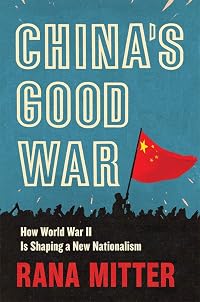
China's Good War: How World War II Is Shaping a New Nationalism
by Rana Mitter
On This Page
Description
Chinese leaders once tried to suppress memories of their nation ?s brutal experience during World War II. Now they celebrate the ?victory ? ?a key foundation of China ?s rising nationalism.For most of its history, the People ?s Republic of China discouraged public discussion of the war against Japan. It was an experience of victimization ?and one that saw Mao Zedong and Chiang Kai-shek fighting for the same goals. But now, as China grows more powerful, the meaning of the war is changing. show more Rana Mitter argues that China ?s reassessment of the war years is central to its newfound confidence abroad and to mounting nationalism at home.China ?s Good War begins with the academics who shepherded the once-taboo subject into wider discourse. Encouraged by reforms under Deng Xiaoping, they researched the Guomindang war effort, collaboration with the Japanese, and China ?s role in forming the post-1945 global order. But interest in the war would not stay confined to scholarly journals. Today public sites of memory ?including museums, movies and television shows, street art, popular writing, and social media ?define the war as a founding myth for an ascendant China. Wartime China emerges as victor rather than victim.The shifting story has nurtured a number of new views. One rehabilitates Chiang Kai-shek ?s war efforts, minimizing the bloody conflicts between him and Mao and aiming to heal the wounds of the Cultural Revolution. Another narrative positions Beijing as creator and protector of the international order that emerged from the war ?an order, China argues, under threat today largely from the United States. China ?s radical reassessment of its collective memory of the war has created a new foundation for a people destined to shape the world. show lessTags
Recommendations

















Member Reviews
I've been vaguely aware for awhile that there was an ongoing effort in the PRC to try and reintegrate the World War II experience of China into a usable past. Mitter provides the reader with an examination of the roots of this process in the wake of Mao's passing, as upon rejoining the world system, Beijing's Communist politicos needed to step away from their old verities of class warfare and autarchy, and the Nationalist experience was something that could be worked with when making claims upon the system. The issue now is how far can Beijing go demanding what is rightfully theirs, when what they call their right is hegemonic power in the Greater Asian area. The other issue is that the Communist claim to legitimacy is based on having show more rebuilt national power and provided economic security; what happens when the second falters?
I liked this book but, in the apparent political demise of Donald Trump, and the rising scorn against Beijing's oppression of the Uighurs, this book is already feeling a little dated. It's part of the reason I basically gave up on current-affairs books back in the 1990s. show less
I liked this book but, in the apparent political demise of Donald Trump, and the rising scorn against Beijing's oppression of the Uighurs, this book is already feeling a little dated. It's part of the reason I basically gave up on current-affairs books back in the 1990s. show less
Ratings
Members
- Recently Added By
Lists

"the china pill"
96 works; 2 members
Author Information

7+ Works 1,000 Members
Rana Mitter is University Lecturer in the History and Politics of Modern China at Oxford University, and a Fellow of St. Cross College.
Awards and Honors
Common Knowledge
- Canonical title
- China's Good War: How World War II Is Shaping a New Nationalism
Classifications
- Genres
- Nonfiction, Politics and Government, History, General Nonfiction
- DDC/MDS
- 320.540951 — Society, government, & culture Political science Types of Government Political ideologies Nationalism, regionalism, internationalism Biography And History Asia China & Korea
- LCC
- DS777.6 .M58 — History of Europe, Asia, Africa and Oceania Asia History of Asia China History
- BISAC
Statistics
- Members
- 55
- Popularity
- 538,773
- Reviews
- 1
- Rating
- (3.50)
- Languages
- English
- Media
- Paper, Audiobook, Ebook
- ISBNs
- 8