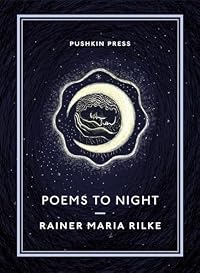
Poems to Night (Pushkin Collection)
by Rainer Maria Rilke
On This Page
Description
A collection of haunting mystical poems of the night by the great Rainer Maria Rilke - most of which have never before been translated into English.Tags
Recommendations















Member Reviews
Poems to Night is the first time Rilke's Night poems have been published in their entirety, translated in English. In 1916, Rilke presented his friend and fellow writer Rudolph Kassner the twenty-two poems in a handwritten notebook.
Rilke wrote the poems between January 1913 and February 1914, during the same time he was working on the Duino Elegies, which has been my favorite volume of poetry for over forty years. And of the elegies, the eighth is my favorite; it was dedicated to Kassner.
In the Introduction, Will Stone confesses that the Poems to Night "possess the aura of a clandestine text, and resist any assured interpretation."
Which is a great relief to me, baffled as I have been by these verses. Each reading further reveals the show more arc of Rilke's vision, how the poems reflect his basic understanding. The experience of being human and finite, and aware of the vast mystery beyond, is the bedrock of Rilke's poetry.
I read the Poems of Night, and read them again. I reread portions of Rilke's biography and a fiction novel of his life to understand Rilke at the time he wrote these poems.
Rilke arouses feelings in me, with certain lines flashing out like neon, and yet to understand his meaning seems to always hover beyond my full grasp. I struggle with the poems, eliciting more from the lines with every reading. His poetry is so unique to his own world view.
There is the theme of alienation, how humans can never fully connect. And how humans are concerned with the temporal and trivial, "seduced" by the world. Above the world is night, the realm of angels, a sacred otherness which we long to encounter and yet "renounce."
The ending lines are powerful.
Lifting one's eyes from the book, from the close and countable lines, to the consummate night outside: O how the compressed feelings scatter like stars, as if a posy of blooms were untied...Everywhere craving for connection and nowhere desire, world too much and earth enough. (Paris, February 1914)~from Poems to Night by Rainer Maria Rilke
Drafts of the Night poems are also presented, along with snippets from his other works that include the theme of Night, and biographical notes on Rilke's life. He was abroad when WWI broke out, unable to return to his Paris apartment. He lost all his manuscripts, books, and personal belongings, including photographs of his family. When he presented the notebook of poems to Kassner, he was in the military working as a clerk.
Poems to Night is a significant addition to Rilke's published works that will interest his legion of readers as well as all lovers of poetry.
I received a free ebook from the publisher through NetGalley. My review is fair and unbiased. show less
Rilke wrote the poems between January 1913 and February 1914, during the same time he was working on the Duino Elegies, which has been my favorite volume of poetry for over forty years. And of the elegies, the eighth is my favorite; it was dedicated to Kassner.
In the Introduction, Will Stone confesses that the Poems to Night "possess the aura of a clandestine text, and resist any assured interpretation."
Which is a great relief to me, baffled as I have been by these verses. Each reading further reveals the show more arc of Rilke's vision, how the poems reflect his basic understanding. The experience of being human and finite, and aware of the vast mystery beyond, is the bedrock of Rilke's poetry.
I read the Poems of Night, and read them again. I reread portions of Rilke's biography and a fiction novel of his life to understand Rilke at the time he wrote these poems.
Rilke arouses feelings in me, with certain lines flashing out like neon, and yet to understand his meaning seems to always hover beyond my full grasp. I struggle with the poems, eliciting more from the lines with every reading. His poetry is so unique to his own world view.
There is the theme of alienation, how humans can never fully connect. And how humans are concerned with the temporal and trivial, "seduced" by the world. Above the world is night, the realm of angels, a sacred otherness which we long to encounter and yet "renounce."
The ending lines are powerful.
Lifting one's eyes from the book, from the close and countable lines, to the consummate night outside: O how the compressed feelings scatter like stars, as if a posy of blooms were untied...Everywhere craving for connection and nowhere desire, world too much and earth enough. (Paris, February 1914)~from Poems to Night by Rainer Maria Rilke
Drafts of the Night poems are also presented, along with snippets from his other works that include the theme of Night, and biographical notes on Rilke's life. He was abroad when WWI broke out, unable to return to his Paris apartment. He lost all his manuscripts, books, and personal belongings, including photographs of his family. When he presented the notebook of poems to Kassner, he was in the military working as a clerk.
Poems to Night is a significant addition to Rilke's published works that will interest his legion of readers as well as all lovers of poetry.
I received a free ebook from the publisher through NetGalley. My review is fair and unbiased. show less
Throughout these poems there are occasional sparks of lyrical brilliance and clear perception, But I found these poems to be largely incomprehensible and nebulous. Perhaps it is the translation, perhaps it is Rilke's style itself, or perhaps it is my weakness as a reader of poetry, but I was not particularly fond of these poems. I wanted to like them, and I want to like Rilke, but I was disappointed. The book is beautiful though; an excellent size if one wishes to keep a volume of poetry it in a purse or bag. (And admittedly, I bought it for that reason)
Members
- Recently Added By
Author Information

1,106+ Works 31,362 Members
More than any other modern German writer, Rainer Maria Rilke seems to match our romantic idea of what a poet should be, though, as with many writers, separating artistry from affectation is often difficult. Restless, sensitive, reverent, yet egotistical, Rilke often seems to hover in his poems like a sort of ethereal being. He was born in 1875 to show more a wealthy family in Prague. After a few years devoted to the study of art and literature, he spent most of his adult life wandering among the European capitals and devoting himself single-mindedly to poetry. His early poems reflect his interest in the visual and plastic arts, as he tries to lose himself in contemplation of objects such as an antique torso of Apollo.His later books of poetry, such as Duino Elegies (1923) and Sonnets to Orpheus (1923), on the contrary, focus intently on internal realms. The poetry of Rilke is noted, above all, for metaphysical and psychological nuances. (Bowker Author Biography) show less
Series
Belongs to Publisher Series
Classifications
Statistics
- Members
- 36
- Popularity
- 795,347
- Reviews
- 2
- Rating
- (4.00)
- Languages
- English
- Media
- Paper, Ebook
- ISBNs
- 3
- ASINs
- 1