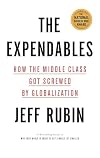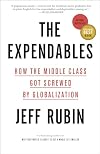
The Expendables: How the Middle Class Got Screwed By Globalization
by Jeff Rubin
On This Page
Description
"Union membership has collapsed. Full-time employment is beginning to look like a quaint idea from the distant past. If it seems that the middle class is in retreat around the developed world, it is. Former CIBC World Markets Chief Economist Jeff Rubin argues that all this was foreseeable back when Canada, the United States and Mexico first started talking free trade. Labour argued then that manufacturing jobs would move to Mexico. Free-trade advocates disagreed. Today, Canadian and American show more factories sit idle. More steel is used to make bottlecaps than cars. Meanwhile, Mexico has become one of the world's biggest automotive exporters. And it's not just NAFTA. Cheap oil, low interest rates, global deregulation and tax policies that benefit the rich all have the same effect: the erosion of the middle class. Growing global inequality is a problem of our own making, Rubin argues. And solving it won't be easy if we draw on the same ideas about capital and labour, right and left, that led us to this cliff. Articulating a vision that dovetails with the ideas of both Naomi Klein and Donald Trump, The Expendables is an exhilaratingly fresh perspective that is at once humane and irascible, fearless and rigorous, and most importantly, timely. GDP is growing, the stock market is up and unemployment is down, but the surprise of the book is that even the good news is good for only one percent of us."-- show lessTags
Recommendations

























Member Reviews
He has some interesting stuff to say and I've never had the downsides of globalization explained so well. But the author makes some startling contradictions. He makes a very interesting point that measuring the success of a country by GDP and number of jobs is irrelevant because GDP only really affects the wealth of the wealthy class and because wages have largely not kept up with inflation. But then he just completely forgets to apply it to his analysis. He seems enamored with the Trump administration's commitment to pushing back against free trade agreements. Opposition to free trade agreements isn't purely a Trumpian issue as he points out the similarities between Trump and Sanders. But then for some reason he goes on to praise Trump show more for trying to bring manufacturing jobs and commercial investment back to the United States by imposing tariffs on China. Which are the very thing he argued earlier isn't a relevant reflection of how well people are doing within a country. The author's support of the Trump administration's policies and tactics begin to wear and agitate as the book goes on. His alignment with Trump does not help his credibility and is the main reason I did not finish this book. If anyone is a GDP and jobs president, it is DJT. Nowhere in Trump's policies does he seek to raise worker's wages or boost the incomes of the middle class. Or build up America's crumbling infrastructure. Isn't that the answer to the problem if the author's own argument about GDP and jobs numbers being irrelevant is true? Who did Trump give the majority of his flagship tax cut to, again? Don't ask Jeff Rubin, he doesn't seem to remember. show less
There’s not a lot new in Jeff Rubin’s “The Expendables: How the Middle Class Got Screwed by Globalization.”
In fact, we can go back to William Greider’s 1997 classic “One World, Ready or Not: The Manic Logic of Global Capitalism” to hear many of the same complaints about globalization.
Yes, China and other low-cost producers have sucked manufacturing jobs out of OECD countries.
Rubin updates the argument with his take on why Donald Trump and other crypto-fascist world leaders represent the forgotten middle-class.
Rubin hails Trump as the only president to really go against the grain to bring back manufacturing jobs to America since the inception of this round of globalization, except when you factor in the pandemic that show more isn’t actually the case.
For a more frank and entertaining take on how the middle-class has lost out I recommend the Instagram feed of former labour secretary and egghead Robert Reich. I also recommend Six Faces of Globalization: Who Wins, Who Loses, and Why it Matters, by Anthea Roberts et al.
With regard to Canadian economics, Rubin understates the long term decline of the Canadian resource sector on government revenues.
For a discussion on the increased influence of the financial services industry on the economy I’d refer you Mariana Mazzucato’s “The Value of Everything: Making and Taking in the Global Economy.”
Rubin ignores the research of Thomas Piketty which clearly showed how the rich vacuumed capital in his landmark “Capital in the Twenty-First Century.”
For a discussion of sustainable and equitable global economic development I recommend Kate Raworth’s “Doughnut Economics: Seven Ways to Think Like a 21st Century Economist.”
And for a longer term view of why the US economy has stalled read Robert J. Gordon’s “The Rise and Fall of American Growth: The US standard of Living Since the Civil War.” From 1870-1940 things got way better at a pace that was unlikely to continue, regardless of globalization.
Where Rubin gets my attention, however, is on his brief discussion of migration. Rubin suggests that if the World Trade Organization (WTO) was really serious about free trade its members would allow the free flow of migrant workers from low wage localities to the higher wage centres like the US, Canada, and Australia. That way wages and opportunities would eventually equalize around the world.
The European Union and one could also say that the United States have been experiments on this model. But as long as there’s a booby hatch — as Brexit demonstrated recently — such experiments are bound to fail.
The United States put down its own rebellion in a bloody contest of will in the Civil War 1861-1865.
I’ve long held that this story of migrant workers is long from over, and that if migrant workers were given equal political standing in their adopted countries the political landscape would be much different than it is today. show less
In fact, we can go back to William Greider’s 1997 classic “One World, Ready or Not: The Manic Logic of Global Capitalism” to hear many of the same complaints about globalization.
Yes, China and other low-cost producers have sucked manufacturing jobs out of OECD countries.
Rubin updates the argument with his take on why Donald Trump and other crypto-fascist world leaders represent the forgotten middle-class.
Rubin hails Trump as the only president to really go against the grain to bring back manufacturing jobs to America since the inception of this round of globalization, except when you factor in the pandemic that show more isn’t actually the case.
For a more frank and entertaining take on how the middle-class has lost out I recommend the Instagram feed of former labour secretary and egghead Robert Reich. I also recommend Six Faces of Globalization: Who Wins, Who Loses, and Why it Matters, by Anthea Roberts et al.
With regard to Canadian economics, Rubin understates the long term decline of the Canadian resource sector on government revenues.
For a discussion on the increased influence of the financial services industry on the economy I’d refer you Mariana Mazzucato’s “The Value of Everything: Making and Taking in the Global Economy.”
Rubin ignores the research of Thomas Piketty which clearly showed how the rich vacuumed capital in his landmark “Capital in the Twenty-First Century.”
For a discussion of sustainable and equitable global economic development I recommend Kate Raworth’s “Doughnut Economics: Seven Ways to Think Like a 21st Century Economist.”
And for a longer term view of why the US economy has stalled read Robert J. Gordon’s “The Rise and Fall of American Growth: The US standard of Living Since the Civil War.” From 1870-1940 things got way better at a pace that was unlikely to continue, regardless of globalization.
Where Rubin gets my attention, however, is on his brief discussion of migration. Rubin suggests that if the World Trade Organization (WTO) was really serious about free trade its members would allow the free flow of migrant workers from low wage localities to the higher wage centres like the US, Canada, and Australia. That way wages and opportunities would eventually equalize around the world.
The European Union and one could also say that the United States have been experiments on this model. But as long as there’s a booby hatch — as Brexit demonstrated recently — such experiments are bound to fail.
The United States put down its own rebellion in a bloody contest of will in the Civil War 1861-1865.
I’ve long held that this story of migrant workers is long from over, and that if migrant workers were given equal political standing in their adopted countries the political landscape would be much different than it is today. show less
Ratings
Members
- Recently Added By
Author Information

8 Works 591 Members
Awards and Honors
Distinctions
Common Knowledge
- Canonical title*
- 我們成了消耗品:全球化海嘯中被吞噬的中產階級
- Original title
- The Expendables: How the Middle Class Got Screwed By Globalization
*Some information comes from Common Knowledge in other languages. Click "Edit" for more information.
Classifications
- Genres
- Economics, Nonfiction, General Nonfiction, Business
- DDC/MDS
- 305.5 — Social sciences Social sciences, sociology & anthropology Groups of people People by social and economic levels
- LCC
- HT684 .R835 — Social sciences Communities. Classes. Races Communities. Classes. Races Classes Classes arising from occupation
- BISAC
Statistics
- Members
- 35
- Popularity
- 814,280
- Reviews
- 2
- Rating
- (3.36)
- Languages
- Chinese, traditional, English
- Media
- Paper, Audiobook, Ebook
- ISBNs
- 8
- ASINs
- 3