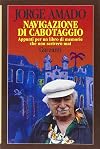
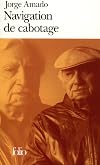
Navegação de Cabotagem
by Jorge Amado
54 Members (3.50)
On This Page
Description
Reedition of the 1992 publication, {Navegac ʹa o de cabotagem} is a sort of a litotes, that is, a negative statement hiding the purpose of affirming something, thus, an ironic twist of an accomplished fact devoid of an open intention of being accomplished. So are the "annotations for a book of memories that I will never write." Jorge Amado's memories, written by himself, are the very substance of this book, covering the years 1930 to 1990 of his life as writer, politician, lover-husband, show more father, and friend of the world. More than 100 pictures, some previously seen in the press, but many of a personal nature belonging to the family archives, are included. His memories are dispersed through short episodes describing his encounters with people of universal recognition (Jean-Paul Sartre, Picasso, Pablo Neruda, Simone de Beauvoir, the Brazilians Oscar Niemeyer, Glauber Rocha, Carybe , Dorival Caymmi, among many others), as well as with the ordinary folks of his local environment or the "baianos" who populated his many books, under their real or invented names. He proudly tells about the prizes and awards received during his life as writer, like the one from the Soviets (Stalin Prize), and humbly shows his disappointment with the communist leader, one of the reasons for Amado having left the Brazilian Communist Party forever in 1956. His memories tell of his travels, incidents, and happenings in many places around the world, from Paris to Moscow to Beijing, the births of his children (Joa o Jorge and Paloma, born in Praga), his love for Ze lia Gattai, whom he married in 1978, after decades of a happy life. This book, published when Amado was in his late 80s, is enriched by a "Posfa cio" by Le do Ivo who calls the readers' attention to the possibility that this sort of 'autobiography' might be tinted by the author's rich and indestructible imagination. Therefore, many passages that are described as paradisiacal might hide struggles and sadness that Amado himself would not like to face in his memories. Moreover, Le do Ivo clarifies that the term "cabotagem" means navigation between ports while boat sailors do not lose sight of land, but the memories bring aspects of Amado's life far away from the Brazilian land, beyond the ocean, perhaps beyond any limit on this Earth... In any case, nobody could describe Jorge Amado's experiences, real or as half-imagined in some stories, other than himself. show lessTags
Recommendations



































Member Reviews
Members
- Recently Added By
Author Information

155+ Works 10,858 Members
Jorge Amado, August 10, 1912 - August 6, 2001 Elected to the Brazilian Academy of Letters, Jorge Amado possesses a talent for storytelling as well as a deep concern for social and economic justice. He was born in Bahia, Brazil, in 1912. Some critics claim that his early works suffer from his politics. Others commonly express reservations show more concerning Amado's sentimentality and erotico-mythic stereotyping. In the works represented in English translation, his literary merits prevail. The Violent Land (1942) chronicles the development of Brazilian territory and struggles for its resources, memorializing the deeds of those who built the country. Gabriela, Clove and Cinnamon (1958), which achieved critical and popular success in both Brazil and the United States, tells a sensual love story of a Syrian bar owner and his beautiful cook. Home Is the Sailor (1962) introduces Captain Vasco Moscoso de Aragao, a comic figure in the tradition of Don Quixote. In Dona Flor and Her Two Husbands (1966), Amado introduced the folk culture of shamans and Yorube gods. The protagonists of Shepherds of the Night (1964) are Bahia's poor. (Bowker Author Biography) Jorge Amado has been called the greatest twentieth-century Brazilian novelist. He was born in 1912 in Ilheus, in the northeastern-most state of Bahai. This area serves as the backdrop for most of Amado's work, which reflects a deep appreciation of the Brazilian essence. Amado's works have made him a national figure in Brazil. Amado's early novels were shaped by a belief in Marxism, and relate the sufferings of humble fishermen and cocoa plantation workers. By the 1950s, he had turned his attention to the plight of middle-class Bahains. This more jovial approach brought him worldwide acclaim, and his keen comic sense and appreciation of the common man have drawn comparisons to the novels of Charles Dickens. Music, cuisine, and passion figure prominently in Amado's literary output. Amado's works have been translated from Portuguese into more than forty languages, have sold over fifty million copies worldwide, and have been reworked for film, television, and stage. His portraits of commanding female characters, including Gabriela from Gabriela, Clove and Cinnamon, and Dona Flor from Dona Flor and Her Two Husbands, have been adapted to the screen, and actress Sonia Braga earned her initial success in these roles. Other titles include The Sand Captains; Memory of a Child; The War of the Saints; and Home Is the Sailor. (Bowker Author Biography) show less
Common Knowledge
- Canonical title*
- Navigation de cabotage
- Original title
- Navegação de cabotagem
*Some information comes from Common Knowledge in other languages. Click "Edit" for more information.
Classifications
- Genres
- Fiction and Literature, Biography & Memoir
- DDC/MDS
- 869.3 — Literature & rhetoric Spanish Literature Literatures of Portuguese and Galician languages Portuguese fiction
- LCC
- PQ9697 .A647 .Z472 — Language and Literature French, Italian, Spanish and Portuguese literatures Portuguese literature Provincial, local, colonial, etc. Brazil
Statistics
- Members
- 54
- Popularity
- 565,988
- Rating
- (3.50)
- Languages
- 6 — French, German, Italian, Portuguese, Russian, Spanish
- Media
- Paper, Ebook
- ISBNs
- 13
- ASINs
- 2