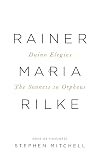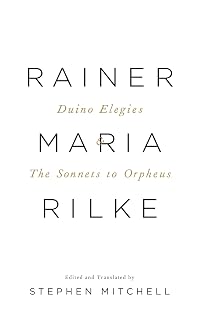
Duino Elegies / The Sonnets to Orpheus
by Rainer Maria Rilke
On This Page
Description
Available for the first time in a single volume, Ranier Maria Rilke’s two most beloved sequences of poems rendered by his most faithful translator. Rilke is unquestionably the twentieth century’s most significant and compelling poet of romantic transformation and spiritual quest. His poems of ecstatic identification with the world exert perennial fascination. In Stephen Mitchell’s versions of Rilke’s two greatest masterpieces readers will discover an English rendering that captures show more the lyric intensity, fluency, and reach of his poetry. Stephen Mitchell adheres impeccably to Rilke’s text, to his formal music, and to the complexity of his thought; at the same time, Mitchell’s work has authority and power as poetry in its own right. show lessTags
Recommendations










Member Reviews
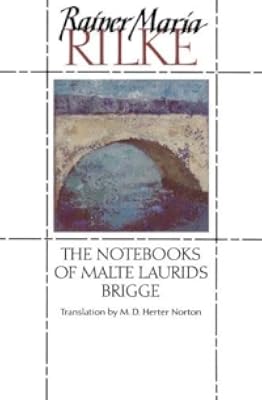
My introduction to Rilke was through his novel, The Notebooks of Malte Laurids Brigge, where he introduces many of the themes that permeate the Elegies and Sonnets. Here we find references to alienation, fear, poverty, loneliness, art, disease, and death. Yet even with death there is great beauty and soaring poetry even in translation (especially fine by Stephen Mitchell).
Rilke creates powerful yet elegant poetic odes to the majesty of the human experience and its relationship to the external world in this comprehensive translation of two major works. A realm in which the human being exists in a state of perplexity and struggle. I was fascinated by the ideas of death as an other, the "terrible rival" from the notebooks, and a meditation show more on the fear of death as well as death overcome. The great joy of learning to be yourself and enjoy your being; what I call a will to relax and "let your being be". The many aspects of love that appear both as desire and as a rival for the work of the artist.
Through it all we find the poet "learning to see" with a new will and a new being. There were moments I was reminded of Nietzsche's Zarathrustra, and of course Orpheus and and other myths from Ovid along with the Bible and other literary resonances. Above all I came to accept Rilke's admonishment for us to go ahead and become "beginners". To begin is to begin to create and will your being and ultimately your life, even in the face of death. show less
Rilke creates powerful yet elegant poetic odes to the majesty of the human experience and its relationship to the external world in this comprehensive translation of two major works. A realm in which the human being exists in a state of perplexity and struggle. I was fascinated by the ideas of death as an other, the "terrible rival" from the notebooks, and a meditation show more on the fear of death as well as death overcome. The great joy of learning to be yourself and enjoy your being; what I call a will to relax and "let your being be". The many aspects of love that appear both as desire and as a rival for the work of the artist.
Through it all we find the poet "learning to see" with a new will and a new being. There were moments I was reminded of Nietzsche's Zarathrustra, and of course Orpheus and and other myths from Ovid along with the Bible and other literary resonances. Above all I came to accept Rilke's admonishment for us to go ahead and become "beginners". To begin is to begin to create and will your being and ultimately your life, even in the face of death. show less
Probably the most infuriating book of poetry I've ever read, perhaps will ever read. The highs and lows are so dizzyingly high and so mind-numbingly, banally low that I couldn't always keep pace. The first and tenth elegies were high, the other elegies interesting and beautiful, if you can stomach the whole whiney little boy thing he falls into occasionally, and his affection for idiot-metaphysics ('Sein Aufgang ist Dasein' and so forth). Many of the sonnets, however, are appalling. Once Rilke ditches the generally critical stance of the elegies (complaints on injustice, suffering etc...) the idiot-metaphysics becomes overwhelming:
"Be - and at the same time know the implication of non-being...
to nature's whole supply of speechless, show more dumb,
and also used up things, the unspeakable sums,
rejoicing, add yourself and nullify the count."
Not to say there aren't great sonnets in there too, but my overall impression was one of disgust at this wonderful poet - what's more human than poetry? - wanting to become an object, thrilling in a mysticism of death. Add this to the apparent desire for a god to save us from the injustice and suffering so perfectly evoked in the elegies (uh... couldn't we save ourselves?), and my brain explodes. Because the whole thing is so beautiful, and at once so horrible, that there's nothing else for my brain to do. show less
"Be - and at the same time know the implication of non-being...
to nature's whole supply of speechless, show more dumb,
and also used up things, the unspeakable sums,
rejoicing, add yourself and nullify the count."
Not to say there aren't great sonnets in there too, but my overall impression was one of disgust at this wonderful poet - what's more human than poetry? - wanting to become an object, thrilling in a mysticism of death. Add this to the apparent desire for a god to save us from the injustice and suffering so perfectly evoked in the elegies (uh... couldn't we save ourselves?), and my brain explodes. Because the whole thing is so beautiful, and at once so horrible, that there's nothing else for my brain to do. show less
But we, while we are intent upon one object,
already feel the pull of another. Conflict
is second nature to us. Aren't lovers
always arriving at each other's boundaries?—
although they promised vastness, hunting, home.
As when for some quick sketch, a wide background
of contrast is laboriously prepared
so that we can see more clearly: we never know
the actual, vital contour of our own
emotions—just what forms them from the outside.
already feel the pull of another. Conflict
is second nature to us. Aren't lovers
always arriving at each other's boundaries?—
although they promised vastness, hunting, home.
As when for some quick sketch, a wide background
of contrast is laboriously prepared
so that we can see more clearly: we never know
the actual, vital contour of our own
emotions—just what forms them from the outside.
Translated and read by Stephen Mitchell. I love Rilke so instead of commenting on the poems, I'll kvetch a little about some of the shortfalls of audiobooks. In book form, does this translation have an introduction? Explanatory notes? A facing page in the original German? In addition to the pretty clear sense at times of not getting the whole book, I also wonder how to convert audio duration to pages. It doesn't trouble me that much, but I find myself more drawn to novels as I peruse audiobooks. It's a nuisance to read non-fiction and then go to a bookstore or library to look at intros, afterwords, end notes, and diagrams. In any event, Duino Elegies and Sonnets to Orpheus work very well together and I enjoyed Mitchell's somewhat show more academic but non-intrusive reading. show less
Rilke, in this comprehensive translation of two major works, crafts powerful yet elegant poetic odes to the majesty of the human experience and its relationship to the external world. A realm in which the human being exists in quandary and struggle. The translation is quite readable and often beautiful, but sometimes a little uneven. I would like to compare it to other translations.
Obviously we should all read all of Rilke's poems... but the Sonnets to Orpheus would be the second work I would buy, right after the Book of Hours. I like having the parallel translations--I can sound out just enough German to appreciate some of the sonic work.
"Elegías de Duino" es la obra más importante de Rilke. Suma poética articulada y completa, constituye su itinerario poético concluido, la aventura de la interiorización de la realidad entera. "Los Sonetos a Orfeo" son una especie de apéndice de las "Elegías". Con la misma temática y centrados en la figura de Orfeo, hacen de este mito una espléndida metáfora para plasmar el ideario de las "Elegías".
Members
- Recently Added By
Lists

Poésie (recueils)
10 works; 1 member

German Literature
518 works; 55 members

Western World's Greatest Books - Project Gutenberg
295 works; 15 members

Tonikat reading completed on Librarything journals
329 works; 2 members
Author Information

More than any other modern German writer, Rainer Maria Rilke seems to match our romantic idea of what a poet should be, though, as with many writers, separating artistry from affectation is often difficult. Restless, sensitive, reverent, yet egotistical, Rilke often seems to hover in his poems like a sort of ethereal being. He was born in 1875 to show more a wealthy family in Prague. After a few years devoted to the study of art and literature, he spent most of his adult life wandering among the European capitals and devoting himself single-mindedly to poetry. His early poems reflect his interest in the visual and plastic arts, as he tries to lose himself in contemplation of objects such as an antique torso of Apollo.His later books of poetry, such as Duino Elegies (1923) and Sonnets to Orpheus (1923), on the contrary, focus intently on internal realms. The poetry of Rilke is noted, above all, for metaphysical and psychological nuances. (Bowker Author Biography) show less
Some Editions
Awards and Honors
Series
Belongs to Publisher Series
insel taschenbuch (0080)
Work Relationships
Is contained in
Common Knowledge
- Canonical title
- Duino Elegies / The Sonnets to Orpheus
- Original title
- Duineser Elegien. Die Sonnette an Orpheus
- Original publication date
- 1922/1923 (original German) (original German); 1975-1977 (English: Poulin) (English: Poulin)
Classifications
Statistics
- Members
- 899
- Popularity
- 29,857
- Reviews
- 13
- Rating
- (4.46)
- Languages
- 9 — Czech, Dutch, English, French, German, Macedonian, Multiple languages, Portuguese, Spanish
- Media
- Paper, Audiobook, Ebook
- ISBNs
- 36
- UPCs
- 3
- ASINs
- 13