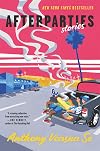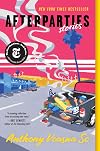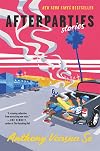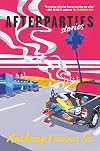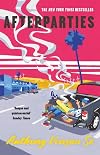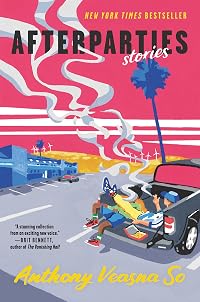
Afterparties: Stories
by Anthony Veasna So
On This Page
Description
A Roxane Gay's Audacious Book Club Pick!Named a Best Book of Summer by: Wall Street Journal * Thrillist * Vogue * Lit Hub * Refinery29 * New York Observer * The Daily Beast * Time * BuzzFeed * Entertainment Weekly A vibrant story collection about Cambodian-American life--immersive and comic, yet unsparing--that offers profound insight into the intimacy of queer and immigrant communitiesSeamlessly transitioning between the absurd and the tenderhearted, balancing acerbic humor with sharp show more emotional depth, Afterparties offers an expansive portrait of the lives of Cambodian-Americans. As the children of refugees carve out radical new paths for themselves in California, they shoulder the inherited weight of the Khmer Rouge genocide and grapple with the complexities of race, sexuality, friendship, and family. A high school badminton coach and failing grocery store owner tries to relive his glory days by beating a rising star teenage player. Two drunken brothers attend a wedding afterparty and hatch a plan to expose their shady uncle's snubbing of the bride and groom. A queer love affair sparks between an older tech entrepreneur trying to launch a "safe space" app and a disillusioned young teacher obsessed with Moby-Dick. And in the sweeping final story, a nine-year-old child learns that his mother survived a racist school shooter. The stories in Afterparties, "powered by So's skill with the telling detail, are like beams of wry, affectionate light, falling from different directions on a complicated, struggling, beloved American community" (George Saunders) show lessTags
Recommendations







Member Recommendations
Member Reviews
This frenetic collection of short fiction by Cambodian-American author Anthony Veasna So is an impassioned testament to human survival and the struggle to heal and rebuild in the aftermath of horrific events. So’s characters are the sons and daughters, grandsons and granddaughters, of Cambodian migrants who came to America, fleeing the murderous Khmer Rouge regime and the genocide that killed millions. Family and community loom large in these pages—the legacy of endurance being passed from one generation to the next. But almost as important as family connections are issues of racial and personal identity. Many of So’s narrators are queer young men looking to meld or reconcile their queer individuality with their Cambodian show more heritage. Mostly though, So’s characters, like all of us, are people who simply want to get on with things: move their lives forward and overcome the obstacles that circumstance places in their way. “Three Women of Chuck’s Donuts” tells the story of single mother Sothy, who owns and operates Chuck’s Donuts (“she’s never met a Chuck in her life; she simply thought the name was American enough to draw customers.”), and her two daughters and their tense encounter with a mysterious repeat customer who habitually arrives in the middle of the night, orders a fritter, but never eats it as he keeps watch out the window. “We Would’ve Been Princes!”, set at a chaotic afterparty following a wedding, describes the efforts of brothers Marlon and Bond to determine if their rich uncle has given the traditional cash gift to the bride and groom. And, most poignantly, “Generational Differences” addresses the issue of traumatic memory head-on: a Cambodian woman who was a teacher in Stockton, California in 1989 recounts to her son her experience as a survivor of a racially motivated school shooting. But her memory of this event is inevitably linked to earlier memories, of the genocide and of her brother’s suicide. “I don’t need you to recall the details of those tragedies that were dropped into my world,” she says near the end, concluding that, as survivors, all they can do is keep living. Unfortunately for readers, So himself did not survive, having died of a drug overdose in late 2020 at the age of 28. The loss of a unique voice and the premature end to what might have been a brilliant career endows these pulsating stories with great urgency and leave us wondering what might have been. In the meantime, we can relish Anthony Veasna So’s legacy: his depiction of a haunted community, one that, though resilient, vibrant and thriving, will always struggle to step out from under the shadow of its brutalized past. show less
“When I tried articulating my feelings about home, my mind inevitably returned to these songs, the way the incomprehensible intertwined with what made me feel so comfortable. I’d lived with misunderstanding for so long, I’d stopped even viewing it as bad. It was just there, embedded in everything I loved.”
“Here is the part that seems like a revelation until it’s forgotten as life is lived, because nothing’s special about an adulthood spent in the asshole of California, which some government official deemed worthy of a bunch of PTSD’d out refugees, farting out dreams like it’s success intolerant. “
These beautiful set of stories take place around Stockton, California and it focuses on the Cambodian immigrant show more experience. The Khmer Rouge genocide still hangs over this community and it completely shades their lives, even decades later. These tales also looks at the queer experience, living in this environment. The author was in his 20s, when he wrote this collection and it is so impressive how deft and deeply intelligent his writing was. Sadly, he died at 28 of an over-dose, before this book was published. We were definitely robbed of an emerging talent. show less
“Here is the part that seems like a revelation until it’s forgotten as life is lived, because nothing’s special about an adulthood spent in the asshole of California, which some government official deemed worthy of a bunch of PTSD’d out refugees, farting out dreams like it’s success intolerant. “
These beautiful set of stories take place around Stockton, California and it focuses on the Cambodian immigrant show more experience. The Khmer Rouge genocide still hangs over this community and it completely shades their lives, even decades later. These tales also looks at the queer experience, living in this environment. The author was in his 20s, when he wrote this collection and it is so impressive how deft and deeply intelligent his writing was. Sadly, he died at 28 of an over-dose, before this book was published. We were definitely robbed of an emerging talent. show less
Short version: I loved Anthony Veasna So's Afterparties.
Not so short version: I loved Afterparties for the community it depicts—Cambodians in California's Central Valley who escaped the Khmer Rouge and their descendants. This isn't a community I know well, and So's stories offered one revelation after another as I thought about what it might mean to be a member of this community, to balance the weight of history with the pressures of poverty, and with the competing claims of identity: to be "truly" Cambodian in a fundamental way and to be a teenager living in the U.S., coming into one's own sexuality and power—and lack of power.
I loved Afterparties for the community it builds. Afterparties is one of those short story collections in show more which a minor character from one story may be the central character in another story. Everyone's connected, and So gives us a chance to see those connections, but also makes us work for it, which I appreciate. I liked not being told everything. I liked the lack of backstory. I liked that I had to build my own mental picture of community networks as I read. The effort involved made that community feel all that more valuable to me.
I also loved Afterparties because it exists. So died of a drug overdose in 2020, a year before this book came out. His second, and last, book is scheduled for a 2023 release. I'm deeply grateful that we will have these two collections to enjoy, laugh with, and learn from, even as I mourn the fact that those first two books will also be his last.
I received a free electronic review copy of this title from the publisher via Edelweiss; the opinions are my own. show less
Not so short version: I loved Afterparties for the community it depicts—Cambodians in California's Central Valley who escaped the Khmer Rouge and their descendants. This isn't a community I know well, and So's stories offered one revelation after another as I thought about what it might mean to be a member of this community, to balance the weight of history with the pressures of poverty, and with the competing claims of identity: to be "truly" Cambodian in a fundamental way and to be a teenager living in the U.S., coming into one's own sexuality and power—and lack of power.
I loved Afterparties for the community it builds. Afterparties is one of those short story collections in show more which a minor character from one story may be the central character in another story. Everyone's connected, and So gives us a chance to see those connections, but also makes us work for it, which I appreciate. I liked not being told everything. I liked the lack of backstory. I liked that I had to build my own mental picture of community networks as I read. The effort involved made that community feel all that more valuable to me.
I also loved Afterparties because it exists. So died of a drug overdose in 2020, a year before this book came out. His second, and last, book is scheduled for a 2023 release. I'm deeply grateful that we will have these two collections to enjoy, laugh with, and learn from, even as I mourn the fact that those first two books will also be his last.
I received a free electronic review copy of this title from the publisher via Edelweiss; the opinions are my own. show less
For me, the most striking thing about these stories from Anthony Veasna So (sadly lost to an overdose prior to this book's publication) a first gen Cambodian American, is the ways in which they highlight how living through horror finds its first level of relief through humor. So tells the stories of the generation of refugees, his grandparents and parents and their contemporaries, who escaped Cambodian genocide of Pol Pot's Khmer Rouge and of their children. My parents and their contemporaries were the children of parents who escaped Lenin's mass extermination of Jews in the Soviet Union and Hitler's Shoah in Germany, scarred survivors. For my grandparents generation, and So's parents, the only two options for going forward seem to be show more relentless jocularity or the walking nightmare of PTSD. (I had grandparents who took both paths.) It was this dynamic that lead to the 50's-80's Jewish domination of comedy. Jews owned humor, from Shecky Greene to Milton Berle, Henny Youngman to Lenny Bruce, Joan Rivers to Don Rickles, and on and on. Mid-century Jews laughed so they would not cry. That same humor and those same PTSD soaked wraiths show up in Afterparties. They just look a little different than my grandparents, and they are populating parts of California in which no one else wants to live rather than parts of New York where no one else wants to live, but they share a lot. The children of this generation who escaped genocide are dutiful if not always loving offspring pushed to become professionals and insulate themselves with money, hanging on to their heritage mostly through food. This next generation, the children of the damned, are flashy and endlessly acquisitive in ways that make their Americanized children cringe. (I am that generation for the Jews and So is that gen for the Cambos.) I have no grand point, just that maybe this is what follows a holocaust necessarily. Those who avoid walking around like empty shells, seeing Cossacks or Khmer Rouge soldiers hiding in suburban American backyards, those people embrace fake it 'til you make it humor. Its a lot to chew on.
As for So's stories themselves, they are heartbreaking and funny and illuminating and show us so many people we want to know. Some of the stories are better than others, but I found all worth my time and attention. So's death is tragic in its own right, but the tragedy is compounded by the clear promise of his work -- I expect he would have written some spectacular stuff had he lived.
My favorite story was "The Shop" where we see connection to community and innate kindness destroy a man before his son's eyes. The story also features a closeted lover, some surprising monks, and a hilarious and heartbreaking doctor's wife who might have been my favorite character in the book. That story was, in my estimation, as close to perfect as it could be. "We Would've Been Princes" set at a huge family wedding and at the afterparty for the younger generation, came very close. It sharply defines the competing forces of being an American and a Cambodian. The stories I felt weakest were those So wrote from a woman's perspective. "Three Women of Chuck's Donuts" featured two smart and resourceful young girls and their exhausted but resolute mother, and though I found the older daughter's character compelling, I thought her grit and her mother's was overshadowed by the specter of the danger men bring with them a constant. The other "Somaly Serey, Serey Somaly" is sent in a nursing home and touched on the end of life, the ghosts of the past, and of the women charged with shepherding those at the end of their lives through the confusion of dementia and the press of memories more horrible than most of us can imagine. Again, the POV character, Serey, was really interesting but then fell off into this void, her bravery and compassion overshadowed by the demands of the old world and other external limitations. Those two stories were stripped of the honest humor and pathos of the other stories and they left little room to see the flashes of freedom and its rewards, of opportunities ahead (to succeed and to crash and burn), we see elsewhere. Both were still good, but less magical that the rest.
One note, many of So's characters are gay and horny, and the sex here is graphic and not remotely romanticized. You will read about bodies stuck together with cum, chafed and stretched rectums and jaws that seize up from overuse. If that is a problem for you that is between you and yourself (I may be judging you, but you do you) and you will want to steer clear. There is a line in one story about a guy wanting to bottom but not with a white guy because he doesn't want his rectum colonized by a "white predator." That made me laugh out loud sitting alone on a park bench, and it was totally worth looking crazy. If you steer clear you will miss moments like that.
Additional note. I started out listening to this on audio and hated the reader. Most of the recitation was flat and over-enunciated, and when the reader did try to infuse some energy into certain parts his tone and choices of what to emphasize often did not fit the prose. I traded the audio for the Kindle version and was happy I did so. show less
As for So's stories themselves, they are heartbreaking and funny and illuminating and show us so many people we want to know. Some of the stories are better than others, but I found all worth my time and attention. So's death is tragic in its own right, but the tragedy is compounded by the clear promise of his work -- I expect he would have written some spectacular stuff had he lived.
My favorite story was "The Shop" where we see connection to community and innate kindness destroy a man before his son's eyes. The story also features a closeted lover, some surprising monks, and a hilarious and heartbreaking doctor's wife who might have been my favorite character in the book. That story was, in my estimation, as close to perfect as it could be. "We Would've Been Princes" set at a huge family wedding and at the afterparty for the younger generation, came very close. It sharply defines the competing forces of being an American and a Cambodian. The stories I felt weakest were those So wrote from a woman's perspective. "Three Women of Chuck's Donuts" featured two smart and resourceful young girls and their exhausted but resolute mother, and though I found the older daughter's character compelling, I thought her grit and her mother's was overshadowed by the specter of the danger men bring with them a constant. The other "Somaly Serey, Serey Somaly" is sent in a nursing home and touched on the end of life, the ghosts of the past, and of the women charged with shepherding those at the end of their lives through the confusion of dementia and the press of memories more horrible than most of us can imagine. Again, the POV character, Serey, was really interesting but then fell off into this void, her bravery and compassion overshadowed by the demands of the old world and other external limitations. Those two stories were stripped of the honest humor and pathos of the other stories and they left little room to see the flashes of freedom and its rewards, of opportunities ahead (to succeed and to crash and burn), we see elsewhere. Both were still good, but less magical that the rest.
One note, many of So's characters are gay and horny, and the sex here is graphic and not remotely romanticized. You will read about bodies stuck together with cum, chafed and stretched rectums and jaws that seize up from overuse. If that is a problem for you that is between you and yourself (I may be judging you, but you do you) and you will want to steer clear. There is a line in one story about a guy wanting to bottom but not with a white guy because he doesn't want his rectum colonized by a "white predator." That made me laugh out loud sitting alone on a park bench, and it was totally worth looking crazy. If you steer clear you will miss moments like that.
Additional note. I started out listening to this on audio and hated the reader. Most of the recitation was flat and over-enunciated, and when the reader did try to infuse some energy into certain parts his tone and choices of what to emphasize often did not fit the prose. I traded the audio for the Kindle version and was happy I did so. show less
This was like stepping into a gallery of exquisitely crafted vignettes, each with the potential to expand into its own captivating novel. I found myself craving more with each story, needing to probe deeper into the lives of the characters and the world they inhabited. While the pacing, with frequent stops and starts, occasionally left me wanting, it also served to underscore the fleeting nature of the narratives. Through these vignettes, I gained insights into the Cambodian-American experience in California, particularly the profound impact of the refugee experience and the complex interplay between generations. Despite my desire for greater character and plot development, I couldn't help but fall in love with the richly drawn show more characters. The writing was immersive, evocative, reflective, and contemplative. Truly my only complaint is that it wasn't a thick stack of interconnected novels, letting me linger even longer. show less
I loved this book so much. Each story is great, and together as a collection they inform each other. Characters are vivid, structure and plot are varied/surprising/satisfying/complex. There is a feeling that writer is holding nothing back. I got such a clear sense of the community he writes about. Autobiography/biography clearly is the start but is by no means the end/the limit of each story. There is a whole world here. I will forever be sad that this all of his I will get to read but so thankful for what he has created here.
I RECEIVED A DRC FROM THE PUBLISHER VIA NETGALLEY. THANK YOU.
My Review: The death by accidental overdose, at age 28, of Author Anthony Veasna So means this collection will have to serve us for a long time. The loss, I know you're unsurprised to hear me say, is going to alter our national literary conversation. Author So wrote these stories, and a handful of essays in prestigious venues like n+1 Magazine, all seemingly intent on exploring something I think he was beautifully placed...first-generation American, talented beyond the ordinary, and further outsidered by his queerness...and perfectly suited by temperament to render his own: Dreaming your way into a world too brutal to survive. These stories are satisfying in many ways, and not show more least among them is the author's simple, direct, conversational style. Try this: read any first paragraph out loud. Don't act, speak; they are all beautifully built for the rhythms of twenty-first century American speech. And that is why I will mourn Author So's early exit. I think we would've found many corners to turn and potholes to fill if he still walked among us. That makes me feel sad.
As is reasonable and customary at this blog, the Bryce Method of short, separate impressions and distinct individual ratings for the stories will organize my thoughts and feelings while hopefully allowing you to reach your own conclusions. As there are so many thoughts, you'll need to look at them here: https://tinyurl.com/3b7vnnj9 But I'll be amazed and disappointed if you don't laugh out loud a lot. show less
My Review: The death by accidental overdose, at age 28, of Author Anthony Veasna So means this collection will have to serve us for a long time. The loss, I know you're unsurprised to hear me say, is going to alter our national literary conversation. Author So wrote these stories, and a handful of essays in prestigious venues like n+1 Magazine, all seemingly intent on exploring something I think he was beautifully placed...first-generation American, talented beyond the ordinary, and further outsidered by his queerness...and perfectly suited by temperament to render his own: Dreaming your way into a world too brutal to survive. These stories are satisfying in many ways, and not show more least among them is the author's simple, direct, conversational style. Try this: read any first paragraph out loud. Don't act, speak; they are all beautifully built for the rhythms of twenty-first century American speech. And that is why I will mourn Author So's early exit. I think we would've found many corners to turn and potholes to fill if he still walked among us. That makes me feel sad.
As is reasonable and customary at this blog, the Bryce Method of short, separate impressions and distinct individual ratings for the stories will organize my thoughts and feelings while hopefully allowing you to reach your own conclusions. As there are so many thoughts, you'll need to look at them here: https://tinyurl.com/3b7vnnj9 But I'll be amazed and disappointed if you don't laugh out loud a lot. show less
Members
- Recently Added By
Lists

Best Contemporary Literary Fiction (Around the Last 30 Years)
388 works; 124 members

Recommend the 20 best books you've read in the last five years
2,168 works; 606 members

Best 21st Century Books (So Far)
670 works; 86 members

Short Story Collections and Anthologies
261 works; 42 members

2022 Notable Books for Adults
25 works; 3 members

Top Five Books of 2021
604 works; 181 members

Five star books
1,767 works; 110 members

2021 Christmas Gifts
66 works; 13 members

Favorite Books from the 2020s
32 works; 4 members

Good LGBT fiction for LGBT folk and friends
551 works; 51 members

Books Read in 2021
5,361 works; 114 members

Short Story and Novella Collections
47 works; 6 members

Asian American Literature
46 works; 6 members

Your favorite 20 fiction books PUBLISHED in the last five years
20 works; 1 member

Still to Read 2022
5 works; 1 member

LIT - Il Bookclub Della McMusa
51 works; 1 member
Author Information

3+ Works 616 Members
Anthony Veasna So was an American writer. He was born on February 20, 1992 and was raised in Stockton, California. He was a graduate of Stanford University, studying English literature, and earned his MFA in fiction at Syracuse University. He taught English and creative writing at Syracuse University. His writing has appeared in the New Yorker, show more n+1, Granta, and ZYZZYVA. His debut story collection, Afterparties, is to be published on August 3, 2021. He died on December 8, 2020 in San Francisco at the age of 28. (Bowker Author Biography) show less
Awards and Honors
Awards
Distinctions
Notable Lists
Common Knowledge
- Original publication date
- 2021
Classifications
Statistics
- Members
- 571
- Popularity
- 51,714
- Reviews
- 24
- Rating
- (4.03)
- Languages
- English, German, Spanish
- Media
- Paper, Audiobook, Ebook
- ISBNs
- 15
- ASINs
- 4