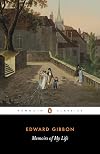
Memoirs of My Life
by Edward Gibbon, Dero Saunders (Editor)
On This Page
Description
Edward Gibbon (1737-1794) was an English historian and Member of Parliament known for his monumental series The Decline and Fall of The Roman Empire, which chronicled the dissipation of the Roman dynasties in a lofty, majestic style unique to its author. Memoirs of My Life, published posthumously in 1796, wholly unveils the character of the world's greatest historian in full candour and openness. We follow him from birth, through to his education at Oxford, to his time in Switzerland where show more he met Voltaire and fell in love with a Swiss girl. We accompany him on his travels through France and Lausanne, leading on to his eventual arrival in Rome, where he conceived his epic Decline and Fall. Gibbon's Memoirs is a portrait of a rich and productive life and offers a compelling insight into a towering figure; it is essential listening for anyone interested in great literature. show lessTags
Recommendations





















Member Reviews
The life story of a man at least as interesting himself as his landmark work The History of the Decline & Fall of the Roman Empire. Jammed with bizarre but instructive peripherals on the Age of Enlightenment - such as Oxford in plain 18th Century decadence, or ordinary life during the Seven Years' War. Or of course Gibbon's unsuccesful courtship of the cerebral Suzanne Curchod, who later married Jacques Necker (the minister of finance whose dismissal sparked the French Revolution), founded a legendary salon, & herself became mother to one of history's most influential women, Germaine de Staël.
The so-called "giant" of English Enlightenment did indeed lead a life of appropriately vast scope - not to mention entertainment value.
The so-called "giant" of English Enlightenment did indeed lead a life of appropriately vast scope - not to mention entertainment value.
What's not to love about a man who writes this well, even when he's not really trying, and gets more upset about intellectual arguments than he does about a faltering love life? Nothing not to love. Gibbon's life wasn't particularly eventful, but this prose would drag me through even a contemporary, 'trauma' filled memoir. Along the way he takes moderate shots at the university system, olde time religione, and the French. A very pleasant way to spend a few hours, in short. Particularly worth reading if you like Anthony Powell, since Gibbon's tone here comes very close to Powell's in both A Dance and his own autobiography.
It is probably my fault. I wanted a low-effort introduction to Gibbon, and I got a low-effort Gibbon. Despite Churchill's praise, Gibbon just goes on and on. Here he is on his birth, which most writers would skip over, not having any interesting memories of it.
> Of these private and public scenes and of the first years of my own life, I must be indebted not to memory but to information… [Insert a page-long poem here] It is thus that the poet has animated his statue: the theologian must infuse a miraculous gift of science and language, the philosopher might allow more time for the gradual exercise of his new senses, but all would agree that the consciousness and memory of Adam might proceed in a regular series from the moment of his show more birth. Far different is the origin and progress of human nature, and I may confidently apply to myself the common history of the whole species. Decency and ignorance cast a veil over the mystery of generation, but I may relate that after floating nine months in a liquid element I was painfully transported into the vital air. Of a new-born infant it cannot be predicated 'he thinks, therefore he is'; it can only be affirmed 'he suffers, therefore he feels'. But in this imperfect state of existence I was still unconscious of myself and of the universe, my eyes were open without the power of vision, and, according to M. de Buffon, the rational soul, that secret and incomprehensible energy, did not manifest its presence till after the fortieth day. During the first year I was below the greatest part of the brute creation, and must inevitably have perished had I been abandoned to my own care. Three years at least had elapsed before I acquired our peculiar privileges, the facility of erect motion, and the intelligent use of articulate and discriminating sounds. Slow is the growth of the body; that of the mind is still slower: at the age of seven years I had not attained to one half of the strength and proportions of manhood; and could the mental powers be measured with the same accuracy, their deficiency would appear far more considerable.
And he keeps on going. As a memoir, it is hard to read because Gibbon assumes a close familiarity with the most minor of contemporary conflicts (he'll assume, for example, that you are aware of all the details and points of criticism of someone else's negative book review). There are very few other people in the book, but Gibbon goes on and on about money. Very revealing.
Still, as you read, it is hard not to be amused by Gibbon's writing particularities. He is obsessed with the passive voice. You cannot read more than a page without encountering no fewer than a half dozen double negatives.
> It is not my wish to deny how deeply I was interested in these Memoirs, of which I need not surely be ashamed
> The gratification of my desires (they were not immoderate) has been seldom disappointed by the want of money or credit
> By many, conversation is esteemed as a theatre or a school; but after the morning has been occupied by the labours of the library, I wish to unbend rather than to exercise my mind; and in the interval between tea and supper I am far from disdaining the innocent amusement of a game at cards.
Gibbon was very much a scholar, and his enthusiasm for learning is infectious.
> After glancing my eye over the design and order of a new book, I suspended the perusal till I had finished the task of self-examination, till I had revolved in a solitary walk all that I knew or believed or had thought on the subject of the whole work, or of some particular chapter. I was then qualified to discern how much the author added to my original stock; and if I was sometimes satisfied by the agreement, I was sometimes armed by the opposition of our ideas.
> After this long fast, the longest which I have ever known, I once more tasted at Dover the pleasures of reading and thinking; and the hungry appetite with which I opened a volume of Tully’s philosophical works is still present to my memory.
> According to the scale of Switzerland I am a rich man; and I am indeed rich, since my income is superior to my expense, and my expense is equal to my wishes. My friends, more especially Lord Sheffield, kindly relieve me from the cares to which my taste and temper are most adverse: the economy of my house is settled without avarice or profusion; at stated periods all my bills are regularly paid, and in the course of my life, I have never been reduced to appear, either as plaintiff or defendant, in a court of justice. Shall I add that since the failure of my first wishes, I have never entertained any serious thoughts of a matrimonial connection?
> The warm desires, the long expectations of youth are founded on the ignorance of themselves and of the world. They are gradually damped by time and experience, by disappointment or possession; and after the middle season, the crowd must be content to remain at the foot of the mountain, while the few who have climbed the summit, aspire to descend or expect to fall. In old age, the consolation of hope is reserved for the tenderness of parents, who commence a new life in their children; the faith of enthusiasts who sing hallelujahs above the clouds; and the vanity of authors who presume the immortality of their name and writings. show less
> Of these private and public scenes and of the first years of my own life, I must be indebted not to memory but to information… [Insert a page-long poem here] It is thus that the poet has animated his statue: the theologian must infuse a miraculous gift of science and language, the philosopher might allow more time for the gradual exercise of his new senses, but all would agree that the consciousness and memory of Adam might proceed in a regular series from the moment of his show more birth. Far different is the origin and progress of human nature, and I may confidently apply to myself the common history of the whole species. Decency and ignorance cast a veil over the mystery of generation, but I may relate that after floating nine months in a liquid element I was painfully transported into the vital air. Of a new-born infant it cannot be predicated 'he thinks, therefore he is'; it can only be affirmed 'he suffers, therefore he feels'. But in this imperfect state of existence I was still unconscious of myself and of the universe, my eyes were open without the power of vision, and, according to M. de Buffon, the rational soul, that secret and incomprehensible energy, did not manifest its presence till after the fortieth day. During the first year I was below the greatest part of the brute creation, and must inevitably have perished had I been abandoned to my own care. Three years at least had elapsed before I acquired our peculiar privileges, the facility of erect motion, and the intelligent use of articulate and discriminating sounds. Slow is the growth of the body; that of the mind is still slower: at the age of seven years I had not attained to one half of the strength and proportions of manhood; and could the mental powers be measured with the same accuracy, their deficiency would appear far more considerable.
And he keeps on going. As a memoir, it is hard to read because Gibbon assumes a close familiarity with the most minor of contemporary conflicts (he'll assume, for example, that you are aware of all the details and points of criticism of someone else's negative book review). There are very few other people in the book, but Gibbon goes on and on about money. Very revealing.
Still, as you read, it is hard not to be amused by Gibbon's writing particularities. He is obsessed with the passive voice. You cannot read more than a page without encountering no fewer than a half dozen double negatives.
> It is not my wish to deny how deeply I was interested in these Memoirs, of which I need not surely be ashamed
> The gratification of my desires (they were not immoderate) has been seldom disappointed by the want of money or credit
> By many, conversation is esteemed as a theatre or a school; but after the morning has been occupied by the labours of the library, I wish to unbend rather than to exercise my mind; and in the interval between tea and supper I am far from disdaining the innocent amusement of a game at cards.
Gibbon was very much a scholar, and his enthusiasm for learning is infectious.
> After glancing my eye over the design and order of a new book, I suspended the perusal till I had finished the task of self-examination, till I had revolved in a solitary walk all that I knew or believed or had thought on the subject of the whole work, or of some particular chapter. I was then qualified to discern how much the author added to my original stock; and if I was sometimes satisfied by the agreement, I was sometimes armed by the opposition of our ideas.
> After this long fast, the longest which I have ever known, I once more tasted at Dover the pleasures of reading and thinking; and the hungry appetite with which I opened a volume of Tully’s philosophical works is still present to my memory.
> According to the scale of Switzerland I am a rich man; and I am indeed rich, since my income is superior to my expense, and my expense is equal to my wishes. My friends, more especially Lord Sheffield, kindly relieve me from the cares to which my taste and temper are most adverse: the economy of my house is settled without avarice or profusion; at stated periods all my bills are regularly paid, and in the course of my life, I have never been reduced to appear, either as plaintiff or defendant, in a court of justice. Shall I add that since the failure of my first wishes, I have never entertained any serious thoughts of a matrimonial connection?
> The warm desires, the long expectations of youth are founded on the ignorance of themselves and of the world. They are gradually damped by time and experience, by disappointment or possession; and after the middle season, the crowd must be content to remain at the foot of the mountain, while the few who have climbed the summit, aspire to descend or expect to fall. In old age, the consolation of hope is reserved for the tenderness of parents, who commence a new life in their children; the faith of enthusiasts who sing hallelujahs above the clouds; and the vanity of authors who presume the immortality of their name and writings. show less
http://nwhyte.livejournal.com/1370466.html
Edward Gibbon's short and entertaining autobiography, telling the story of his life and of how he wrote the Decline and Fall. The two chapters in which Gibbon describes the completion, publication and reception of the Decline and Fall ought to be essential reading for anyone planning a writing career. In particular, his reflections on completing the twenty-year project are poignant:
'It was on the night of the 27th of June 1787, between the hours of eleven and twelve, that I wrote the last line of the last page in a summer-house in my garden. After laying down my pen, I took several turns in a berceau, or covered walk of acacias. I will not dissemble the first emotions of joy on the recovery of show more my freedom, and, perhaps the establishment of my fame. But my pride was soon humbled, and a sober melancholy was spread over my mind by the idea that I had taken an everlasting leave of an old and agreeable companion, and that whatsoever might be the future fate of my history, the life of the historian must be short and precarious.'
There is lots more here as well: his political career (which was entirely the result of Gibbon's receipt of patronage - two different seats in parliament for pocket boroughs, and a junior government position which appears to have involved no actual duties in return for a large salary), his experience of Oxford (and some of his trenchant criticisms of the Oxbridge system remain valid), his reflections on living in Lausanne rather than London, his experience as an officer in the militia. Gibbon comes across as, of course, tremendously intelligent, but also rather modest with it: he is conscious of some of the flaws of Decline and Fall, but claims that his own satisfaction at a job well done is more important than public praise or condemnation, though at the same time praise is always welcome. He expresses the vague hope, in 1791, that people will still read his work in a hundred years' time. I was reading this aloud to Anne as she drove us home from England yesterday, and I found I had got something in my eye, also affecting my throat, as I got to the end:
'The present is a fleeting moment, the past is no more; and our prospect of futurity is dark and doubtful. This day may possibly be my last: but the laws of probability, so true in general, so fallacious in particular, still allow about fifteen years.... The warm desires, the long expectations of youth, are founded on the ignorance of themselves and of the world: they are gradually damped by time and experience, by disappointment and possession; and after the middle season the crowd must be content to remain at the foot of the mountain; while the few who have climbed the summit aspire to descend or expect to fall. In old age, the consolation of hope is reserved for the tenderness of parents, who commence a new life in their children; the faith of enthusiasts, who sing Hallelujahs above the clouds; and the vanity of authors, who presume the immortality of their name and writing.'
The Penguin edition is not the text made famous by Gibbon's friend Lord Sheffield, but a new (well, 1983) treatment of the manuscripts by Penguin's editor Betty Radice, who steps from behind the curtain and explains her methodology in an interesting introduction. Well worth getting. show less
Edward Gibbon's short and entertaining autobiography, telling the story of his life and of how he wrote the Decline and Fall. The two chapters in which Gibbon describes the completion, publication and reception of the Decline and Fall ought to be essential reading for anyone planning a writing career. In particular, his reflections on completing the twenty-year project are poignant:
'It was on the night of the 27th of June 1787, between the hours of eleven and twelve, that I wrote the last line of the last page in a summer-house in my garden. After laying down my pen, I took several turns in a berceau, or covered walk of acacias. I will not dissemble the first emotions of joy on the recovery of show more my freedom, and, perhaps the establishment of my fame. But my pride was soon humbled, and a sober melancholy was spread over my mind by the idea that I had taken an everlasting leave of an old and agreeable companion, and that whatsoever might be the future fate of my history, the life of the historian must be short and precarious.'
There is lots more here as well: his political career (which was entirely the result of Gibbon's receipt of patronage - two different seats in parliament for pocket boroughs, and a junior government position which appears to have involved no actual duties in return for a large salary), his experience of Oxford (and some of his trenchant criticisms of the Oxbridge system remain valid), his reflections on living in Lausanne rather than London, his experience as an officer in the militia. Gibbon comes across as, of course, tremendously intelligent, but also rather modest with it: he is conscious of some of the flaws of Decline and Fall, but claims that his own satisfaction at a job well done is more important than public praise or condemnation, though at the same time praise is always welcome. He expresses the vague hope, in 1791, that people will still read his work in a hundred years' time. I was reading this aloud to Anne as she drove us home from England yesterday, and I found I had got something in my eye, also affecting my throat, as I got to the end:
'The present is a fleeting moment, the past is no more; and our prospect of futurity is dark and doubtful. This day may possibly be my last: but the laws of probability, so true in general, so fallacious in particular, still allow about fifteen years.... The warm desires, the long expectations of youth, are founded on the ignorance of themselves and of the world: they are gradually damped by time and experience, by disappointment and possession; and after the middle season the crowd must be content to remain at the foot of the mountain; while the few who have climbed the summit aspire to descend or expect to fall. In old age, the consolation of hope is reserved for the tenderness of parents, who commence a new life in their children; the faith of enthusiasts, who sing Hallelujahs above the clouds; and the vanity of authors, who presume the immortality of their name and writing.'
The Penguin edition is not the text made famous by Gibbon's friend Lord Sheffield, but a new (well, 1983) treatment of the manuscripts by Penguin's editor Betty Radice, who steps from behind the curtain and explains her methodology in an interesting introduction. Well worth getting. show less
[From Books and You, Doubleday, Doran & Co., 1940, pp. 37-38:]
I come next to a book that I name with hesitation, for, as I must remind the reader, I wish to speak here only of books that one would be the poorer for not having read, and though I have a great fondness for Gibbon’s Autobiography, I am not quite sure that it would have made much difference to me not to have read it. I should certainly have lost a keen pleasure, but if I mention it I feel that I should also mention a large number of other works, not so great as the greatest, to be judged by a different standard, and they would need a chapter to themselves. But Gibbon’s Autobiography is very readable; it is short, written with the peculiar elegance of which he was master, show more and it has both dignity and humour. Of the latter I cannot resist giving an example. When he was at Lausanne he fell in love, but his father threatening to disinherit him, he prudently gave up the thought of marrying the object of his affections. He ends his recital of the episode with these words: “I sighed as a lover, I obeyed as a son; and my wound was insensibly healed by time, absence, and the habits of a new life.” I think if the book contained nothing else, it would be worth reading for that delicious sentence. show less
I come next to a book that I name with hesitation, for, as I must remind the reader, I wish to speak here only of books that one would be the poorer for not having read, and though I have a great fondness for Gibbon’s Autobiography, I am not quite sure that it would have made much difference to me not to have read it. I should certainly have lost a keen pleasure, but if I mention it I feel that I should also mention a large number of other works, not so great as the greatest, to be judged by a different standard, and they would need a chapter to themselves. But Gibbon’s Autobiography is very readable; it is short, written with the peculiar elegance of which he was master, show more and it has both dignity and humour. Of the latter I cannot resist giving an example. When he was at Lausanne he fell in love, but his father threatening to disinherit him, he prudently gave up the thought of marrying the object of his affections. He ends his recital of the episode with these words: “I sighed as a lover, I obeyed as a son; and my wound was insensibly healed by time, absence, and the habits of a new life.” I think if the book contained nothing else, it would be worth reading for that delicious sentence. show less
Edward Gibbon is almost intimidating to read. He has full command of grammar, vocabulary, and style while quoting multiple languages including ancient Greek. He's an agreeable voice and provides a window on life in England and Switzerland in the last half of the 18C. Be sure to keep a dictionary by your side as you read his Memoirs.
Apparently Gibbon left behind various drafts towards an autobiography, but this edition combines the drafts in a different way from the way they were combined in the standard version by Gibbon's friend, Lord Sheffield. Well worth reading as another view of the 18th century. I would've liked to hear more about the composition of and reactions to the Decline and Fall, though.
Members
- Recently Added By
Lists

Best Biographies, Autobiographies and Memoirs
465 works; 160 members

W. S. Maugham's Reading Suggestions for Spiritual Enrichment: British
24 works; 3 members

Trinity College Booklist (1951): Class Four, History
120 works; 2 members

How to Read a Book's Recommended Reading List
309 works; 10 members
Author Information

421+ Works 17,048 Members
All Editions
Some Editions
Awards and Honors
Series
Belongs to Publisher Series
Work Relationships
Common Knowledge
- Canonical title
- Memoirs of My Life
- Original publication date
- 1796
- People/Characters
- Edward Gibbon; Suzanne Necker
Classifications
- Genres
- Biography & Memoir, Nonfiction, History, General Nonfiction
- DDC/MDS
- 937.06092 — History & geography History of ancient world (to ca. 499) Italian Peninsula to 476 and adjacent territories to 476 Empire 31 B.C.-476 A.D.
- LCC
- PR3476 .A82 — Language and Literature English English Literature 17th and 18th centuries (1640-1770)
- BISAC
Statistics
- Members
- 413
- Popularity
- 75,198
- Reviews
- 9
- Rating
- (4.00)
- Languages
- English, French, German, Spanish
- Media
- Paper, Ebook
- ISBNs
- 27
- ASINs
- 30