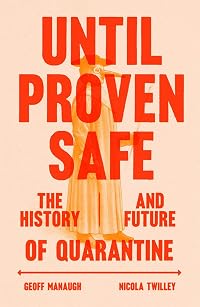
Until Proven Safe: The History and Future of Quarantine
by Nicola Twilley, Geoff Manaugh
On This Page
Description
Geoff Manaugh and Nicola Twilley have been researching quarantine since long before the COVID-19 pandemic. With Until Proven Safe, they bring us an audiobook as compelling as it is definitive, not only urgent listening for social-distanced times but also an up-to-the-minute investigation of the interplay of forces–––biological, political, technological––that shape our modern world.Quarantine is our most powerful response to uncertainty: it means waiting to see if something hidden show more inside us will be revealed. It is also one of our most dangerous, operating through an assumption of guilt. In quarantine, we are considered infectious until proven safe.
Until Proven Safe tracks the history and future of quarantine around the globe, chasing the story of emergency isolation through time and space—from the crumbling lazarettos of the Mediterranean, built to contain the Black Death, to an experimental Ebola unit in London, and from the hallways of the CDC to closed-door simulations where pharmaceutical execs and epidemiologists prepare for the outbreak of a novel coronavirus.
But the story of quarantine ranges far beyond the history of medical isolation. In Until Proven Safe, the authors tour a nuclear-waste isolation facility beneath the New Mexican desert, see plants stricken with a disease that threatens the world's wheat supply, and meet NASA's Planetary Protection Officer, tasked with saving Earth from extraterrestrial infections. They also introduce us to the corporate tech giants hoping to revolutionize quarantine through surveillance and algorithmic prediction.
We live in a disorienting historical moment that can feel both unprecedented and inevitable; Until Proven Safe helps us make sense of our new reality through a thrillingly reported, thought-provoking exploration of the meaning of freedom, governance, and mutual responsibility.
A Macmillan Audio production from Farrar, Straus and Giroux
. show less
Tags
Recommendations




























Member Reviews
Much like Twilley's podcast, this book is wide ranging and always interesting. The last couple chapters were the weakest. I'm not sure what nuclear waste storage has to do with quarantine—it is still fun to read about, but not really on topic. The discussion of digital surveillance, contact tracing and quarantine is also very weak—mostly speculative and not based on actual reporting. The book would have benefitted if the authors had reported from South Korea, China, or possibly the US developers of contract-tracing apps.
> Later, the practice of slashing mail with chisels and awls, which often left it in shreds, was made obsolete by a device called a rastel (from the Latin rastellus, or “rake”), which resembles the love child of show more a waffle iron and a medieval torture device. Letters were placed between hinged, spiked plates and punctured pre-fumigation
> for a century, from 1770, Austro-Hungarian authorities maintained a thousand-mile quarantine corridor along their imperial frontier, all the way from the shores of the Adriatic to the Transylvanian mountains. This epidemiological boundary was not simply a line but a buffer zone, thirty miles wide in many places, cutting a broad swath through modern-day Serbia, Bosnia, and Croatia. Inside this belt, every peasant was also a soldier, responsible for manning the sanitary cordon for at least one week in every eight, and more during an outbreak—up to a total of six months’ active service each year. A chain of two thousand lookout posts was constructed, each no more than a musket-shot’s distance from the next, and soldiers were instructed to fire on any unauthorized traffic. Nineteen crossing posts offered disinfection services, open-air parlatorios for distanced conversation across the divide, and supervised quarantine for travelers—twenty-one days when no outbreak was suspected, and forty-eight when the presence of plague was confirmed in the region
> When Napoleon sent sixty thousand French soldiers to Haiti to quash a slave rebellion in 1801, 80 percent of them died within two years, jaundiced, feverish, and vomiting a noxious substance that resembled spent coffee grounds. Defeated, Napoleon sold off the rest of his North American possessions to the United States in the Louisiana Purchase. Meanwhile, what was left of the imperial fleet sailed back to French and Italian ports in 1804, bringing yellow fever with them
> The use of these kinds of canaries in the coal mine of public health is expensive but effective. In Australia, which is the only continent free of the Varroa mite, sentinel beehives are stationed near ports, to alert biosecurity officials to any accidental introduction. In California, 139 flocks of sentinel chickens stand guard in chicken coops around the state; if the white leghorns are bitten by mosquitoes infected by West Nile or St. Louis encephalitis, they will develop antibodies that alert local public health agencies to the presence of the disease. show less
> Later, the practice of slashing mail with chisels and awls, which often left it in shreds, was made obsolete by a device called a rastel (from the Latin rastellus, or “rake”), which resembles the love child of show more a waffle iron and a medieval torture device. Letters were placed between hinged, spiked plates and punctured pre-fumigation
> for a century, from 1770, Austro-Hungarian authorities maintained a thousand-mile quarantine corridor along their imperial frontier, all the way from the shores of the Adriatic to the Transylvanian mountains. This epidemiological boundary was not simply a line but a buffer zone, thirty miles wide in many places, cutting a broad swath through modern-day Serbia, Bosnia, and Croatia. Inside this belt, every peasant was also a soldier, responsible for manning the sanitary cordon for at least one week in every eight, and more during an outbreak—up to a total of six months’ active service each year. A chain of two thousand lookout posts was constructed, each no more than a musket-shot’s distance from the next, and soldiers were instructed to fire on any unauthorized traffic. Nineteen crossing posts offered disinfection services, open-air parlatorios for distanced conversation across the divide, and supervised quarantine for travelers—twenty-one days when no outbreak was suspected, and forty-eight when the presence of plague was confirmed in the region
> When Napoleon sent sixty thousand French soldiers to Haiti to quash a slave rebellion in 1801, 80 percent of them died within two years, jaundiced, feverish, and vomiting a noxious substance that resembled spent coffee grounds. Defeated, Napoleon sold off the rest of his North American possessions to the United States in the Louisiana Purchase. Meanwhile, what was left of the imperial fleet sailed back to French and Italian ports in 1804, bringing yellow fever with them
> The use of these kinds of canaries in the coal mine of public health is expensive but effective. In Australia, which is the only continent free of the Varroa mite, sentinel beehives are stationed near ports, to alert biosecurity officials to any accidental introduction. In California, 139 flocks of sentinel chickens stand guard in chicken coops around the state; if the white leghorns are bitten by mosquitoes infected by West Nile or St. Louis encephalitis, they will develop antibodies that alert local public health agencies to the presence of the disease. show less
Ratings
Members
- Recently Added By
Lists

Science: Health & Medical
100 works; 1 member

Anticipated 2021 Reads
231 works; 7 members
Author Information

4+ Works 358 Members

8+ Works 989 Members
Awards and Honors
Distinctions
Common Knowledge
- Important places
- Venice, Veneto, Italy; North Brother Island, New York, New York, USA; Plum Island, New York, USA
- First words
- On March 6, 2020, a King County, Washington, health department van pulled up in front of an Econo Lodge motel outside Seattle. -Chapter 1, The Coming Quarantine
- Canonical DDC/MDS
- 614.46
- Canonical LCC
- RA655
Classifications
- Genres
- History, Nonfiction, General Nonfiction, Science & Nature
- DDC/MDS
- 614.46 — Applied science & technology Medicine & health Epidemics, Poisons, Alternative Medicine Incidence of and public measures to prevent disease Quarantine
- LCC
- RA655 — Medicine Public aspects of medicine Public aspects of medicine Public health. Hygiene. Preventive medicine Epidemics. Epidemiology. Quarantine. Disinfection
- BISAC
Statistics
- Members
- 151
- Popularity
- 217,008
- Reviews
- 2
- Rating
- (4.14)
- Languages
- English
- Media
- Paper, Audiobook, Ebook
- ISBNs
- 8
- ASINs
- 2