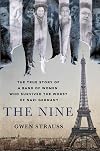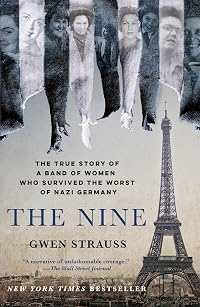
The Nine: The True Story of a Band of Women Who Survived the Worst of Nazi Germany
by Gwen Strauss
On This Page
Description
"The Nine follows the true story of the author's great aunt Helene Podliasky, who led a band of nine female resistance fighters as they escaped a German forced labor camp and made a ten-day journey across the front lines of WWII from Germany back to Paris. The nine women were all under thirty when they joined the resistance. They smuggled arms through Europe, harbored parachuting agents, coordinated communications between regional sectors, trekked escape routes to Spain and hid Jewish show more children in scattered apartments. They were arrested by French police, interrogated and tortured by the Gestapo. They were subjected to a series of French prisons and deported to Germany. The group formed along the way, meeting at different points, in prison, in transit, and at Ravensbrück. By the time they were enslaved at the labor camp in Leipzig, they were a close-knit group of friends. During the final days of the war, forced onto a death march, the nine chose their moment and made a daring escape. Drawing on incredible research, this powerful, heart-stopping narrative is a moving tribute to the power of humanity and friendship in the darkest of times"-- show lessTags
Recommendations













Member Reviews
Not long ago in The Walls Came Tumbling Down by Henriette Roosenburg, I read the story of a Dutch Resistance woman who made her way home in the chaos of postwar Europe. Roosenburg was a member of the Nacht and Nebel (‘Night and Fog’) group of political prisoners and had been liberated from the Waldheim camp in Germany, but the French Resistance women whose story is told in The Nine, How a Band of Daring Resistance Women Escaped from Nazi Germany had been in Ravensbrück, the camp exclusively for women slave labourers which I had read about in Sarah Helm's If This is a Woman. The escape of the women who are featured in The Nine was not from the Ravensbrück camp itself but from one of the infamous WW2 Nazi Death Marches. Many of the show more thousands who perished in this Death March were Jewish, but the death march from Ravensbrück also included communists, Jehovah’s Witnesses, the Romani, and women from the resistance.
The book is structured around chapters which follow a chronological recount of the escape and its aftermath but feature the back story of each of the Nine, of whom six were French, two were Dutch and one was Spanish. It begins with the author's aunt Hélène Podliasky, 24 at the time of her arrest and the leader of the group because of her skill with multiple languages.
Over the ten days of their journey until they were rescued by American soldiers, they encounter humanity in all its diversity. Their first attempt to get some food and shelter fails when the town mayor sends someone to report them to the Germans, but then they meet some Yugoslav POWs.
At first they were a bit anxious about being at risk of sexual assault from these men. In the chapter about Nicole Clarence, arrested on a routine check when she was working as an agent de liaison delivering intelligence at night, Strauss explains that in the 1940s many assumptions were made about women that by today's standards we would not accept.
For these women, keeping their dignity was part of what enabled them to survive.
To read the rest of my review please visit https://anzlitlovers.com/2021/08/24/the-nine-by-gwen-strauss/ show less
The book is structured around chapters which follow a chronological recount of the escape and its aftermath but feature the back story of each of the Nine, of whom six were French, two were Dutch and one was Spanish. It begins with the author's aunt Hélène Podliasky, 24 at the time of her arrest and the leader of the group because of her skill with multiple languages.
Over the ten days of their journey until they were rescued by American soldiers, they encounter humanity in all its diversity. Their first attempt to get some food and shelter fails when the town mayor sends someone to report them to the Germans, but then they meet some Yugoslav POWs.
At first light, the Yugoslavs woke the women by knocking politely on the barn door. The women sat up in the hay where they had slept so peacefully. Unused to real rest, they were slightly dazed. The Yugoslavs climbed up the ladder with a pitcher of café au lait, a bowl of boiled potatoes, a bottle of liniment for their aching legs, butter, salt and a handful of cigarettes, enough for each woman to have one.
The nine cleared a space on the floor for this precious breakfast. How long had it been since they had awakened to such kindness? How long since they had been allowed to sleep instead of being roused by brutal shouts. (p. 93)
At first they were a bit anxious about being at risk of sexual assault from these men. In the chapter about Nicole Clarence, arrested on a routine check when she was working as an agent de liaison delivering intelligence at night, Strauss explains that in the 1940s many assumptions were made about women that by today's standards we would not accept.
For example, it was commonly understood that a young woman out alone at night was 'asking for trouble'. If she suffered unwanted attention, it was her fault. That was the risk Nicole and any young female agent de liaison were taking. A young woman who was raped might feel ashamed and so might remain silent. She would have no legal recourse, certainly not against a German police officer. Her power had to come from how she could manipulate the situation. The women in the group often admired one another for their beauty, for their ability to use their female charm on men, and for the game of playing innocent in order to get something past those in her power. Nicole would have thought that her most powerful tool was her charm. It was a dangerous game, because of course in the end the women had no power. Men, like the soldier arresting Nicole, could take what they wanted with impunity. (p.79)
For these women, keeping their dignity was part of what enabled them to survive.
To read the rest of my review please visit https://anzlitlovers.com/2021/08/24/the-nine-by-gwen-strauss/ show less
Harrowing stories from World War II are saturating the historical fiction market at the moment, and with each novel there is a clearer understanding of the horrors that abounded during this tumultuous time. How can one human have that amount of hatred for another to inflict such pain and torture is a question that will forever bombard my mind, and loomed again while I was reading The Nine.
Captivated from the first sentence, I am so thankful that Gwen Strauss brought this astounding story of her great aunt, and her fellow resistance fighters, to light. This was a story that needed to be told, and should be heard by future generations! It is incredible that they survived these horrific conditions and unimaginable situations, and lived to show more tell the tale! Even more than 75 years later stories like these hit you right in the gut, transporting you to a time and place that no one would ever want to go, giving flesh and life to these heroines, exposing more of the truth of this dark stain on our world history.
Reading The Nine has made a lasting imprint on my mind and heart, and I am gratified to Ms. Strauss and all of her compassion and dedication to this novel. It is clear that this was a passion project, with meticulous detail, and masterfully written, I cannot recommend this book enough! Yes, there are moments that are difficult to read, as is true with most stories from this dark time, but trust me when I say it is well worth it to fight through the tough, as you will be encouraged beyond measure. The Nine is a reading experience I will never forget, and my heart goes out to those who had to endure such torture. Truly unimaginable...
*I have voluntarily reviewed a complimentary copy of this book which I received from St. Martin's Press through NetGalley. All views and opinions expressed are completely honest, and my own. show less
Captivated from the first sentence, I am so thankful that Gwen Strauss brought this astounding story of her great aunt, and her fellow resistance fighters, to light. This was a story that needed to be told, and should be heard by future generations! It is incredible that they survived these horrific conditions and unimaginable situations, and lived to show more tell the tale! Even more than 75 years later stories like these hit you right in the gut, transporting you to a time and place that no one would ever want to go, giving flesh and life to these heroines, exposing more of the truth of this dark stain on our world history.
Reading The Nine has made a lasting imprint on my mind and heart, and I am gratified to Ms. Strauss and all of her compassion and dedication to this novel. It is clear that this was a passion project, with meticulous detail, and masterfully written, I cannot recommend this book enough! Yes, there are moments that are difficult to read, as is true with most stories from this dark time, but trust me when I say it is well worth it to fight through the tough, as you will be encouraged beyond measure. The Nine is a reading experience I will never forget, and my heart goes out to those who had to endure such torture. Truly unimaginable...
*I have voluntarily reviewed a complimentary copy of this book which I received from St. Martin's Press through NetGalley. All views and opinions expressed are completely honest, and my own. show less
This is an intense and extremely thorough description of the lives of nine courageous young women who rose to the occasion and joined resistance movements during WWII. They, like others, are the unsung heroes. Although their reasons for risking their lives were varied, ranging from romantic involvements to love of country to saving Jews and children, all of their efforts were valiant.
After being betrayed and captured, they were interrogated, beaten, abused and sent to various prison camps and concentration camps in Germany, where they found each other in their struggle to survive. They bonded and cared for each other with total commitment and loyalty and credit this amazing friendship for their survival.
Their harrowing experiences, show more however, were hair-raising. Often only luck and deception saved them. Though they experienced the loss of their friends, family and children, they could not stop to mourn or rest. They had to continue with their roll calls, their work and their suffering regardless. They propped each other up providing each other with the courage to continue. They were political prisoners, and did not suffer as greatly as some in the camps, but they were forced to witness selections, torture, suicides, neglect and the murder of innocent victims. They were barely fed and lived in squalor with absolutely no hygiene or medicine. They never knew when they would be singled out for unknown or unpreventable infractions. Illness could be an automatic death sentence. There was no medication and if you couldn’t work, you had no purpose.
Their imprisonment and the people they encountered during that time, is thoroughly investigated by the author. Their torment by soldier and citizen alike, is writ large on the page. Their ultimate escape and rescue is the stuff of nightmares. Liberators were often as cruel or crueler than the Nazis. The Russians and Americans were sometimes like animals let loose.
This book has a different approach to WWII since it does not single out the plight of the Jews, but rather it focuses on those who were impacted by the Nazis who were not actually their specific targets, like the Jews, gypsies and homosexuals. It dwells more on the citizens of the countries that Hitler invaded who refused to take it sitting down and tried to fight back.
One of this group of nine women featured is the author’s aunt, and armed only with brief information, nicknames and a few facts, she has unearthed their history and follows their lives until their deaths. On the way, many other interesting and heroic people, perhaps unsung until now, are featured, along with these nine women. Often, after the tragedy of the Holocaust, many of its victims either wanted to, or were told to, hide their experiences. They were too inhuman and uncivilized to contemplate and had to be left in the past. It was, therefore, a difficult task to uncover a lot of their experiences.
The effect of the wartime experiences on Hitler’s victims is profound because it extends from one generation to another. Since, when they returned, their surviving relatives asked them not to talk of their fiendish experiences, and the women were sometimes suspected of having been prostitutes for the Germans and were judged tainted even though they were not willing partners, even more psychological scars formed. The negative psychological effects for the victims were visited upon their families. Depression, hostility, and suicides occurred. The children suffered from the secrets that were harbored. They formed their own support grups.
The book is a must read for anyone who reads about WWII, although it is hard to read. It is necessary to prevent man’s inhumanity to man, which is on full display, from repeating itself. I have read a lot on the Holocaust, and yet, this book revealed even more of the horrors to me, of the maniacal, largely unbelievable barbarism that actually occurred. Once again, I was surprised to discover that there were still more heinous acts committed by Nazis then I had known before. It fills in a lot of the blank spaces that you may not have even known were in your store of knowledge about the events. show less
After being betrayed and captured, they were interrogated, beaten, abused and sent to various prison camps and concentration camps in Germany, where they found each other in their struggle to survive. They bonded and cared for each other with total commitment and loyalty and credit this amazing friendship for their survival.
Their harrowing experiences, show more however, were hair-raising. Often only luck and deception saved them. Though they experienced the loss of their friends, family and children, they could not stop to mourn or rest. They had to continue with their roll calls, their work and their suffering regardless. They propped each other up providing each other with the courage to continue. They were political prisoners, and did not suffer as greatly as some in the camps, but they were forced to witness selections, torture, suicides, neglect and the murder of innocent victims. They were barely fed and lived in squalor with absolutely no hygiene or medicine. They never knew when they would be singled out for unknown or unpreventable infractions. Illness could be an automatic death sentence. There was no medication and if you couldn’t work, you had no purpose.
Their imprisonment and the people they encountered during that time, is thoroughly investigated by the author. Their torment by soldier and citizen alike, is writ large on the page. Their ultimate escape and rescue is the stuff of nightmares. Liberators were often as cruel or crueler than the Nazis. The Russians and Americans were sometimes like animals let loose.
This book has a different approach to WWII since it does not single out the plight of the Jews, but rather it focuses on those who were impacted by the Nazis who were not actually their specific targets, like the Jews, gypsies and homosexuals. It dwells more on the citizens of the countries that Hitler invaded who refused to take it sitting down and tried to fight back.
One of this group of nine women featured is the author’s aunt, and armed only with brief information, nicknames and a few facts, she has unearthed their history and follows their lives until their deaths. On the way, many other interesting and heroic people, perhaps unsung until now, are featured, along with these nine women. Often, after the tragedy of the Holocaust, many of its victims either wanted to, or were told to, hide their experiences. They were too inhuman and uncivilized to contemplate and had to be left in the past. It was, therefore, a difficult task to uncover a lot of their experiences.
The effect of the wartime experiences on Hitler’s victims is profound because it extends from one generation to another. Since, when they returned, their surviving relatives asked them not to talk of their fiendish experiences, and the women were sometimes suspected of having been prostitutes for the Germans and were judged tainted even though they were not willing partners, even more psychological scars formed. The negative psychological effects for the victims were visited upon their families. Depression, hostility, and suicides occurred. The children suffered from the secrets that were harbored. They formed their own support grups.
The book is a must read for anyone who reads about WWII, although it is hard to read. It is necessary to prevent man’s inhumanity to man, which is on full display, from repeating itself. I have read a lot on the Holocaust, and yet, this book revealed even more of the horrors to me, of the maniacal, largely unbelievable barbarism that actually occurred. Once again, I was surprised to discover that there were still more heinous acts committed by Nazis then I had known before. It fills in a lot of the blank spaces that you may not have even known were in your store of knowledge about the events. show less
I struggled a little with the nonlinear aspects. There were break and time jumps when a new character was brought in and time was rewound to include the soft intro to their beginnings and how they ended up in the prison.
But this is one of the few WW2 books that discuss, though briefly, the forced prostitution and the sex crimes commited against the prisioners, as well as the murder of the babies born in the camps. Its not an easy topic to cover, but I appreciate that it wasn't completely glazed over or not even mentioned like so many other books do. Its important to take note of all the crimes and not just hold back so soften the load of understanding exactly what happened.
But this is one of the few WW2 books that discuss, though briefly, the forced prostitution and the sex crimes commited against the prisioners, as well as the murder of the babies born in the camps. Its not an easy topic to cover, but I appreciate that it wasn't completely glazed over or not even mentioned like so many other books do. Its important to take note of all the crimes and not just hold back so soften the load of understanding exactly what happened.
After escaping from a German labor camp, Helene a group of nine female resistance fighters across the front lines. This book tells the story of each of the nine women, their involvement in the resistance, and their lives during WWII. I thought this was a well research and engaging story. The resistance work and escape was fascinating. My biggest criticism is that I did not want to read about the author's research, I just wanted to hear the story. Because of this criticism, 3 out of 5 stars.
This brisk biography is a compelling and beautifully written story of nine women who survived the worst of Nazi Germany. Caught at various points in 1944 they met at Ravensbrück concentration camp. This is the true story of Helene, Nicole, Jacky, Zaza, Lon, Guigui, Zinka, Mena and Josée and the things these French, Dutch and Spanish women faced.
I was drawn right from the opening page by this deeply researched chronicle that highlights the courage of women who worked for the French Resistance until the moment they were caught. Under the Nazi strong arms, they suffered unspeakable brutality, torture and lived in inhumane condition. Ms. Straus alternated tales of their early lives, Resistance activities, and arrest with their horrific show more experiences in concentration camps and factories, escape, and finally the walk across Germany to American lines. The narrative is infused with harrowing details about Ravensbrück , how the relationships between these nine women developed and the complications they faced once they returned to their home town. By the end it is revealed that most lived a long and fruitful life well into the recent century.
This account is a fantastic piece of narrative that captures the sense of what life was when the German leadership was breaking down and facing defeat: the cruelest parts of WW11 was then unleashed on all prisoners.
I never get tired reading these tragic accounts of how people lived daily with atrocities and managed to come through. Obviously this is a very heavy subject matter and could be disturbing for some but more importantly is to never forget.
Well-said
My thanks to St-Martin Press and Netgalley for the opportunity to read and review this book. show less
I was drawn right from the opening page by this deeply researched chronicle that highlights the courage of women who worked for the French Resistance until the moment they were caught. Under the Nazi strong arms, they suffered unspeakable brutality, torture and lived in inhumane condition. Ms. Straus alternated tales of their early lives, Resistance activities, and arrest with their horrific show more experiences in concentration camps and factories, escape, and finally the walk across Germany to American lines. The narrative is infused with harrowing details about Ravensbrück , how the relationships between these nine women developed and the complications they faced once they returned to their home town. By the end it is revealed that most lived a long and fruitful life well into the recent century.
This account is a fantastic piece of narrative that captures the sense of what life was when the German leadership was breaking down and facing defeat: the cruelest parts of WW11 was then unleashed on all prisoners.
I never get tired reading these tragic accounts of how people lived daily with atrocities and managed to come through. Obviously this is a very heavy subject matter and could be disturbing for some but more importantly is to never forget.
Well-said
My thanks to St-Martin Press and Netgalley for the opportunity to read and review this book. show less
I need to remember these women every time I want to whine about something. I love war stories, and this honest, traumatic, amazing true story of these women and their will to live and persevere is one that will stay with me.
I listened to the audiobook, and the narrator did a fantastic job!
Every time I read about survivors of the concentration camps, I am in awe that anyone would make it through alive, with any semblance of sanity. Not only does this book detail the nine women's journey, it follows up on what their lives were like after their "freedom" - a freedom that haunted many of the survivors.
It's a must-read, and a book that will stay with me. The author did extensive research and brought these women to life for the reader. show more Excellent book!
Thank you to NetGalley and the publisher for providing me a copy of this story. And to the narrator for doing such an amazing job. show less
I listened to the audiobook, and the narrator did a fantastic job!
Every time I read about survivors of the concentration camps, I am in awe that anyone would make it through alive, with any semblance of sanity. Not only does this book detail the nine women's journey, it follows up on what their lives were like after their "freedom" - a freedom that haunted many of the survivors.
It's a must-read, and a book that will stay with me. The author did extensive research and brought these women to life for the reader. show more Excellent book!
Thank you to NetGalley and the publisher for providing me a copy of this story. And to the narrator for doing such an amazing job. show less
Members
- Recently Added By
Lists

THE WAR ROOM
813 works; 24 members

History: Holocaust
106 works; 1 member
Author Information

10+ Works 1,349 Members
Some Editions
Awards and Honors
Distinctions
The Guardian Book of the Day (2021-07-10)
Common Knowledge
- Alternate titles
- The Nine: How a Band of Daring Resistance Women Escaped from Germany
- Original publication date
- 2021
- People/Characters
- Helene "Christine" Podliasky; Marie-Madeleine Fourcade "Hedgehog"
- Important places
- Germany; Ravensbrück concentration camp, Ravensbrück, Brandenburg, Germany
- Important events
- Holocaust; World War II
Classifications
Statistics
- Members
- 406
- Popularity
- 76,750
- Reviews
- 22
- Rating
- (4.30)
- Languages
- Dutch, English, Finnish, French
- Media
- Paper, Audiobook, Ebook
- ISBNs
- 20
- ASINs
- 4