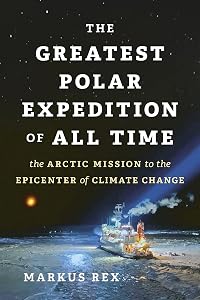
The Greatest Polar Expedition of All Time: The Arctic Mission to the Epicenter of Climate Change
by Markus Rex
On This Page
Description
"A captain's tell-all about the world's largest Arctic expedition--an illuminating account of seafaring adventure, Arctic natural history, and cutting-edge climate science. The book about the Mosaic Expedition: as seen in the documentary film Arctic Drift, Atmospheric scientist Markus Rex recounts the monumental Arctic expedition he captained for one year in this gripping and authoritative book. A groundbreaking step towards understanding the climate crisis, the MOSAiC expedition--launched show more in 2019 by the Alfred Wegener Institute for Polar and Marine Research--was the first of its kind, journeying deep into the epicentre of climate change, the Arctic, to seek hard-to-find and potentially world-changing scientific data. Rex begins with life aboard the Polarstern, a powerful icebreaker ship that is frozen into fragile ice and carried across the Arctic by the Transpolar Drift. Away from the rest of the world, the team prepares for life under brutal conditions, constructing "cities" and "towns" on the ice where they will study the Arctic ecosystem, its atmosphere, ocean, sea ice, and more. A terrifying feat that had never been attempted before, the team of hundreds of scientists perform their research during terrifying storms, cracking ice floes, frost-bite, and even quarantines as Covid-19 sweeps the globe. But there are heartwarming moments, too, as Markus Rex describes Christmas parties on the ice and polar bears playing with scientific equipment like puppies. He muses on expeditions past, such as the ill-fated Franklin Expedition, and Fridtjof Nansen's Fram expedition, which he follows as a guide. And he explores answers to the pressing questions facing the Arctic today: How will climate change impact this precious ecosystem--and therefore the rest of the world? What is the best way to protect the Arctic? Interweaving history, science, and memoir, The Greatest Polar Expedition of All Time is a page-turner about the teamwork it takes to complete a risky goal, all in the name of understanding--and responding to--the climate crisis."-- show lessTags
Recommendations




































Member Reviews
Markus Rex’s The Greatest Polar Expedition of All Time: The Arctic Mission to the Epicenter of Climate Change details the MOSAiC expedition aboard the Polarstern during the winter of 2019-2020. Rex, a veteran of arctic and Antarctic expeditions, describes how MOSAiC organized to lodge itself in an ice floe and follow the current, much as Fridtjof Nansen did 125 years prior, taking data on the formation of arctic sea ice and its decline over the previous century as a result of anthropogenic climate change. Commenting on the parallels between the historic and recent expeditions, Rex writes, “The ice may look endless and eternal, but it isn’t. It has its limits and is growing smaller all the time. In the southeast, where Nansen show more wrote…, where he claimed that the ice would remain for all eternity, for millennia to come there is now an open ocean” (pg. 182).
Rex explains the science and the history while also describing the day-to-day life of polar exploration, including rebuilding camp after the ice floe changes due to currents in the wind and water, developing rituals to keep up morale during the polar night, and scaring off polar bears – both to keep the human scientists safe and to encourage the bears to hunt where they will find food – in addition to something he could never plan for: the COID-19 pandemic. Where the first two-thirds of Rex’s account detail polar science as normal, even with the normal complications, he changes focus at the beginning of the final third to discuss how the team responded to the pandemic: scrambling to assist those who’d departed the Polarstern in returning home, struggling to get supplies to the ship on its ice floe, and still managing to find important results such as a hole in the polar ozone layer (pg. 158) that resembles the earlier hole in the Antarctic ozone (pg. 155). Rex concludes of MOSAiC, “By conducting a yearlong expedition, we can better analyze the processes that cause the Arctic to heat faster than any other region on the planet. Complex mechanisms create close connections between the Arctic’s atmosphere, snow, sea ice, ocean, ecosystem, and biogreochemistry. These processes don’t just intensify climate change, but are also altered themselves” (pg. 248).
Rex’s The Greatest Polar Expedition of All Time advocates for international scientific programs as a way to solve great problems, foster international communication, and offer hope in the darkest times, such as the pandemic. show less
Rex explains the science and the history while also describing the day-to-day life of polar exploration, including rebuilding camp after the ice floe changes due to currents in the wind and water, developing rituals to keep up morale during the polar night, and scaring off polar bears – both to keep the human scientists safe and to encourage the bears to hunt where they will find food – in addition to something he could never plan for: the COID-19 pandemic. Where the first two-thirds of Rex’s account detail polar science as normal, even with the normal complications, he changes focus at the beginning of the final third to discuss how the team responded to the pandemic: scrambling to assist those who’d departed the Polarstern in returning home, struggling to get supplies to the ship on its ice floe, and still managing to find important results such as a hole in the polar ozone layer (pg. 158) that resembles the earlier hole in the Antarctic ozone (pg. 155). Rex concludes of MOSAiC, “By conducting a yearlong expedition, we can better analyze the processes that cause the Arctic to heat faster than any other region on the planet. Complex mechanisms create close connections between the Arctic’s atmosphere, snow, sea ice, ocean, ecosystem, and biogreochemistry. These processes don’t just intensify climate change, but are also altered themselves” (pg. 248).
Rex’s The Greatest Polar Expedition of All Time advocates for international scientific programs as a way to solve great problems, foster international communication, and offer hope in the darkest times, such as the pandemic. show less
 This review was written for LibraryThing Early Reviewers.
Wow, this book was wonderful! Written by Markus Rex, the head of the MOSAIC project, the book chronicles the daily happenings of the MOSAIC expedition, the world's largest Arctic expedition, designed to get to the heart of climate change.
Rex is a wonderful writer! (And kudos to his translator Sarah Pybus, as well!) His captain's log - which is essentially what this book is - reads like a thrilling adventure novel. The wonder and awe and excitement he feels are palpable; his emotions jump out of the page and engage the reader as surely as if the reader were there him/herself. The book covers everything - how Rex's icebreaking research ship, the Polarstern, works; how they determine what ice floe is appropriate for "docking" the ship to show more float to the North Pole; how they set up the different research stations on ice floes; how they deal with polar bears; how they work in social activities when in such isolation from the rest of the world; how the Arctic seasons behave. It is all incredibly fascinating! And, on top of it all, Rex describes how they cope with the COVID-19 pandemic, which was hitting the world while MOSAIC was still in blissful isolation.
This book was a treatise to the absolute dire need for humans to combat climate change. It was incredibly sobering to learn about the frighteningly rapid changes in the Arctic and what that means for the rest of the world. Ultimately, Rex pleas for humans to come together and work together to heal the earth. The MOSAIC expedition provided much-needed scientific data. Now we just have to apply it to save our world. show less
Rex is a wonderful writer! (And kudos to his translator Sarah Pybus, as well!) His captain's log - which is essentially what this book is - reads like a thrilling adventure novel. The wonder and awe and excitement he feels are palpable; his emotions jump out of the page and engage the reader as surely as if the reader were there him/herself. The book covers everything - how Rex's icebreaking research ship, the Polarstern, works; how they determine what ice floe is appropriate for "docking" the ship to show more float to the North Pole; how they set up the different research stations on ice floes; how they deal with polar bears; how they work in social activities when in such isolation from the rest of the world; how the Arctic seasons behave. It is all incredibly fascinating! And, on top of it all, Rex describes how they cope with the COVID-19 pandemic, which was hitting the world while MOSAIC was still in blissful isolation.
This book was a treatise to the absolute dire need for humans to combat climate change. It was incredibly sobering to learn about the frighteningly rapid changes in the Arctic and what that means for the rest of the world. Ultimately, Rex pleas for humans to come together and work together to heal the earth. The MOSAIC expedition provided much-needed scientific data. Now we just have to apply it to save our world. show less
This review was written for LibraryThing Early Reviewers.“Our generation may be the last to experience an Arctic that is covered in ice year round,” Markus Rex states. To understand what is happening and ascertain the impact of climate change, someone had to study the Arctic ice. And the best way was to trap an icebreaker into a stable ice flow, set up camps with scientific equipment, and travel with the ice…for a year!
Over a hundred years ago, intrepid Arctic explorer Fridtjof Nansen first accomplished this feat. In 2019, a team with hundreds of scientists from across the world went into the Arctic ice. Markus Rex tells their story day by day. With beautiful descriptions of the Arctic world, thrilling stories of the challenges of life on shifting ice, and continual threats from Polar show more bears, the book is a thrilling quick read. Rex includes stories that humanize the scientists, and offers easily understood scientific insight. It also includes a multitude of photographs.
Rex warns that immediate action must be taken to avoid the loss of Arctic ice and avoid the inevitable results, The expedition was made possible by cooperation across nations. That cooperation is imperative to meet the threat of climate change. Our only hope, he warns, is to embrace multilateralism.
I enjoyed the book and appreciate it’s message. I personally would have enjoyed an appendix chapter with some of the knowledge gained from the experiments taken during the expedition. Perhaps that is another book!
I received a free ARC from the publisher through LibraryThing. My review is fair and unbiased. show less
Over a hundred years ago, intrepid Arctic explorer Fridtjof Nansen first accomplished this feat. In 2019, a team with hundreds of scientists from across the world went into the Arctic ice. Markus Rex tells their story day by day. With beautiful descriptions of the Arctic world, thrilling stories of the challenges of life on shifting ice, and continual threats from Polar show more bears, the book is a thrilling quick read. Rex includes stories that humanize the scientists, and offers easily understood scientific insight. It also includes a multitude of photographs.
Rex warns that immediate action must be taken to avoid the loss of Arctic ice and avoid the inevitable results, The expedition was made possible by cooperation across nations. That cooperation is imperative to meet the threat of climate change. Our only hope, he warns, is to embrace multilateralism.
I enjoyed the book and appreciate it’s message. I personally would have enjoyed an appendix chapter with some of the knowledge gained from the experiments taken during the expedition. Perhaps that is another book!
I received a free ARC from the publisher through LibraryThing. My review is fair and unbiased. show less
This review was written for LibraryThing Early Reviewers.I liked the CONCEPT of this book far more than its actual execution.
The concept is intriguing: a group of scientists from various disciplines set out on a polar expedition board a ship that is purposely locked into the Arctic ice for a year in order to study climate change. The face obstacles due to weather, the harsh conditions, polar bears, equipment problems, etc., and everyone comes out alive at the end and with a wealth of data that couldn't have been collected any other way. That's a great concept for a book.
What we got though was very much less than that. It's a bloodless tale of almost literally nameless technocrats dealing with process-related issues rather than actually doing anything we can read about and grasp. There are show more almost no *people* in this story; almost no one is named. We don't get to know any of them. NO one has a personality or quirks, or causes or experiences any problems. We aren't even told exactly what the experiments they're running are, or what the point of any of it is until the final chapter, where we get a very terse description that doesn't illuminate much. Oh and halfway through the expedition, the author--the expedition's nominal leader--takes a vacation home so that he can spend time with his family for the holidays, then returns to the ship a couple months later. What the heck?
Disappointing. This one was a real missed opportunity because it's written almost in such a way as to briefly detail the expedition while purposely cutting out all the interesting parts. Dry and uninteresting. show less
The concept is intriguing: a group of scientists from various disciplines set out on a polar expedition board a ship that is purposely locked into the Arctic ice for a year in order to study climate change. The face obstacles due to weather, the harsh conditions, polar bears, equipment problems, etc., and everyone comes out alive at the end and with a wealth of data that couldn't have been collected any other way. That's a great concept for a book.
What we got though was very much less than that. It's a bloodless tale of almost literally nameless technocrats dealing with process-related issues rather than actually doing anything we can read about and grasp. There are show more almost no *people* in this story; almost no one is named. We don't get to know any of them. NO one has a personality or quirks, or causes or experiences any problems. We aren't even told exactly what the experiments they're running are, or what the point of any of it is until the final chapter, where we get a very terse description that doesn't illuminate much. Oh and halfway through the expedition, the author--the expedition's nominal leader--takes a vacation home so that he can spend time with his family for the holidays, then returns to the ship a couple months later. What the heck?
Disappointing. This one was a real missed opportunity because it's written almost in such a way as to briefly detail the expedition while purposely cutting out all the interesting parts. Dry and uninteresting. show less
This review was written for LibraryThing Early Reviewers.I really enjoyed the careful, steady voice and the great perspective of the author. As the expedition leader, he sees into the activities of all of his fellow scientists. His writing is measured and accessible, and the book was an easy read. It wasn't overly technical, either.
This review was written for LibraryThing Early Reviewers.I found this book to be a good mix of entertaining, interesting, and informative. The expedition to the Arctic polar ice cap was really interesting and rather unique.
The book gets very repetitive in the "winter" section. The ice is constantly changing, and every entry is about how a new ice ridge formed and the entire camp needs to be rearranged. That got boring very quickly. (I imagine it also got frustrating for the actual researchers, but as a narrative it made me worry the entire book would be as monotonous. Fortunately, it wasn't.)
I only wish the author had included more detail about the actual scientific work that was being performed. He discusses the equipment, and at the very end of the book talks about the types of data they show more had collected, but I would have appreciated a more detailed discussion, and at the beginning of the book. It was hard to put things in context with the scientific discussing being relegated to the epilogue.
Finally, the fact that this expedition started just a few months pre-Covid, and then ended in September 2020 was fascinating from that perspective. The author discusses it a little, and I know it wasn't the purpose of the book, but I would have been interested in a little more discussion about that aspect of the mission. show less
The book gets very repetitive in the "winter" section. The ice is constantly changing, and every entry is about how a new ice ridge formed and the entire camp needs to be rearranged. That got boring very quickly. (I imagine it also got frustrating for the actual researchers, but as a narrative it made me worry the entire book would be as monotonous. Fortunately, it wasn't.)
I only wish the author had included more detail about the actual scientific work that was being performed. He discusses the equipment, and at the very end of the book talks about the types of data they show more had collected, but I would have appreciated a more detailed discussion, and at the beginning of the book. It was hard to put things in context with the scientific discussing being relegated to the epilogue.
Finally, the fact that this expedition started just a few months pre-Covid, and then ended in September 2020 was fascinating from that perspective. The author discusses it a little, and I know it wasn't the purpose of the book, but I would have been interested in a little more discussion about that aspect of the mission. show less
This review was written for LibraryThing Early Reviewers.Disclaimer: ARC via Librarything giveaway.
Markus Rex’s account of the MOASiC group’s polar expedition reads more like a diary or a brief journal of the expedition. Rex details the various changes that have occurred in the North Pole because of climate, including a very interesting discussion of sea ice. Rex clearly conveys the risks to the Arctic as well as to the Earth general because of climate change. Additionally, his passion for the science and belief in the importance of his expedition are clearly conveyed.
While the science part of the book is interesting, and is important because of climate change, there really isn’t a sense of the people or even expedition itself. The reader gets the whys and wherefores but there is not a show more real sense of place. Rex conveys his love for what he is doing, the importance of the science, but what doesn’t appear is the sense of being at the North Pole. There is also a strange lack of other people. There are over 100 people on the mission, and while Rex, eventually, gets around to naming some of them, there is little sense of who they are as people. This is weirdness is furthered at various points in the book - for instance “the captain” is mentioned several times before Rex gives the man’s name or when in a nice little bit about cuisine on the ship, Rex applauds the kitchen staff, but never mentions their names. It is a strange thing.
That said, why the book does feel very much like his journal so he didn’t forget what happened at places, I am still glad I read it. show less
Markus Rex’s account of the MOASiC group’s polar expedition reads more like a diary or a brief journal of the expedition. Rex details the various changes that have occurred in the North Pole because of climate, including a very interesting discussion of sea ice. Rex clearly conveys the risks to the Arctic as well as to the Earth general because of climate change. Additionally, his passion for the science and belief in the importance of his expedition are clearly conveyed.
While the science part of the book is interesting, and is important because of climate change, there really isn’t a sense of the people or even expedition itself. The reader gets the whys and wherefores but there is not a show more real sense of place. Rex conveys his love for what he is doing, the importance of the science, but what doesn’t appear is the sense of being at the North Pole. There is also a strange lack of other people. There are over 100 people on the mission, and while Rex, eventually, gets around to naming some of them, there is little sense of who they are as people. This is weirdness is furthered at various points in the book - for instance “the captain” is mentioned several times before Rex gives the man’s name or when in a nice little bit about cuisine on the ship, Rex applauds the kitchen staff, but never mentions their names. It is a strange thing.
That said, why the book does feel very much like his journal so he didn’t forget what happened at places, I am still glad I read it. show less
This review was written for LibraryThing Early Reviewers.Members
- Recently Added By
Author Information

1 Work 53 Members
Some Editions
Common Knowledge
- Original title
- Eingrefroren am Nordpol
- Original publication date
- 2020
- Dedication
- For Friederike, Tim, and Philipp
- Original language
- German
- Disambiguation notice
- Originally published in German as Eingrefroren am Nordpol by C. Bertelsmann Verlag, Verlagsgruppe GmbH, Munchen, Germany, 2020
Classifications
- Genres
- Science & Nature, Nonfiction, Travel, General Nonfiction
- DDC/MDS
- 363.738 — Society, government, & culture Social problems and social services Public Safety - Police, Crime Investigation Environmental Issues - Pollution, Recycling, Global Warming Pollution Pollutants by source
- LCC
- G670 — Geography, Anthropology and Recreation Geography (General) Arctic and Antarctic regions
- BISAC
Statistics
- Members
- 53
- Popularity
- 574,384
- Reviews
- 13
- Rating
- (3.66)
- Languages
- English, German
- Media
- Paper, Ebook
- ISBNs
- 5
- ASINs
- 2