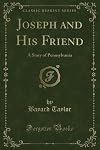
Joseph and his friend: a story of Pennsylvania
by Bayard Taylor
On This Page
Description
Joseph and His Friend: A Story of Pennsylvania (1870) is a novel by Bayard Taylor. Written toward the end of Taylor's career as a prominent travel writer and poet, Joseph and His Friend: A Story of Pennsylvania has been recognized by scholars as the first gay novel in American literary history. "When they were seated side by side, and Joseph leaned his head back on the supporting arm, while the train moved away with them, he felt that a new power, a new support, had come to his life. The show more face upon which he looked was no longer strange; the hand which had rested on his heart was warm with kindred blood. Involuntarily he extended his own; it was taken and held, and the dark gray, courageous eyes turned to him with a silent assurance which he felt needed no words." During a train derailment, Joseph Aster sustains minor injuries and his helped by a kind stranger named Philip Held. Regaining his senses, Joseph feels an unspeakably strong spiritual and physical connection with his savior. As they become inseparable friends, Joseph's home life begins to suffer as his wife Julia asserts control over their finances, often to the benefit of her wealthy family. When tragedy strikes, Joseph has no one to turn to but Philip, a man he has grown to love more than anything in the world. With a beautifully designed cover and professionally typeset manuscript, this edition of Bayard Taylor's Joseph and His Friend: A Story of Pennsylvania is a classic work of queer literature reimagined for modern readers. show lessTags
Recommendations





























Member Reviews
The Publisher Says: Joseph, a young man, marries a wealthy woman just as he is discovering an even more powerful love with his new friend Philip and must contend with the revelation of his wife's manipulative nature as well as his increasing feelings for Philip.
Joseph and His Friend has been deemed the "first gay novel" in America. It has also been noted for its enigmatic treatment of homosexuality. Roger Austen notes "In the nineteenth century, Bayard Taylor had written that the reader who did not feel 'cryptic forces' at play in Joseph and His Friend would hardly be interested in the external movement of his novel."
I PROCURED THIS BOOK FROM PROJECT GUTENBERG.
My Review: I love the straight-people arguments about how "gay" things show more weren't really A Thing in historical time! Alexander and Hephaistion? Besties! Achilles and Patroclus? Companions! Naomi and Ruth? Dutiful daughter-in-law! They really don't mean that. They mean "y'all creepy little losers aren't real and if you try harder you'll be just like me" so, since we won't do that, it's easy to hate us guilt-free. (Lest we be in any doubt, "I accept you, just not the sins you're committing" is hateful, judgmental rejection, like the horrifying "I love you anyway" that good christians love to emit.)
This is the story of a man who marries a horrible, manipulative woman, figures out she's awful, and confronts her with a demand that she change. Instead, she has a hissy fit and dies. (Good riddance to bad rubbish.) The way he figures out she's bad news is the love of a good man. He is involved in a train wreck (literal this time) and is nursed back to health by Philip. The good, kind, caring, nurturing Philip delivers everything Joseph has thirsted for. Their strong loving bond gives Joseph the strength to face down all of Society as his beady-eyed, small-souled religious-nut community suspects he is the cause of his revolting wife's death.
As soon as Joseph leaves these awful, judgmental church-goers and spends some more time in The Wilderness, the first place he returns to is Philip. "Ooops," thought Bayard Taylor, "that won't do," (or it was said to him) and hey-presto Joseph is suddenly, without the slightest reason, in love with Philip's sister who has barely appeared before this. As kludges go, this one's pretty awkward but doesn't shock me. Especially revealing of the nature of it as kludge is the extended meditation Philip runs through where he laments the fact that Joseph will be "take{n} further from my heart"; he determines, though, that it's really all for the best and he'll be vicariously happy intheir marriage. Note: he doesn't at any time think "now I'll go get me one of those marriage things" or think about how he's happy his sister has such a good man; he mourns his own loss and sets up a lifetime of pining for what she ghosted out from under his nose.
Why I kept going despite the very serious problems with this book is simple: the American nineteenth century wasn't all that tolerant of Others. We're racist now, but these folks had just fought a war five years before it came out to determine if chattel slavery was going to remain legal. The whole thing, just by existing, is a shock to the social system. The author acknowledges as much in his preface:
Borrow it from the library, download it for free. Not a book you'll want to re-read absent a real fascination with queerness in the nineteenth century. show less
Joseph and His Friend has been deemed the "first gay novel" in America. It has also been noted for its enigmatic treatment of homosexuality. Roger Austen notes "In the nineteenth century, Bayard Taylor had written that the reader who did not feel 'cryptic forces' at play in Joseph and His Friend would hardly be interested in the external movement of his novel."
I PROCURED THIS BOOK FROM PROJECT GUTENBERG.
My Review: I love the straight-people arguments about how "gay" things show more weren't really A Thing in historical time! Alexander and Hephaistion? Besties! Achilles and Patroclus? Companions! Naomi and Ruth? Dutiful daughter-in-law! They really don't mean that. They mean "y'all creepy little losers aren't real and if you try harder you'll be just like me" so, since we won't do that, it's easy to hate us guilt-free. (Lest we be in any doubt, "I accept you, just not the sins you're committing" is hateful, judgmental rejection, like the horrifying "I love you anyway" that good christians love to emit.)
This is the story of a man who marries a horrible, manipulative woman, figures out she's awful, and confronts her with a demand that she change. Instead, she has a hissy fit and dies. (Good riddance to bad rubbish.) The way he figures out she's bad news is the love of a good man. He is involved in a train wreck (literal this time) and is nursed back to health by Philip. The good, kind, caring, nurturing Philip delivers everything Joseph has thirsted for. Their strong loving bond gives Joseph the strength to face down all of Society as his beady-eyed, small-souled religious-nut community suspects he is the cause of his revolting wife's death.
As soon as Joseph leaves these awful, judgmental church-goers and spends some more time in The Wilderness, the first place he returns to is Philip. "Ooops," thought Bayard Taylor, "that won't do," (or it was said to him) and hey-presto Joseph is suddenly, without the slightest reason, in love with Philip's sister who has barely appeared before this. As kludges go, this one's pretty awkward but doesn't shock me. Especially revealing of the nature of it as kludge is the extended meditation Philip runs through where he laments the fact that Joseph will be "take{n} further from my heart"; he determines, though, that it's really all for the best and he'll be vicariously happy intheir marriage. Note: he doesn't at any time think "now I'll go get me one of those marriage things" or think about how he's happy his sister has such a good man; he mourns his own loss and sets up a lifetime of pining for what she ghosted out from under his nose.
Why I kept going despite the very serious problems with this book is simple: the American nineteenth century wasn't all that tolerant of Others. We're racist now, but these folks had just fought a war five years before it came out to determine if chattel slavery was going to remain legal. The whole thing, just by existing, is a shock to the social system. The author acknowledges as much in his preface:
To those who prefer quiet pictures of life to startling incidents, the attempt to illustrate the development of character to the mysteries of an elaborate plot, and the presentation of men and women in their mixed strength and weakness to the painting of wholly virtuous ideals and wholly evil examples: who are as interested in seeing moral and intellectual forces at work in a simple country community as on a more conspicuous place of human action: who believe in the truth and tenderness of man's love for man, as of man's love for woman: who recognize the trouble which confused ideals of life and the lack of high and intellect culture bring upon a great portion of our country population,–to all such, no explanation of this volume is necessary. Others will not read it.
Borrow it from the library, download it for free. Not a book you'll want to re-read absent a real fascination with queerness in the nineteenth century. show less
Bayard Taylor (1825-1878), American author
Joseph and Friend "has been called America's first gay novel"
Young-#3752
Joseph and Friend "has been called America's first gay novel"
Young-#3752
Ratings
Members
- Recently Added By
Author Information

75+ Works 641 Members
Work Relationships
Common Knowledge
- Original publication date
- 1871
Classifications
- Genres
- Fiction and Literature, LGBTQ+, General Fiction
- DDC/MDS
- 813.4 — Literature & rhetoric American literature in English American fiction in English Later 19th Century 1861-1900
- LCC
- PZ3 .T212 .J — Language and Literature Fiction and juvenile belles lettres Fiction and juvenile belles lettres Fiction in English
- BISAC
Statistics
- Members
- 27
- Popularity
- 1,007,878
- Reviews
- 2
- Rating
- (3.25)
- Languages
- English
- Media
- Paper, Ebook
- ISBNs
- 9
- ASINs
- 2