
True Names
by Vernor Vinge
On This Page
Description
In 1981, three years before the publication of Neuromancer, Vernor Vinges critically acclaimed novella True Names invented the concept of cyberspace, introducing fictionally the idea of a global network of computers. In forums as diverse as Wired, The Whole Earth Catalog, Artificial Intelligence conferences, and Omni, Vinges concept of cyberspace has been the subject of articles and debate. This book is the first forum to explore, in original articles and never-reprinted magazine pieces, the show more frontier of the Internet and all its subsets. show lessTags
Recommendations

















Member Reviews
Arguably the first cyberpunk story. Immersive interfacing, massive networking and, as the title implies, the dangers of doxxing. Throw in AI approaching sentience and various chatbots as well. The story is simple but well written. It's when it was written that should give you pause.
June of 1979 to January of 1980.Two years after the Apple 2.
Perhaps the most prescient novel I've ever read - it gets very little wrong (population is set at a mere 5 billion, for example) and does add in some fun sci-fi elements (the Finger of God) but overall an amazingly accurate predictive exercise. Read it and wonder if the author had a time machine.
June of 1979 to January of 1980.Two years after the Apple 2.
Perhaps the most prescient novel I've ever read - it gets very little wrong (population is set at a mere 5 billion, for example) and does add in some fun sci-fi elements (the Finger of God) but overall an amazingly accurate predictive exercise. Read it and wonder if the author had a time machine.
True Names by Vernor Vinge 1984 e-book
I’m not sure why it’s taken me nearly 40 years to read this book, but I’m now convinced that anyone with any interest in Science Fiction or specifically Cyberpunk this is a required read, so spoiler I liked it a lot.
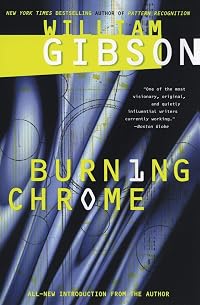
When people talk about the origins of Cyber punk normally the first name off people lips is William Gibson. I agree that Gibson added a huge amount to the Sub-genre but in my opinion, there should be a lot more plaudits for other authors that developed ideas, before and around the Time William Gibson was publishing his most respected works. A year before Burning Chrome and two before Neuromancer Vernor Vinge a respected Computer Scientist and Mathematician published the Novella show more True Names.
The Story follows a group of Computer Hackers and specifically Mr Slippery as they use full immersion Virtual reality. They hide their ‘True Names’ as if you know someone’s True name you can have control and leverage in the real world. They see the Government as the Great Adversary, but Mr Slippery’s True Name is found out by a Government agency and they force him to work for them in order to track down another Hacker, ‘The Mailman’ who seems to be doing wide ranging damage to databases.
My synopsis of the story does not make it sound very special. It’s a very entertaining read and Vinge has a style of prose that pulls you into the story, but what makes this story so special and in my opinion mind blowing is context. This was written Pre-Neuromancer and is the first full representation of what is later known as Cyberspace. The use of virtual reality was so ahead of its time and there are still ideas that have not come to fruition. I’m convinced there are ideas that have been directly plucked from this story for books like Ready Player One. The only thing that really dates this book is the mention of the amount or memory the computers use. Those of you not as old as me I urge you to google (other search engines are available) the type of home computers that existed. Look at the Zx Spectrum and it puts in context how far ahead these ideas were. To me this novella and its ideas were and are incredible.
Unfortunately finding a physical copy of the novella isn’t easy. There was a reprint a few years back along with essays from various people and there are some ebook versions around. I must admit that this was the first Vernor Vinge that I have read and it encourages me to read more. It also makes me want to explore Cyberpunk, I was never a fan of the sub-genre I actually hated Neuromancer when I read it in the late 1980’s but I am going to revisit those works to see if I was miss guided.
I don’t give many 5 star reviews out but this deserves it just for how ahead of it’s time it was and the influence it had. It's forward thinking predictive Science Fiction at it's best
Goodreads ratings are pretty limiting, my benchmark using those ratings are anything 3 or above is a good strong recommendation that I would happily reread at some point
My Blog http://www.backawayfromthedonkey.co.uk/ show less
I’m not sure why it’s taken me nearly 40 years to read this book, but I’m now convinced that anyone with any interest in Science Fiction or specifically Cyberpunk this is a required read, so spoiler I liked it a lot.
When people talk about the origins of Cyber punk normally the first name off people lips is William Gibson. I agree that Gibson added a huge amount to the Sub-genre but in my opinion, there should be a lot more plaudits for other authors that developed ideas, before and around the Time William Gibson was publishing his most respected works. A year before Burning Chrome and two before Neuromancer Vernor Vinge a respected Computer Scientist and Mathematician published the Novella show more True Names.
The Story follows a group of Computer Hackers and specifically Mr Slippery as they use full immersion Virtual reality. They hide their ‘True Names’ as if you know someone’s True name you can have control and leverage in the real world. They see the Government as the Great Adversary, but Mr Slippery’s True Name is found out by a Government agency and they force him to work for them in order to track down another Hacker, ‘The Mailman’ who seems to be doing wide ranging damage to databases.
My synopsis of the story does not make it sound very special. It’s a very entertaining read and Vinge has a style of prose that pulls you into the story, but what makes this story so special and in my opinion mind blowing is context. This was written Pre-Neuromancer and is the first full representation of what is later known as Cyberspace. The use of virtual reality was so ahead of its time and there are still ideas that have not come to fruition. I’m convinced there are ideas that have been directly plucked from this story for books like Ready Player One. The only thing that really dates this book is the mention of the amount or memory the computers use. Those of you not as old as me I urge you to google (other search engines are available) the type of home computers that existed. Look at the Zx Spectrum and it puts in context how far ahead these ideas were. To me this novella and its ideas were and are incredible.
Unfortunately finding a physical copy of the novella isn’t easy. There was a reprint a few years back along with essays from various people and there are some ebook versions around. I must admit that this was the first Vernor Vinge that I have read and it encourages me to read more. It also makes me want to explore Cyberpunk, I was never a fan of the sub-genre I actually hated Neuromancer when I read it in the late 1980’s but I am going to revisit those works to see if I was miss guided.
I don’t give many 5 star reviews out but this deserves it just for how ahead of it’s time it was and the influence it had. It's forward thinking predictive Science Fiction at it's best
Goodreads ratings are pretty limiting, my benchmark using those ratings are anything 3 or above is a good strong recommendation that I would happily reread at some point
My Blog http://www.backawayfromthedonkey.co.uk/ show less
A fine little cyberpunk story, though pretty by-the-numbers by today's standards. Vinge gives us a story of a virtual-reality version of the internet that is similar to the Sprawl and the Metaverse, though with a slightly different interface and rationale. In practice, it's not all that different though, there's a bit too much time spent on explaining the technical side of how it works, and the time spent in the fantasy-esque virtual world doesn't add all that much. However, the concern with anonymity among a group of internet vandals, far more tech-savvy than the government that tries to stop them, is very well done and still interesting and relevant today. The later part of the story, where access to information allows the show more protagonists to essentially gain godhood, portrays human consciousness in a way that is not that uncommon but still always bothers me and always rings untrue. The ending lifts the story a bit by again focusing on anonymity and what that means. Overall this is definitely not a story to knock your socks off, but if you're looking for an early cyberpunk story this will do nicely. show less
I hadn't come across this author before, and I was (probably) too young for True Names to show up on my radar when it was first published as a novella in 1981. This reissue is accompanied by several essays that were written 10 or more years later, still well before the current date.
The plotline of True Names is straightforward on the surface: a hacker is pressured into attempting to uncover the real-life identity of a more dangerous hacker, which (of course) isn't as straightforward as initially hoped. There are interesting themes of symbolism and trust, and perhaps a sense of assessing people by what they do rather than what they say. I'd say the story has aged rather well.
I dipped into the accompanying essays, and I'm sure I will show more again. The concepts were a bit "technical" for me to fully appreciate from my non-IT-specialised background, but even so, they were thought-provoking.
Worth a read, and then a re-read. show less
The plotline of True Names is straightforward on the surface: a hacker is pressured into attempting to uncover the real-life identity of a more dangerous hacker, which (of course) isn't as straightforward as initially hoped. There are interesting themes of symbolism and trust, and perhaps a sense of assessing people by what they do rather than what they say. I'd say the story has aged rather well.
I dipped into the accompanying essays, and I'm sure I will show more again. The concepts were a bit "technical" for me to fully appreciate from my non-IT-specialised background, but even so, they were thought-provoking.
Worth a read, and then a re-read. show less
My reactions to reading this short novel in 1991. Spoilers follow.
Norman Spinrad said this is the grandfather of cyberpunk. The imagery of Vinge is of the heroic fantasy, though, not that of the spy novel or the crime genres which William Gibson used in his Sprawl novels.
This is quite explicit in the novel's first paragraph where the magician of the First Age of Magic -- implying the novel takes place in the Second Age of Magic -- concern over protecting his True Name is repeated in the computer hacker's concern over his true identity which, as the novel's protagonist Roger Pollack aka Mr. Slippery finds out, can put him in thrall to the Great Enemy, the repressive bureaucracy of the United States government. However, even though the show more low-life element of cyberpunk's "high-tech, low-life" is missing (all the computer magicians in the Coven whose identity we know are middle-class types) the high-tech element is very much the same. The hackers use EEG devices for I/O computer devices much like the decks the cowboys use in Gibson's works.
Both Vinge and Gibson picture a world where data and programs are represented iconographically. This is Gibson's "cyberspace"; Vinge calls it the Other Plane. While Gibson's cyberspace has hulking, abstract cityscapes representing data, hulking masses for ICE (intrusion counter electronics) and menacing shapes of computer viruses, Vinge's other plane is much more of what Gibson called a "consensual hallucination". His baroque Other Plane is a fantasy type world of wizards and monsters. (One of the neater touches in this novel is the fire-breathing dragon in his asbestos Alan Turing t-shirt who guards the Coven's castle.).
Both Vinge and Gibson have artificial personality simulators and artificial intelligences but this can come from sf imagery without any real scientific influence though Debby Charteris wishing to use the kernal of programming that started the Mailman to preserve herself in the Other Plane seems a bit unique (and, if memory serves me correct, shows up as a concept in Gibson's work).
As expected, Vinge is more sophisticated. Most of the government and mainstream lags behind in technological conservatism while the military research arms and the National Security Agency work on the cutting edge. (Vinge clearly recognizes the NSA's influence on computer development and mentions the computer encryption controversy with the NSA of the late '70s.) While Michaelmas in Algis Budrys' eponymous novel has, as David Pringle pointed out in his 100 Best Science Fiction Novels, an almost god-like omniscience -- conveyed second-hand through Domino due to his data access, Pollack and Charteris god-like transcendence is described in mythical imagery.
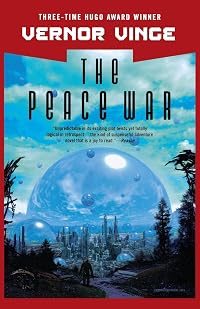
They nobly renounce their power. Vinge seems to have faith in common humanity -- I suspect he is a bit of a libertarian anarchist given his interest in anarchy that he said led to his “Conquest by Default” and the tyranny of scientists in his The Peace War when they attempt domination in the name of peace. In this novel the Slimey Limey seems to herald the eventual end of the repressive bureaucracy. However, its repression is never shown much though -- apart from granting computer user licenses -- just talked about by hackers.
Vinge doesn’t have a lot of flab in this story and comes up with some neat plot twists. One -- the story’s red herring, the idea of an extraterrasterrial intelligence more advanced in information processing covertly subverting our world preparatory to setting up a fiefdom would make a great story. The other good twist was having the Mailman being truly sentient -- but a few seconds of self-awareness taking hours of processing time hence his disguise as an old time mailman. The transcendent scenes of this novel clearly pre-figure the Singularity of Vinge’s later works (a concept, despite Vinge not being a big sf name in terms of sales, that has been picked up by many sf writers).
A few plot twists: I find it hard to believe that the Army team sent to kill Pollack would be told to ignore any further orders due to possible misinformation via Pollack’s control of the information network but still trust orbit-fed, computer derived maps; Second, I find it implausible that detonating three nuclear warheads in Utah (mention is made of missiles detonating in the Midwest silos but it’s unclear if this is their warheads or fuels) could be passed off as just serious computer vandalism by the government. There are some interesting bits in the periphery of Vinge’s world: the electronic newspapers, coups and government manipulation via computerized sabotage of government computer networld and automated decision programs, Finger of God anti-satellite system, and processing centers in satellites. show less
Norman Spinrad said this is the grandfather of cyberpunk. The imagery of Vinge is of the heroic fantasy, though, not that of the spy novel or the crime genres which William Gibson used in his Sprawl novels.
This is quite explicit in the novel's first paragraph where the magician of the First Age of Magic -- implying the novel takes place in the Second Age of Magic -- concern over protecting his True Name is repeated in the computer hacker's concern over his true identity which, as the novel's protagonist Roger Pollack aka Mr. Slippery finds out, can put him in thrall to the Great Enemy, the repressive bureaucracy of the United States government. However, even though the show more low-life element of cyberpunk's "high-tech, low-life" is missing (all the computer magicians in the Coven whose identity we know are middle-class types) the high-tech element is very much the same. The hackers use EEG devices for I/O computer devices much like the decks the cowboys use in Gibson's works.
Both Vinge and Gibson picture a world where data and programs are represented iconographically. This is Gibson's "cyberspace"; Vinge calls it the Other Plane. While Gibson's cyberspace has hulking, abstract cityscapes representing data, hulking masses for ICE (intrusion counter electronics) and menacing shapes of computer viruses, Vinge's other plane is much more of what Gibson called a "consensual hallucination". His baroque Other Plane is a fantasy type world of wizards and monsters. (One of the neater touches in this novel is the fire-breathing dragon in his asbestos Alan Turing t-shirt who guards the Coven's castle.).
Both Vinge and Gibson have artificial personality simulators and artificial intelligences but this can come from sf imagery without any real scientific influence though Debby Charteris wishing to use the kernal of programming that started the Mailman to preserve herself in the Other Plane seems a bit unique (and, if memory serves me correct, shows up as a concept in Gibson's work).
As expected, Vinge is more sophisticated. Most of the government and mainstream lags behind in technological conservatism while the military research arms and the National Security Agency work on the cutting edge. (Vinge clearly recognizes the NSA's influence on computer development and mentions the computer encryption controversy with the NSA of the late '70s.) While Michaelmas in Algis Budrys' eponymous novel has, as David Pringle pointed out in his 100 Best Science Fiction Novels, an almost god-like omniscience -- conveyed second-hand through Domino due to his data access, Pollack and Charteris god-like transcendence is described in mythical imagery.
They nobly renounce their power. Vinge seems to have faith in common humanity -- I suspect he is a bit of a libertarian anarchist given his interest in anarchy that he said led to his “Conquest by Default” and the tyranny of scientists in his The Peace War when they attempt domination in the name of peace. In this novel the Slimey Limey seems to herald the eventual end of the repressive bureaucracy. However, its repression is never shown much though -- apart from granting computer user licenses -- just talked about by hackers.
Vinge doesn’t have a lot of flab in this story and comes up with some neat plot twists. One -- the story’s red herring, the idea of an extraterrasterrial intelligence more advanced in information processing covertly subverting our world preparatory to setting up a fiefdom would make a great story. The other good twist was having the Mailman being truly sentient -- but a few seconds of self-awareness taking hours of processing time hence his disguise as an old time mailman. The transcendent scenes of this novel clearly pre-figure the Singularity of Vinge’s later works (a concept, despite Vinge not being a big sf name in terms of sales, that has been picked up by many sf writers).
A few plot twists: I find it hard to believe that the Army team sent to kill Pollack would be told to ignore any further orders due to possible misinformation via Pollack’s control of the information network but still trust orbit-fed, computer derived maps; Second, I find it implausible that detonating three nuclear warheads in Utah (mention is made of missiles detonating in the Midwest silos but it’s unclear if this is their warheads or fuels) could be passed off as just serious computer vandalism by the government. There are some interesting bits in the periphery of Vinge’s world: the electronic newspapers, coups and government manipulation via computerized sabotage of government computer networld and automated decision programs, Finger of God anti-satellite system, and processing centers in satellites. show less
Ratings
Members
- Recently Added By
Author Information

58+ Works 23,220 Members
All Editions
Awards and Honors
Awards
Notable Lists
Work Relationships
Is contained in
Common Knowledge
- Original publication date
- 1981
Classifications
Statistics
- Members
- 133
- Popularity
- 245,869
- Reviews
- 5
- Rating
- (3.98)
- Languages
- English
- Media
- Paper, Ebook
- ISBNs
- 1
- ASINs
- 1

