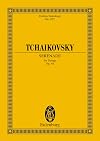
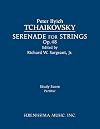
Serenade. in C major / Opus 48, For string orchestra
by Pyotr Ilyich Tchaikovsky
On This Page
Description
Written in September and October of 1880 Tchaikovsky's Serenade for Strings was completed quickly. While away visiting his sister in Kamenka and he "immediately began to feel cheerful, well and relaxed". This work is perfectly reflctive of warmth and happiness the composer experienced on his Autumn holiday. Though originally intended to be a suite, Tchaikovsky ultimately created a symphony for strings. Because of its sunniness this work soon become a concert favorite among string players and show more with audiences worldwide. This newly engraved edition by Richard W. Sargeant, Jr. uses the composer's manuscript and the first edition as its primary sources, correcting the many errors and editorial additions that have been added over the years. A beautiful score showcasing one of Tchaikovsky happiest times as the composer intended it. IMSLP page Tchaikovsky Research show lessTags
Recommendations





















Member Reviews
Members
- Recently Added By
Author Information

1,784+ Works 5,531 Members
One of Russia's greatest composers, Peter Ilich Tchaikovsky was born in Votkinsk, Russia. He received a good early education; his instructors included a French governess and a music teacher. When he was 10 years old, the family moved to St. Petersburg, and Tchaikovsky continued his studies, although his musical talent did not seem particularly show more great. Nevertheless, he continued to study music and graduated from the St. Petersburg Conservatory in 1865. From there he went on to teach theory and composition at the Moscow Observatory from 1866 to 1877. A generous allowance from a wealthy patroness allowed Tchaikovsky to devote time to his own composition without financial worries. His first successful composition was Romeo and Juliet (1869), a fantasy overture in which Tchaikovsky used the sonata form, adapting it to the demands of the Shakespearean play and its characters. Soon after Tchaikovsky's short marriage in 1877 ended, he quit the observatory to devote all of his time to composition. In the years that followed, he wrote his most popular and well-known works. In all, Tchaikovsky wrote nine operas, six symphonies, many songs and short piano pieces, three ballets, three string quartets, and other works, including suites and symphonic poems. The operas Eugene Onegin (1879) and Queen of Spades (1890) were both adapted from stories by Aleksandr Pushkin (see Vol. 2). Among Tchaikovsky's best-known works are his last three symphonies---No. 4 in F minor (1877); No. 5 in E minor (1888); No. 6 in B minor, also known as the Pathetique (1893); and his three ballets---Swan Lake (1877), Sleeping Beauty (1889), and The Nutcracker (1892). Tchaikovsky's music is richly orchestrated, of great emotional intensity, and reflects the composer's melancholy nature and fatalism. (Bowker Author Biography) show less
Classifications
- Genres
- Music, Nonfiction
- DDC/MDS
- 784.9 — Arts & recreation Music Instrumental Music The voice
- LCC
- M1103 .T343 — Music Music Instrumental music String orchestra
- BISAC
Statistics
- Members
- 20
- Popularity
- 1,277,695
- Reviews
- 1
- Languages
- English, No linguistic content
- ISBNs
- 4
- UPCs
- 1
- ASINs
- 1