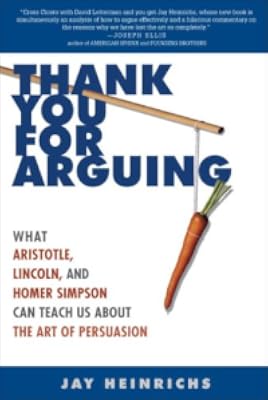
Thank You for Arguing: What Aristotle, Lincoln, and Homer Simpson Can Teach Us About the Art of Persuasion
by Jay Heinrichs
On This Page
Description
Thank You for Arguing is your master class in the art of persuasion, taught by professors ranging from Bart Simpson to Winston Churchill. The time-tested secrets the book discloses include Cicero's three-step strategy for moving an audience to action--as well as Honest Abe's Shameless Trick of lowering an audience's expectations by pretending to be unpolished. But it's also replete with contemporary techniques such as politicians' use of "code" language to appeal to specific groups and an show more eye-opening assortment of popular-culture dodges, including: The Eddie Haskell Ploy ; Eminem's Rules of Decorum ; The Belushi Paradigm ; Stalin's Timing Secret ; The Yoda Technique. Whether you're an inveterate lover of language books or just want to win a lot more anger-free arguments on the page, at the podium, or over a beer, Thank You for Arguing is for you. Written by one of today's most popular online language mavens, it's warm, witty, erudite, and truly enlightening. It not only teaches you how to recognize a paralipsis and a chiasmus when you hear them, but also how to wield such handy and persuasive weapons the next time you really, really want to get your own way. show lessTags
Recommendations

Member Reviews
This is one of those books, maybe the only book, which, many years after reading it I continue to recommend to people like me- those who are too into logos to notice that isn't how people work and there are two other central components to rhetoric! For a while it definitely positively affected my interactions with others- but I often now find myself slipping back into bad arguing habits. Probably due for a re-read!
I stretched this one out quite a while because I would pick it up, read a few sections and put it down for something else. It's a nice conversational read, full of great explanations, strategies, tips, told with not a few anecdotes (which ordinarily would drive me nuts, but weren't so bad taken a bit at a time). Recommended.
While the author is to be commended for trying to make a potentially dry subject - rhetoric - interesting, the result in this book is a rather glib and facile attempt to explain rhetoric and its uses to a 'lay audience'. While there are lots of examples, and terminology, not much of it is particularly useful unless you have never previously bothered having an argument or expressing your point of view.
The chapters follow a scheme of organisation, but it is quite disjointed rather than naturally flowing. The side boxes are distracting from the main text (this seems to be a technique used in a lot of self-help and management books, as though the reader will get bored if they are expected to just read paragraphs of text. I would prefer to show more read blocks of text rather than jump about the page). And the layout is bad in sections.
The real life examples used in the book are humourous, which makes the ideas more approachable, but the author is often very sexist, and boorish.
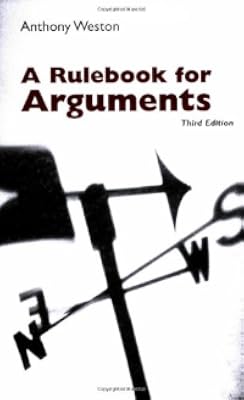
Overall, if you are interested in how to construct an argument, read Weston's 'A Rulebook for Arugments', if you are interested in public speaking, there are a multitude of better books on the subject out there. show less
The chapters follow a scheme of organisation, but it is quite disjointed rather than naturally flowing. The side boxes are distracting from the main text (this seems to be a technique used in a lot of self-help and management books, as though the reader will get bored if they are expected to just read paragraphs of text. I would prefer to show more read blocks of text rather than jump about the page). And the layout is bad in sections.
The real life examples used in the book are humourous, which makes the ideas more approachable, but the author is often very sexist, and boorish.
Overall, if you are interested in how to construct an argument, read Weston's 'A Rulebook for Arugments', if you are interested in public speaking, there are a multitude of better books on the subject out there. show less
As a teacher of high school rhetoric I found this a great book that explains the classical art of persuasion. He uses many great examples from history, his personal experience, politics, television and other things in our culture. He has a funny sense of humor and gets his point across well. It is well organized and he uses sideboards to give other facts or definitions which were helpful. I will recommend this to those who know nothing about rhetoric and also to my students.
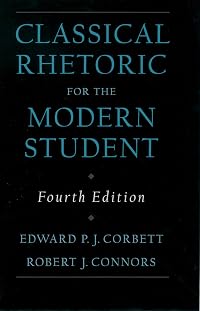
A great primer on argumentation. It has a nice conversational style and doesn't get too hung-up on rhetorical figures or argumentation styles. It gives a usable overview of the major argument "voices" then gives salient examples. This is a very workable place to start a study on rhetoric before moving on to Corbett and Connors.
A interesting rhetoric primer disguised as a self-help book. However despite handy end of chapter summaries it suffers from fragmentation and disorganisation.
I love this book! Rhetoric has always been one of those things that I've gone "hunh???" over. This makes rhetoric fun and funny! His examples really do include Aristotle to Homer Simpson, along with his teen son and his preschool daughter. Funny, funny, funny!!
Members
- Recently Added By
Lists

Guttabois
27 works; 1 member

Perspectives Book Club Picks
49 works; 3 members
Author Information
23 Works 1,832 Members
Jay Heinrichs is the New York Times bestselling author of Thank You for Arguing. He has taught persuasion to editors at Ivy League universities, NASA, and the Pentagon and runs the acclaimed blog Figarospeeeh.com, as well as the rhetoric site ArgueLab.com.
Classifications
- Genres
- Nonfiction, General Nonfiction, Philosophy
- DDC/MDS
- 303.342 — Society, government, & culture Social sciences, sociology & anthropology Social processes Coordination and control Leadership
- LCC
- P301.5 .P47 .H45 — Language and Literature Philology. Linguistics Language. Linguistic theory. Comparative grammar Style. Composition. Rhetoric
- BISAC
Statistics
- Members
- 599
- Popularity
- 48,856
- Reviews
- 9
- Rating
- (3.83)
- Languages
- Chinese, English, Korean
- Media
- Paper, Audiobook, Ebook
- ISBNs
- 12
- ASINs
- 2