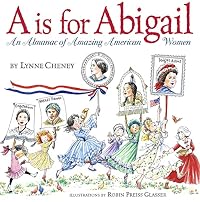
A is for Abigail: An Almanac of Amazing American Women
by Lynne Cheney
On This Page
Description
Each letter of the alphabet is represented by an important woman in the history of the United States, as well as others in her same field of accomplishment.Tags
Recommendations


Member Reviews
This book is one that highlights the strength of amazing American women, where the main message is to inform readers of these women’s accomplishments and advancement to the United States. I really wanted to like this book for it has a few features that are great, notably the illustrations and language, however I cannot bring myself to really like it due to the poor writing/ organization.
The illustrations and language are both amazing, popping off the pages vividly. Both enhance the story and create a mood of inspiration and pride, especially for those readers who are female. Both the illustrations and language are clear and detailed, providing detailed accounts and physical images of the women described. I especially like the letter show more “p”, where its page shows American performers. Each character comes to life and is unique. The accompanying language to this section is clear and to the point.
What I did not enjoy about this book was the extremely overwhelming writing and its organization. Many pages consist of words all over the page, making it hard to find the starting point and even harder to read. It is very overwhelming, especially when the text featured was presented as page borders, like the letter “b” page.
Overall, I think this book highlights American women well, but could definitely be improved. The pages that stand out are the ones that are not as overwhelming, and are the pages I enjoyed the most alongside the beautiful illustrations and language. show less
The illustrations and language are both amazing, popping off the pages vividly. Both enhance the story and create a mood of inspiration and pride, especially for those readers who are female. Both the illustrations and language are clear and detailed, providing detailed accounts and physical images of the women described. I especially like the letter show more “p”, where its page shows American performers. Each character comes to life and is unique. The accompanying language to this section is clear and to the point.
What I did not enjoy about this book was the extremely overwhelming writing and its organization. Many pages consist of words all over the page, making it hard to find the starting point and even harder to read. It is very overwhelming, especially when the text featured was presented as page borders, like the letter “b” page.
Overall, I think this book highlights American women well, but could definitely be improved. The pages that stand out are the ones that are not as overwhelming, and are the pages I enjoyed the most alongside the beautiful illustrations and language. show less
I love this book. It is about the amazing women that helped the United States come to be the country it is today. I also like it for the fact that it states things in alphabetic order. For example, E is for the Educators. On this page it lists women such as Anne Sullivan who helped Helen Keller. It talked about Emma Willard who founded the Troy Female Seminary because she knew women had the right to a good education. This book talks about the first women who fought in war, the first women who became writers, the most famous and notable actresses, women who won gold medals at the Olympics, women who marched in the second wave for equal rights, it goes on and on. This is a really good informational book to show that women helped form our show more country as well as men. This book includes so many different women that I have never even heard of but without that person, something in this world would be different. Every page is filled with illustrations top to bottom. Everything is vibrant, fun, and exciting. show less
I imagined myself getting lost in this book as a young child, picturing my mother read to me in bed, listening as she would provide additional commentary on each page. The text itself is a bit skimpy when it comes to learning anything of real value about these women, but it is a good starting point for anyone who might be interested in learning more about American women who pioneered in different fields. Staged in alphabetical order, each letter represents largely a different theme or profession rather than focusing on one individual, with the exception of the titular figure. Colorful illustrations are fun and intricate, offering readers a variety of images to scan, reminiscent of Where's Waldo or hidden pictures. The design and layout show more of each page varies, featuring text that curves around the page, blips of captions, or sometimes just a collage of portraits. Some women of color are represented, but the illustrations disappointingly seem to have Anglicized or colloquially white-washed these women. Additionally, some of the women featured are perhaps slightly obscure, but this can be an opportunity to expand one's knowledge and understanding of women's history in the United States. For high school students studying women's rights, this book could serve to springboard research into a particular figure and could be used in the classroom for a quick reference of American women of worth; for younger readers, it might simply plant the proverbial seed of inspiration. show less
This book appeared to have good intentions, but was overambitious. It's almost an illustrated bibliography for kids, or perhaps even more pointedly, an illustrated list of women to look up on Wikipedia. The selection of women is carefully curated to include women of various races, which is great, but gender and LGBT diversity seems pointedly shoved aside (though, to be fair, Susan B. Anthony made the cover). Also, it seemed the immigrant women highlighted were overall very white. Nonetheless, the book is a good jumping off point, and would be an asset to any classroom collection. As a graduate of a Seven Sisters school, I also appreciated the book's emphasis on the Seven Sisters, of which many students might otherwise be unaware.
chaotic collage, possibly a lesson in creative categorizing/sorting methods! Otherwise exciting pictures with lots of information, maybe a scavenger hunt; assigned to "K-3", but only some aspects are targeted there, much of the content is for older student research
This book is very uneven for the choices of the women included. I am unclear what Cheney’s method was for selection. She mentions an old biographical dictionary called Notable American Women as a source of information. There have been more recent and more comprehensive encyclopedias since this source published in 1971 and 1980. If she relied on this dictionary for her information, that might account for the limited range of women chosen for this book. There are some odd decisions, like there are only 8 women artists on page N. No information is given for any of the women; just their name appears at the bottom of their portrait. To find any information, you need to look at the index which provides a line or two on each woman featured show more in the book. One square even depicts the letter “N” instead of a woman artist. Eight seems a pretty small number to celebrate given our rich heritage of women artists in America. Similarly, only 8 women writers are featured on the W page but then other women writers’ names are listed around the 4 margins. Interestingly, Willa Cather and Harriet Beecher Stowe are given some biographical detail but others like Toni Morrison and Pearl S. Buck get only their name listed below their image. Important native women writers like Leslie Marmon Silko and Louise Erdrich are missing completely. In contrast, the J page is dedicated solely to Anna Jarvis, a woman who pioneered the Mother’s Day holiday---not sure I would count that as more important than someone like Ida B Wells-Barnett, anti-lynching activist who I can’t find at all. I also find the illustrations to be more overwhelming than enjoyable; some pages need more white space and clearer layouts to communicate effectively.
I can think of a couple of ways to use this book. It could be used by older students to analyze who is included and who is missing in this fairly recent publication. That could lead to discussions about the inclusion of multiculturalism in children’s materials today. For younger students, they could research one of the women included in the book and do a biographical report on her to provide much more detail than given in this alphabet book. The biographies could be tied to women’s history month or with any other unit, like a unit on artists or scientists or even personal heroes. show less
I can think of a couple of ways to use this book. It could be used by older students to analyze who is included and who is missing in this fairly recent publication. That could lead to discussions about the inclusion of multiculturalism in children’s materials today. For younger students, they could research one of the women included in the book and do a biographical report on her to provide much more detail than given in this alphabet book. The biographies could be tied to women’s history month or with any other unit, like a unit on artists or scientists or even personal heroes. show less
I don't normally read children's books, but I received this book as a Christmas gift from my parents last year and finally read through it in one sitting last night. I'm crazy for Abigail Adams, which was what initially caught my eye about this book and which was ample reason to ignore the author's name! That and all proceeds go to charity. This is a wonderful picture book that describes some of America's most important women through the alphabet and precious illustrations by Robin Preiss Glasser. Many of the expected ladies were present - Abigail Adams, Emily Dickinson, Sandra Day O'Connor. But also some women previously unknown to me, including Elizabeth Blackwell (the first woman to earn a medical degree), Anna Jarvis (who is show more credited with starting the Mother's Day tradition), Mary Kies (the first woman to receive a patent), and many others. Nearly every profession and endeavor is represented, from authors and artists, to doctors, scientists, journalists, political figures, educators, inventors and entrepreneurs, aviators, performers and athletes. With a bit of history, a bit of feminism and a ton of inspiration, this would be a great gift to a little girl or boy in your life. Sure to drive home the message that men and women alike can do or be anything they can dream! show less
Members
- Recently Added By
Author Information

23+ Works 5,449 Members
Lynne Cheney was born on August 14, 1941 in Casper, Wyoming. She received a B.A. with honors from Colorado College, a M.A. in English from the University of Colorado, and a Ph.D. in 19th century British literature from the University of Wisconsin. She was the editor of Washingtonian Magazine from 1983 to 1986. As chairman of the National Endowment show more for the Humanities from 1986 to 1993, she wrote and spoke about the importance of knowing American history and she worked to provide opportunities for teachers to gain the knowledge that leads to inspired instruction. She has written several books including We the People: The Story of Our Constitution and James Madison: A Life Reconsidered. (Bowker Author Biography) show less
Awards and Honors
Awards
Common Knowledge
- People/Characters
- Abigail Adams
Classifications
Statistics
- Members
- 999
- Popularity
- 26,034
- Reviews
- 15
- Rating
- (4.37)
- Languages
- English
- Media
- Paper, Ebook
- ISBNs
- 5
- ASINs
- 2