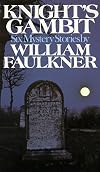
Knight's Gambit
by William Faulkner
On This Page
Description
Six mystery stories in which Gavin Stevens, student of crime and Mississippi folkways, detects the criminals' underlying motives. Includes Smoke; Monk; Hand upon the waters; Tomorrow; An Error in Chemistry; Knight's Gambit.Tags
Recommendations










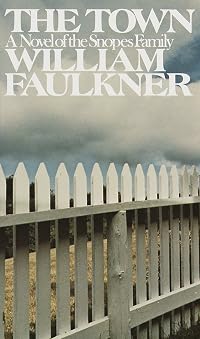
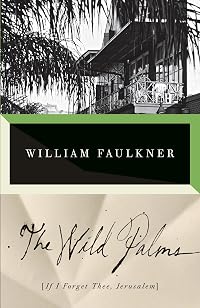




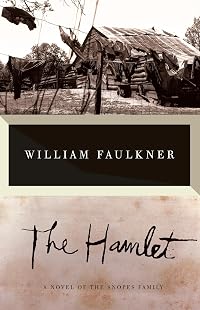









Member Reviews
The legendary British DJ and journalist, John Peel once said of his favourite band (The Fall)
"they are always different, they are always the same"
That thought resonated when reading Knight's Gambit because it's different to any other William Faulkner I've ever read, but same because it's technically brilliant and unique and so utterly William Faulkner.
Six short stories (5 and a novella) written between 1932 and 1942, I'd be fibbing if I said all the stories were of a similar standard. Knight's Gambit, the novella that gives this volume its name is Faulkner at his best.
"they are always different, they are always the same"
That thought resonated when reading Knight's Gambit because it's different to any other William Faulkner I've ever read, but same because it's technically brilliant and unique and so utterly William Faulkner.
Six short stories (5 and a novella) written between 1932 and 1942, I'd be fibbing if I said all the stories were of a similar standard. Knight's Gambit, the novella that gives this volume its name is Faulkner at his best.
A collection of stories featuring the lawyer, Gavin Stevens, including [b:Tomorrow|1510005|Tomorrow|William Faulkner|https://i.gr-assets.com/images/S/compressed.photo.goodreads.com/books/1453450751l/1510005._SX50_.jpg|1501599], my hands-down favorite from Faulkner, thus far.
Smoke - A riveting tale of two brothers, a cruel father, and a puzzling murder. Puzzling, that is, to everyone except Gavin Stevens, Faulkner’s very intelligent and clever Yoknapatawpha County lawyer. Even in this day of twisted plot lines and surprise endings, I doubt many will see this one coming. I did not.
Monk - Faulkner is really his best with injustice and tragedy, and this tale has both in spades. The manipulation of the feeble minded by the powerful and show more cruel, with no one seeking to make a difference except Gavin Stevens, a voice of morality in a decadent system.
Hand Upon the Waters - Liked this story of an almost perfect crime. Faulkner is so good at his portrayal of the mentally and physically handicapped and how they are treated by the society in which they live. They have a kind of freedom to be in nature that would not be afforded them today, but also a lack of anyone feeling responsible to care for them as they might need. It was interesting to me that it was the mentally challenged Lonnie who took in the deaf and dumb boy when he came to town.
Tomorrow Well, I cried at the end of this one. I cried for how cruel life can be and how the best instincts of a man can be used against him. And, I wondered if it was better to have loved and seen what Fentry had seen or never to have known love at all, for any other human being on earth. [Just discovered this story was made into a movie in 1972 starring one of my favorite actors, Robert Duvall, and available on Amazon. Absolutely got to watch this one.]
We followed him to the gallery, where a plump, white-haired old lady in a clean gingham sunbonnet and dress and a clean white apron sat in a low rocking chair, shelling field peas into a wooden bowl.
But Uncle Gavin says it don’t take many words to tell the sum of any human experience; that somebody has already done it in eight: He was born, he suffered, and he died.
An Error in Chemistry - A good story with twists and turns and a mystery to be solved by Gavin Stevens, but so far the least of the stories here.
Knight’s Gambit - The title story is more of a novella actually. By the time you get to this one, you feel you know Gavin Stevens pretty well, and yet the story reveals some things about him that are unexpected. Stevens is sophisticated and well-educated and yet he retains his down-to-earth small town persona, which makes him very accessible to both the other characters in the books and the reader, as well. show less
Smoke - A riveting tale of two brothers, a cruel father, and a puzzling murder. Puzzling, that is, to everyone except Gavin Stevens, Faulkner’s very intelligent and clever Yoknapatawpha County lawyer. Even in this day of twisted plot lines and surprise endings, I doubt many will see this one coming. I did not.
Monk - Faulkner is really his best with injustice and tragedy, and this tale has both in spades. The manipulation of the feeble minded by the powerful and show more cruel, with no one seeking to make a difference except Gavin Stevens, a voice of morality in a decadent system.
Hand Upon the Waters - Liked this story of an almost perfect crime. Faulkner is so good at his portrayal of the mentally and physically handicapped and how they are treated by the society in which they live. They have a kind of freedom to be in nature that would not be afforded them today, but also a lack of anyone feeling responsible to care for them as they might need. It was interesting to me that it was the mentally challenged Lonnie who took in the deaf and dumb boy when he came to town.
Tomorrow Well, I cried at the end of this one. I cried for how cruel life can be and how the best instincts of a man can be used against him. And, I wondered if it was better to have loved and seen what Fentry had seen or never to have known love at all, for any other human being on earth. [Just discovered this story was made into a movie in 1972 starring one of my favorite actors, Robert Duvall, and available on Amazon. Absolutely got to watch this one.]
We followed him to the gallery, where a plump, white-haired old lady in a clean gingham sunbonnet and dress and a clean white apron sat in a low rocking chair, shelling field peas into a wooden bowl.
But Uncle Gavin says it don’t take many words to tell the sum of any human experience; that somebody has already done it in eight: He was born, he suffered, and he died.
An Error in Chemistry - A good story with twists and turns and a mystery to be solved by Gavin Stevens, but so far the least of the stories here.
Knight’s Gambit - The title story is more of a novella actually. By the time you get to this one, you feel you know Gavin Stevens pretty well, and yet the story reveals some things about him that are unexpected. Stevens is sophisticated and well-educated and yet he retains his down-to-earth small town persona, which makes him very accessible to both the other characters in the books and the reader, as well. show less
Faulkner demonstrates that he can master the simple short story as well as the complex and brooding novel. Well, sort of simple...
When I was young, my mother (who knew southern literature from the inside, as a southerner and literary scholar of Faulkner's time) recommended this to me. It remains one of the few Faulner pieces I read with pleasure, though I think its quality is not significantly above other popular detective stories of the time.
Faulkner writes great motivation for crime...
Reading these stories after finishing The Sound and the Fury...more Yoknapatawpha County! Love all these stories. Need to read his novels that contain Gavin Stevens as well!
Yoknapatawpha County attorney Gavin Stevens solves mysteries.
Members
- Recently Added By
Lists

20th Century Literature
1,161 works; 54 members

Anthony Boucher's Best Crime Fiction of the Year
115 works; 5 members

Books mentioned in Julian Symons’ Bloody Murder
438 works; 6 members
Author Information

464+ Works 99,221 Members
Born in an old Mississippi family, William Faulkner made his home in Oxford, seat of the University of Mississippi. After the fifth grade he went to school only off and on-lived, read, and wrote much as he pleased. In 1918, refusing to enlist with the "Yankees," he joined the Canadian Air Force, and was transferred to the British Royal Air Force. show more After the war he studied a little at the University, did house painting, worked as a night superintendent at a power plant, went to New Orleans and became a friend of Sherwood Anderson, then to Europe and back home to Oxford. By this time he had written two novels. The Sound and the Fury followed in 1929. Financial success came with Sanctuary in 1931, which he assisted in filming. Faulkner 's novels are intense in their character portrayals of disintegrating Southern aristocrats, poor whites, and African Americans. A complex stream-of-consciousness rhetoric often involves Faulkner in lengthy sentences of anguished power. Most of his tales are set in the mythical Yoknapatawpha County, Mississippi, and are characterized by the use of many recurring characters from families of different social levels spanning more than a century. His best subjects are the old, dying South and the newer materialistic South. As I Lay Dying (1930), is a grotesquely tragicomic story about a family of poor southern whites. With Absalom, Absalom! (1936); the difficult parts of his famous short novel "The Bear" (published in Go Down, Moses, 1942); and the allegorical A Fable (1954), a non-Yoknapatawpha novel set in France during World War I; Faulkner returned to an innovative and difficult style that most readers have trouble with. Yet, interspersed among such works are collections of easily read stories originally published in popular magazines. There seems to be a growing sentiment among critics that the Snopes trilogy-The Hamlet (1940), The Town (1957), and The Mansion (1959)-for the most part an example of Faulkner's "moderate" style, could well be among his most important works. Faulkner was awarded the 1949 Nobel Prize for literature "for his powerful and artistically independent contribution to the new American novel," but it would appear now that he also deserved to win that honor for his contribution to world literature. When reporting his death, the Boston Globe quoted Faulkner's having once told an interviewer: "Since man is mortal, the only immortality for him is to leave something behind him that is immortal since it will always move. That is the artist's way of scribbling "Kilroy was here" on the wall of the final and irrevocable oblivion through which he must some day pass." In addition to the Nobel Prize, Faulkner received the Howells Medal of the American Academy of Arts and Letters in 1950, and in 1951 he was given the National Book Award for his Collected Stories Collected Stories. For his novel A Fable he received the National Book Award for the second time, as well as the Pulitzer Prize in 1955. The Reivers (1962) was awarded the Pulitzer Prize in 1963. In 1957 and 1958, he was the University of Virginia's first writer-in-residence, and in January 1959 he accepted an appointment as consultant on contemporary literature to the Alderman Library of that university. Although Faulkner was not without honors in his lifetime and has received world recognition since then, it is surprising to learn that, when Malcolm Cowley edited The Portable Faulkner in 1946, he found that almost all of Faulkner's books were out of print. By arranging selections from the works to form a continuous chronicle, Cowley deserves much of the credit for making readers aware of the way in which Faulkner was creating a fictive world on a scale grander than that of any novelist since Balzac. William Faulkner died in Oxford, Mississippi, in 1962. (Bowker Author Biography) show less
Some Editions
Awards and Honors
Distinctions
Notable Lists
Series
Belongs to Publisher Series
Work Relationships
Is contained in
Common Knowledge
- Canonical title
- Knight's Gambit
- Original title
- Knight's Gambit
- Original publication date
- 1949
- Original language
- English
Classifications
Statistics
- Members
- 529
- Popularity
- 56,178
- Reviews
- 10
- Rating
- (3.63)
- Languages
- 8 — Danish, English, French, German, Italian, Romanian, Spanish, Swedish
- Media
- Paper, Ebook
- ISBNs
- 25
- ASINs
- 18