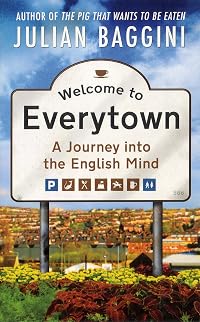
Welcome to Everytown: A Journey into the English Mind
by Julian Baggini
On This Page
Description
This study of an ordinary town in Northern England is "a thoughtful, sympathetic portrait of white working-class life...essential reading" ( Guardian ). What do the English think? Every country has a dominant set of beliefs and attitudes concerning everything from how to live a good life, how we should organize society, and the roles of the sexes. Yet despite many attempts to define England's national character, what might be called the nation's philosophy has remained largely unexamined show more until now. Philosopher Julian Baggini pinpointed postcode S66 on the outskirts of Rotherham as England in microcosm-an area that reflected most accurately the full range of the nation's inhabitants, its most typical mix of urban and rural, old and young, married and single. He then spent six months living there, immersing himself in this typical English Everytown, in order to get to know the mind of a people. It sees the world as full of patterns and order, a view manifest in its enjoyment of gambling. It has a functional, puritanical streak, evident in its notoriously bad cuisine. In the English mind, men should be men and women should be women (but it's not sure what children should be). Sympathetic but critical, serious yet witty, Baggini's account of the English as represented by this particular spot on its map is both a portrait of its people and a personal story about being an alien in your own land. "Baggini turns out to be a sensitive observer who takes people and places on their own terms. He is also good at examining his own prejudices and fears." -Independent "An insightful and often amusing investigation of what it means to be English." -London Review of Books show lessTags
Recommendations


































Member Reviews
I shall let the author speak for himself: "Attmpting to sum up the national philosophy is in many ways an absurdly ambitious project. I hope to have got a lot right, but I know I will have got many things wrong... In some ways, I don't much care." And: "Like it or not, my study would say as much about me, and those like me, as it would about the English mind I was investigating." When Baggini says "like me" he means a full member of Britain's privileged middles classes. In that sense, this is only half a book: while it aspires to cpature "the English philosophy" it really is an examination of the working classes by a middle class outsider. We could sorely do with a similar study in reverse, to be honest. But there are some genuine show more insights in this book, particularly in the opening chapters. It badly loses its way after that, and becomes sporadically frustrating, particularly in Baggini's brief treatment of "mainstream culture", which seems rushed, patronising, and misses several key points - particularly the difference between corporate or massed-produced "culture" and "real" authentic or indigenous culture. show less
Ratings
Members
- Recently Added By
Published Reviews
ThingScore 25
For one who has set out to discover what other people think, Baggini is disturbingly keen to share his own views. Is this because poor old Rotherham turned out to be a distinctly unexciting case study? Perhaps.
added by Nevov
Author Information

55+ Works 5,381 Members
Julian Baggini is the author, co-author or editor of over twenty books including How the World Thinks: A Global History of Philosophy (2018); A Short History of Truth: Consolations for a Post-Truth World (2018); The Edge of Reason: A Rational Skeptic in an Irrational World (2017), and The Pig that Wants to be Eaten and 99 other thought experiments show more (2010). He was the founding editor of The Philosopher's Magazine and has worked with the think tanks The Institute of Public Policy Research, Demos and Counterpoint. He has written for numerous newspapers and magazines, including the Guardian, Prospect and Aeon, and makes regular appearances on radio and television. He is Academic Director of the Royal Institute of Philosophy and an Honorary Research Fellow at the University of Kent. His website is www.microphilosophy.net. show less
Classifications
- Genres
- Sociology, Anthropology, Nonfiction, Travel, Philosophy, General Nonfiction
- DDC/MDS
- 301 — Society, government, & culture Social sciences, sociology & anthropology Sociology and anthropology
- LCC
- DA118 .B25 — History of Europe, Asia, Africa and Oceania Great Britain History of Great Britain England History Antiquities. Social life and customs. Ethnography
- BISAC
Statistics
- Members
- 93
- Popularity
- 346,375
- Reviews
- 1
- Rating
- (3.57)
- Languages
- English
- Media
- Paper, Ebook
- ISBNs
- 3
- ASINs
- 1