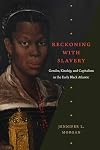
Reckoning with Slavery: Gender, Kinship, and Capitalism in the Early Black Atlantic
by Jennifer L. Morgan
On This Page
Description
"Jennifer L. Morgan draws on the lived experiences of enslaved African women in the sixteenth- and seventeenth-centuries to reveal the contours of early modern notions of trade, race, and commodification in the Black Atlantic."--Tags
Recommendations










Member Reviews
In Reckoning with Slavery, Jennifer Morgan examines the lives of enslaved Black women in the early modern period, and how both their contemporaries and later historians have written about those lives, in order to explore how ideas of trade, race, and commodification developed in the Atlantic world.
Morgan does a lot with very limited archival sources, and I found her observations and speculations about the limitations and silences of the sources—very much following in the footsteps of Saidiya Hartman—to be persuasive. This book is at is strongest as a historiographical intervention rather than a more straightforward work of history. Historians need to keep in mind that the source base is fragmented and partial—but the source base show more is fragmented and partial. It wasn't clear to me that this couldn't have been a longer journal article rather than a full-length book.
I'm also not so sure that I could always make the leap with her from possibilities to probabilities and/or assertions. Some of her approach did seem to me more typical of how lit scholars work than how historians do, treating these women as imaginative metaphors full of possibility than as historical subjects. It may well be an approach that clears the ground for more good historical work in the future, however. show less
Morgan does a lot with very limited archival sources, and I found her observations and speculations about the limitations and silences of the sources—very much following in the footsteps of Saidiya Hartman—to be persuasive. This book is at is strongest as a historiographical intervention rather than a more straightforward work of history. Historians need to keep in mind that the source base is fragmented and partial—but the source base show more is fragmented and partial. It wasn't clear to me that this couldn't have been a longer journal article rather than a full-length book.
I'm also not so sure that I could always make the leap with her from possibilities to probabilities and/or assertions. Some of her approach did seem to me more typical of how lit scholars work than how historians do, treating these women as imaginative metaphors full of possibility than as historical subjects. It may well be an approach that clears the ground for more good historical work in the future, however. show less
Members
- Recently Added By
Lists

Books in the Bibliography of Contested Continent by Peter Mancall
495 works; 1 member
Author Information

2+ Works 211 Members
Awards and Honors
Awards
Classifications
- Genres
- History, Nonfiction, Sexuality and Gender Studies, General Nonfiction, Politics and Government
- DDC/MDS
- 306.3 — Society, government, & culture Social sciences, sociology & anthropology Social Behavior - Dating, Marriage, Divorce Economic institutions
- LCC
- HT871 .M67 — Social sciences Communities. Classes. Races Communities. Classes. Races Classes Slavery
- BISAC
Statistics
- Members
- 66
- Popularity
- 474,140
- Reviews
- 1
- Rating
- (4.00)
- Languages
- English
- Media
- Paper, Audiobook, Ebook
- ISBNs
- 4
- ASINs
- 1