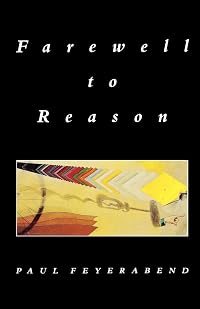
Farewell to Reason
by Paul Feyerabend
On This Page
Description
Farewell to Reason offers a vigorous challenge to the scientific rationalism that underlies Western ideals of "progress" and "development," whose damaging social and ecological consequences are now widely recognized. For all their variety in theme and occasion, the essays in this book share a consistent philosophical purpose. Whether discussing Greek art and thought, vindicating the church's battle with Galileo, exploring the development of quantum physics or exposing the dogmatism of show more Karl Popper, Feyerabend defends a relativist and historicist notion of the sciences. The appeal to reason, he insists, is empty, and must be replaced by a notion of science that subordinates it to the needs of citizens and communities. Provocative, polemical and rigorously argued, Farewell to Reason will infuriate Feyerabend's critics and delight his many admirers. show lessTags
Recommendations


































Member Reviews
In Farewell to Reason, Paul Feyerabend argues, “Diversity is beneficial while uniformity reduces our joys and our (intellectual, emotional, material) resources” (pg. 1). He criticizes the two ideas he believes “have often been used to make Western expansion intellectually respectable – the idea of Reason and the idea of Objectivity” (pg. 5). To this end, he asserts, “There exist no ‘objective’ reasons for preferring science and Western rationalism to other traditions” (pg. 297). Of Democratic relativism, Feyerabend concludes, “Democratic relativism has much to recommend it, especially for us in the West, but it is not the one and only possible way of living” (pg. 59).
Advocates of science, however, worked to build show more up their philosophy. According to Feyerabend, “As science advanced and produced a steadily increasing store of information, formal notions of objectivity were used not only to create knowledge, but also to legitimize, i.e. to show the objective validity of, already existing bodies of information” (pg. 9). He continues, “Values affect not only the application of knowledge but are essential ingredients of knowledge itself” (pg. 28). It recent times, social theorists sought to add context to science. Feyerabend concludes of their work, “Social theory, through striving to supersede history, has only succeeded in becoming an uncomprehended part of it” (pg. 123). The sciences themselves do not stand alone. Feyerabend writes, “The qualitative elements of the sciences or, what amounts to the same thing, the fundamental ideas of a certain branch of knowledge are never uniquely determined by the facts of that branch” (pg. 156).
Feyerabend works to put science in human context and strip it of its supposed objectivity. He writes, “The more sophisticated admirers of science admit and even emphazise [sic] that scientific theories are human creations and that science is one tradition among many. But they add that it is the only tradition that has succeeded in understanding and changing the world. Theories, they say, played an important role in this twin achievement” (pg. 122). Despite the defenders’ claims, Western science can have an adverse affect. According to Feyerabend, “Scholars studying the history of non-Western civilizations and communities found that hunger, violence, increasing scarcity of goods and services that had once been available in abundance, alienation, and ‘underdevelopment’ can often be traced to the disruption, due to the advance of Western science and technology, of complex, fragile but surprisingly successful socioecological systems” (pg. 30).
Discussing the weakness of relativism, and demonstrating his sense of humor, Feyerabend writes, “Relativistic arguments are always ad hominem; their beauty lies in the fact that the homines addressed, being constrained by their code of intellectual honesty, must consider them and, if they are good (in their sense), accept them as ‘objectively valid’. All my arguments in the preceding sections should be read in this manner” (pg. 78). As to the arts, Feyerabend concludes “that the history of the arts presents us with a variety of techniques and means of representation employed for a variety of reasons and adapted to a variety of purposes. The attempt to diagnose progress across all reasons and purposes would be as silly as an attempt to interpret the diagrams in Gray’s anatomy and a crucifixion on a rural road as stages of a single and ascending line of development” (pg. 153).
Looking at the difference between Mach and Einstein, Feyerabend concludes, “Where Mach and Einstein differed it was Einstein who talked positivism while Mach gave a much more complex account of scientific commonsense knowledge. Mach’s ‘epistemology’, however, turns out to be no epistemology at all. It is a general scientific theory (or theory-sketch) comparable in form (though not in content) to atomism, and different from any positivistic ontology” (pg. 193). In this way, he feels it strange “how inventive scientists such as Einstein and Planck, who vigorously opposed positivism, still used an essential part of it and so gave an account of science that was much more simple-minded than the practice in which they were engaged” (pg. 207-208). Using Galileo as an example, Feyerabend cautions, “Astronomers are entirely safe when saying that a model has predictive advantages over another model, but they get into trouble when asserting that it is therefore a faithful image of reality. Or, more generally: the fact that a model works does not by itself show that reality is structured like the model” (pg. 250). While astronomers no longer face arrest like Galileo, “The law still intrudes, the idea of free and independent research is a chimera, and the presence or absence of police intervention has nothing to do with the problem before us, namely the interpretation of scientific knowledge-claims” (pg. 260). To this end, Feyerabend argues, “The events and results that constitute the sciences have no common structure; there are no elements that occur in every scientific investigation but are missing elsewhere (the objection that without such elements the word ‘science’ has no meaning assumes a theory of meaning that has been criticized, with excellent arguments, by Ockham, Berkeley and Wittgenstein)” (pg. 281). show less
Advocates of science, however, worked to build show more up their philosophy. According to Feyerabend, “As science advanced and produced a steadily increasing store of information, formal notions of objectivity were used not only to create knowledge, but also to legitimize, i.e. to show the objective validity of, already existing bodies of information” (pg. 9). He continues, “Values affect not only the application of knowledge but are essential ingredients of knowledge itself” (pg. 28). It recent times, social theorists sought to add context to science. Feyerabend concludes of their work, “Social theory, through striving to supersede history, has only succeeded in becoming an uncomprehended part of it” (pg. 123). The sciences themselves do not stand alone. Feyerabend writes, “The qualitative elements of the sciences or, what amounts to the same thing, the fundamental ideas of a certain branch of knowledge are never uniquely determined by the facts of that branch” (pg. 156).
Feyerabend works to put science in human context and strip it of its supposed objectivity. He writes, “The more sophisticated admirers of science admit and even emphazise [sic] that scientific theories are human creations and that science is one tradition among many. But they add that it is the only tradition that has succeeded in understanding and changing the world. Theories, they say, played an important role in this twin achievement” (pg. 122). Despite the defenders’ claims, Western science can have an adverse affect. According to Feyerabend, “Scholars studying the history of non-Western civilizations and communities found that hunger, violence, increasing scarcity of goods and services that had once been available in abundance, alienation, and ‘underdevelopment’ can often be traced to the disruption, due to the advance of Western science and technology, of complex, fragile but surprisingly successful socioecological systems” (pg. 30).
Discussing the weakness of relativism, and demonstrating his sense of humor, Feyerabend writes, “Relativistic arguments are always ad hominem; their beauty lies in the fact that the homines addressed, being constrained by their code of intellectual honesty, must consider them and, if they are good (in their sense), accept them as ‘objectively valid’. All my arguments in the preceding sections should be read in this manner” (pg. 78). As to the arts, Feyerabend concludes “that the history of the arts presents us with a variety of techniques and means of representation employed for a variety of reasons and adapted to a variety of purposes. The attempt to diagnose progress across all reasons and purposes would be as silly as an attempt to interpret the diagrams in Gray’s anatomy and a crucifixion on a rural road as stages of a single and ascending line of development” (pg. 153).
Looking at the difference between Mach and Einstein, Feyerabend concludes, “Where Mach and Einstein differed it was Einstein who talked positivism while Mach gave a much more complex account of scientific commonsense knowledge. Mach’s ‘epistemology’, however, turns out to be no epistemology at all. It is a general scientific theory (or theory-sketch) comparable in form (though not in content) to atomism, and different from any positivistic ontology” (pg. 193). In this way, he feels it strange “how inventive scientists such as Einstein and Planck, who vigorously opposed positivism, still used an essential part of it and so gave an account of science that was much more simple-minded than the practice in which they were engaged” (pg. 207-208). Using Galileo as an example, Feyerabend cautions, “Astronomers are entirely safe when saying that a model has predictive advantages over another model, but they get into trouble when asserting that it is therefore a faithful image of reality. Or, more generally: the fact that a model works does not by itself show that reality is structured like the model” (pg. 250). While astronomers no longer face arrest like Galileo, “The law still intrudes, the idea of free and independent research is a chimera, and the presence or absence of police intervention has nothing to do with the problem before us, namely the interpretation of scientific knowledge-claims” (pg. 260). To this end, Feyerabend argues, “The events and results that constitute the sciences have no common structure; there are no elements that occur in every scientific investigation but are missing elsewhere (the objection that without such elements the word ‘science’ has no meaning assumes a theory of meaning that has been criticized, with excellent arguments, by Ockham, Berkeley and Wittgenstein)” (pg. 281). show less
Um dos exemplares está em EstSalaC4
Jun 29, 2022Portuguese (Brazil)
Ratings
Members
- Recently Added By
Author Information

64+ Works 3,296 Members
A controversial and influential voice in the philosophy of science, Paul K. Feyerabend was born and educated in Vienna. After military service during World War II and further study at the University of London, he returned to Vienna as a lecturer at the university. In 1959, having taught for several years at Bristol University in England, he came show more to the United States to join the faculty of the University of California at Berkeley, from which, after numerous visiting appointments elsewhere, he retired in 1990. Since the 1970s, Feyerabend has devoted much of his career to arguing that science as practiced cannot be described, let alone regulated, by any coherent methodology, whether understood historically, as in Thomas Kuhn's use of paradigms, or epistemologically, as in classical positivism and its offspring. He illustrates this stance on the dust jacket of one of his books, Against Method (1975), by publishing his horoscope in the place usually reserved for a biographical sketch of the author. In his entry in the Supplement to Who's Who in America, he is quoted as saying, "Leading intellectuals with their zeal for objectivity are criminals, not the liberators of mankind." (Bowker Author Biography) show less
Series
Belongs to Publisher Series
Common Knowledge
- Original title
- Farewell to Reason
- Original publication date
- 1987
Classifications
Statistics
- Members
- 275
- Popularity
- 117,256
- Reviews
- 2
- Rating
- (3.90)
- Languages
- 7 — English, French, German, Italian, Portuguese, Spanish, Turkish
- Media
- Paper, Ebook
- ISBNs
- 13