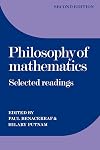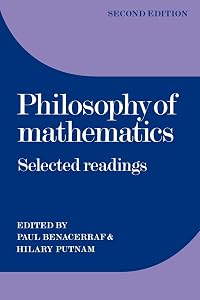
Philosophy of Mathematics: Selected Readings
by Paul Benacerraf (Editor), Hilary Putnam (Editor)
On This Page
Description
The twentieth century has witnessed an unprecedented 'crisis in the foundations of mathematics', featuring a world-famous paradox (Russell's Paradox), a challenge to 'classical' mathematics from a world-famous mathematician (the 'mathematical intuitionism' of Brouwer), a new foundational school (Hilbert's Formalism), and the profound incompleteness results of Kurt Gödel. In the same period, the cross-fertilization of mathematics and philosophy resulted in a new sort of 'mathematical show more philosophy', associated most notably (but in different ways) with Bertrand Russell, W. V. Quine, and Gödel himself, and which remains at the focus of Anglo-Saxon philosophical discussion. The present collection brings together in a convenient form the seminal articles in the philosophy of mathematics by these and other major thinkers. It is a substantially revised version of the edition first published in 1964 and includes a revised bibliography. The volume will be welcomed as a major work of reference at this level in the field. show lessTags
Recommendations






Member Reviews
Did not expect to enjoy this as much as I did. First 'read' it for a philosophy class in undergrad. Felt like I was being punished. Little wiser now and a little more edjumucated in things like logic and metaphysics. Enjoyed the holy hell out of it. Really makes a lot of good connections to interesting philosophical issues.
Ratings
Members
- Recently Added By
Lists

Books referenced in Jim Holt's Why Does the World Exist?
119 works; 1 member

Books in the bibliography of Godel, Escher, Bach by Douglas Hofstadter
97 works; 3 members
Author Information


According to John Passmore, Hilary Putnam's work is a "history of recent philosophy in outline" (Recent Philosophers). He adds that writing "about "Putnam's philosophy' is like trying to capture the wind with a fishing-net." Born in Chicago and educated at the University of Pennsylvania and the University of California at Los Angeles, Putnam show more taught at Northwestern University, Princeton University, and the Massachusetts Institute of Technology before moving to Harvard University in 1965. In his early years at Harvard, he was an outspoken opponent of the war in Vietnam. Although he writes in the idiom of analytic philosophy, Putnam addresses major themes relating science to ethics and epistemology. If these themes are reminiscent of David Hume---as, for that matter, is much of analytic philosophy---his treatment of them is not. Putnam's work is far more profoundly shaped by recent work in logic, foundations of mathematics, and science than would have been possible for Hume; Putnam has contributed to each. He differs from Hume and stands more in the tradition of Willard Quine and American pragmatism in his treatment of the crucial distinctions between analytic and synthetic statements and between facts and values. Both distinctions, sharply made by Hume, are claimed by Putnam not to be absolute. He attempts to show, for example, that basic concepts of philosophy, science, and mathematics all are interrelated, so that mathematics bears more similarity to empirical reasoning than is customarily acknowledged. (Bowker Author Biography) show less
Classifications
Statistics
- Members
- 293
- Popularity
- 110,244
- Reviews
- 2
- Rating
- (4.32)
- Languages
- English
- Media
- Paper, Ebook
- ISBNs
- 4
- ASINs
- 3