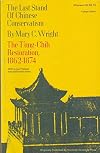
The Last Stand of Chinese Conservatism: The Tʻung-Chih Restoration, 1862-1874
by Mary Clabaugh Wright
On This Page
Tags
Recommendations

















Member Reviews
Wright examines China´s failure to resist Western and Japanese encroachments between the First Opium War in 1839 and the end of World War II. Some say that this is a result of newly industrialised and democratic nations in the ascendant coming into contact with a corrupt and tired China that was already in decline. The point is made that at the beginning of this period the Chinese were ruled by an Imperial Dynasty that was not native to China, and that these Manchu Emperors were hostile to Chinese institutions, traditions and the general populace. And it is suggested by some that the decline of Chinese Imperial power at this time was simply part of the recurring cycles of consolidation and disintegration that have dominated China for show more millennia.
Wright does not dismiss these observations out of hand, but uses meticulously researched Chinese and Western sources to argue that China at this time had a thoroughly integrated Manchu/Chinese administration. What discrimination still existed was limited to a few ceremonial institutions. Wright casts the net wider and reviews the relative impact of other circumstances that afflicted China in the 19th Century; natural disasters, internal revolt, trade imbalances, declining tax receipts, corruption in the bureaucracy and the Government, the Western superiority in military force, the impact of opium and the effect on Imperial prestige that flowed from the unequal treaties imposed on China by the West.
Wright untangles these influences that fed upon each other, and the role of individuals and interests groups. She has dredged from the prejudices of popular history the story of a short period between 1862 and 1870 when China addressed itself to - and was accepted by - the West as a co-equal power. Wright does not hypothesise what China needed to do or might have done to arrest its decline, she simply relates the history of this period, known as the T´ung-chih Restoration, and the policies and people that directed it. The Restoration was based on a return to traditional Confucian values of respect, competency and integrity. But in the end - and this is Wright´s main thesis - these were essentially personal virtues and there was no concomitant investment in building or reforming Chinese institutions and policies. When men of great talent drove Chinese polity they held their own - just. But in the absence of that personal talent, Chinese institutions and policies had neither the resilience nor flexibility to cope with a new world order dominated by economic interests.
Rather than simply relating history, or speculating on turns that history might have taken but did not, Wright has used history to analyse history. She has an exceptional ability to write about ideas and events in a coherent memorable way. Reading Chinese history for a non-Chinese speaker often presents difficulty in remembering names and places. Wright overcomes this by the way she builds up this history in small blocks, under sub-headings within every chapter. The reader is able to absorb a tremendous amount of history thereby, and I never felt that I had lost track of characters and issues that were played out over a vast stage.
It is some testament to Wright´s work - and indeed to her - that her history is still the subject of debate in China. It is fundamentally about the struggle between conservatism and progress. Was China correct in the 1800´s to maintain that preserving traditional values and living with limited ambitions within the available resources was a better choice than the pursuit of growth and ever expanding power? History was the judge of that in 19th Century China, but the Chinese might say that is taking the short term view. Zhou enlai was once asked what he thought of the French Revolution and famously replied ¨I think it is too early to tell¨. What we can say is that this battle of values is still being played out between China and the West, and within China itself. An excellent book, both for what it debunks about 19th Century China and the West, and for what it tells us about the 21st Century world. show less
Wright does not dismiss these observations out of hand, but uses meticulously researched Chinese and Western sources to argue that China at this time had a thoroughly integrated Manchu/Chinese administration. What discrimination still existed was limited to a few ceremonial institutions. Wright casts the net wider and reviews the relative impact of other circumstances that afflicted China in the 19th Century; natural disasters, internal revolt, trade imbalances, declining tax receipts, corruption in the bureaucracy and the Government, the Western superiority in military force, the impact of opium and the effect on Imperial prestige that flowed from the unequal treaties imposed on China by the West.
Wright untangles these influences that fed upon each other, and the role of individuals and interests groups. She has dredged from the prejudices of popular history the story of a short period between 1862 and 1870 when China addressed itself to - and was accepted by - the West as a co-equal power. Wright does not hypothesise what China needed to do or might have done to arrest its decline, she simply relates the history of this period, known as the T´ung-chih Restoration, and the policies and people that directed it. The Restoration was based on a return to traditional Confucian values of respect, competency and integrity. But in the end - and this is Wright´s main thesis - these were essentially personal virtues and there was no concomitant investment in building or reforming Chinese institutions and policies. When men of great talent drove Chinese polity they held their own - just. But in the absence of that personal talent, Chinese institutions and policies had neither the resilience nor flexibility to cope with a new world order dominated by economic interests.
Rather than simply relating history, or speculating on turns that history might have taken but did not, Wright has used history to analyse history. She has an exceptional ability to write about ideas and events in a coherent memorable way. Reading Chinese history for a non-Chinese speaker often presents difficulty in remembering names and places. Wright overcomes this by the way she builds up this history in small blocks, under sub-headings within every chapter. The reader is able to absorb a tremendous amount of history thereby, and I never felt that I had lost track of characters and issues that were played out over a vast stage.
It is some testament to Wright´s work - and indeed to her - that her history is still the subject of debate in China. It is fundamentally about the struggle between conservatism and progress. Was China correct in the 1800´s to maintain that preserving traditional values and living with limited ambitions within the available resources was a better choice than the pursuit of growth and ever expanding power? History was the judge of that in 19th Century China, but the Chinese might say that is taking the short term view. Zhou enlai was once asked what he thought of the French Revolution and famously replied ¨I think it is too early to tell¨. What we can say is that this battle of values is still being played out between China and the West, and within China itself. An excellent book, both for what it debunks about 19th Century China and the West, and for what it tells us about the 21st Century world. show less
香港大學歷史系
This book is a gift from Sai Kuan
This book is a gift from Sai Kuan
Jul 3, 2025Chinese, traditional
Members
- Recently Added By
Lists

All Things China
205 works; 3 members
Author Information
3 Works 83 Members
Common Knowledge
- Canonical title
- The Last Stand of Chinese Conservatism: The Tʻung-Chih Restoration, 1862-1874
- Original publication date
- 1957
- Dedication
- For Arthur Frederick Wright (husband).
- Last words
- (Click to show. Warning: May contain spoilers.)To the makers of the T´ung-chih Restoration adjustment that yielded - as it must have yielded to be effective - on the essentials of the Confucian society was no alternative to extinction, but extinction itself.
- Original language
- English
Classifications
Statistics
- Members
- 55
- Popularity
- 557,048
- Reviews
- 2
- Rating
- (5.00)
- Languages
- English, French
- Media
- Paper
- ISBNs
- 3
- ASINs
- 4